
Introduction
Agile software development has become a common approach for building and improving digital products. It focuses on delivering value in small increments, learning from feedback, and adapting when requirements change.
Scrum is one of the best-known frameworks used to apply Agile principles. However, Agile and Scrum are not the same thing.
Agile is a broader set of values and principles. Scrum is a lightweight framework for managing complex product work. The current Scrum Guide defines Scrum around a Scrum Team, accountabilities, events, artifacts, and commitments.
Understanding the difference helps development teams choose the right way to organize their work.
What Is Agile Software Development?
Agile software development is an iterative approach to creating software. Instead of planning every detail before development begins, teams deliver useful increments and use feedback to guide future work.
The Agile Manifesto emphasizes four key ideas:
- Individuals and interactions over processes and tools
- Working software over comprehensive documentation
- Customer collaboration over contract negotiation
- Responding to change over following a plan
These values do not mean that documentation, contracts, planning, or tools are unimportant. They mean that teams should prioritize collaboration, usable software, customer value, and adaptability when making decisions.
The Agile principles also emphasize frequent delivery, collaboration between business and development teams, technical excellence, sustainable development, and continuous improvement.
How the Agile Development Process Works
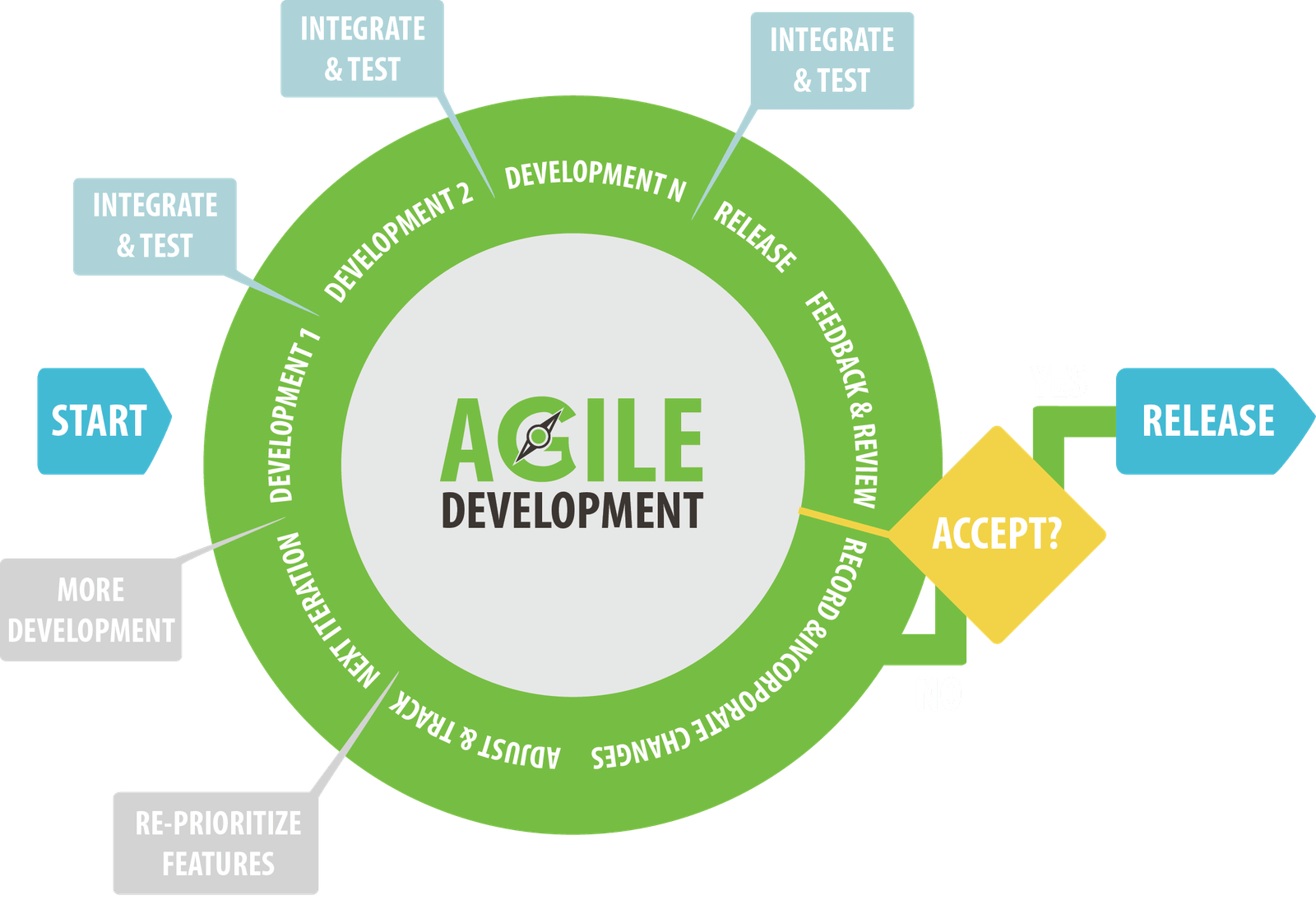
A typical Agile software development process looks like this:
- Define the product vision – Establish the problem, users, and desired outcome.
- Prioritize the work – Break large requirements into smaller pieces of valuable work.
- Develop incrementally – Build and test smaller product increments.
- Collect feedback – Review the product with users, customers, or stakeholders.
- Adapt the plan – Change priorities based on new information.
- Release and improve – Deliver value and continue improving the product.
The exact process can vary. Agile is not a single prescriptive development methodology.
Agile Software Development
Modern Agile teams are also adapting to changes in software engineering.
AI coding assistants can help with code generation, testing, documentation, refactoring, and code review. CI/CD pipelines automate builds, tests, security checks, and deployments. Cloud platforms make it easier to release software frequently.
However, these tools do not replace Agile principles.
Teams still need clear product goals, good communication, technical quality, user feedback, and continuous improvement. Automation can make delivery faster, but poor priorities can still produce the wrong product quickly.
What Is Scrum Software Development?
Scrum software development uses Scrum as a framework for developing and sustaining complex products.
Scrum is based on empiricism. Teams make decisions using what they observe and learn. Its three pillars are transparency, inspection, and adaptation.
Scrum is not another name for Agile. It is one framework that can be used within an Agile approach.
The Scrum Guide currently identifies three accountabilities within one Scrum Team:
- Developers
- Product Owner
- Scrum Master
These are accountabilities rather than traditional management positions. The Scrum Team works toward a common Product Goal.
What Is a Scrum Sprint?
A Sprint is a fixed-length period in which a Scrum Team works toward a Sprint Goal.
According to the current Scrum Guide, a Sprint is one month or less. A new Sprint begins immediately after the previous Sprint ends.
Many teams use two-week Sprints, but Scrum does not require every team to use the same duration.
During a Sprint, the team develops a usable Increment while maintaining quality and working toward the Sprint Goal.
Scrum Events
Scrum defines five formal events:
| Scrum Event | Purpose |
| Sprint | Container for the other Scrum events and development work |
| Sprint Planning | Establishes the Sprint Goal and plans the work |
| Daily Scrum | Helps Developers inspect progress toward the Sprint Goal |
| Sprint Review | Inspects the outcome and discusses future adaptations |
| Sprint Retrospective | Identifies improvements to team effectiveness |
The Daily Scrum is timeboxed to 15 minutes. The other events have timeboxes based on the length of the Sprint.
Scrum Artifacts and Commitments
Scrum has three primary artifacts:
| Artifact | Commitment |
| Product Backlog | Product Goal |
| Sprint Backlog | Sprint Goal |
| Increment | Definition of Done |
The Product Backlog represents the evolving work needed to improve the product. The Sprint Backlog contains the Sprint Goal, selected work, and the team’s plan for delivering it.
The Increment is a usable step toward the Product Goal. The Definition of Done provides a shared quality standard for completed work.
Agile vs Scrum: What Is the Difference?
The simplest way to understand Agile vs Scrum is this:
Agile is a mindset and set of values and principles. Scrum is a specific framework used to organize complex work.
| Agile | Scrum |
| Broad approach to software development | Specific framework |
| Based on values and principles | Based on defined accountabilities, events, and artifacts |
| Does not prescribe one workflow | Provides a structured framework |
| Can be implemented through different approaches | Commonly uses Sprints |
| Focuses on adaptability and continuous value delivery | Focuses on empiricism, inspection, adaptation, and product value |
| Includes multiple frameworks and practices | Is one framework within the broader Agile ecosystem |
This distinction is important. Calling Scrum “the Agile methodology” is technically inaccurate.
Benefits of Agile Software Development
Agile software development can provide several advantages:
- Faster feedback from users and stakeholders
- Earlier delivery of valuable functionality
- Better response to changing requirements
- Continuous product improvement
- Greater visibility into development progress
- Stronger collaboration between technical and business teams
- Earlier identification of product and technical risks
However, Agile does not automatically make a project successful. Teams still need clear goals, realistic priorities, skilled people, testing, security, and effective product management.
When Should You Use Scrum?
Scrum can work well when:
- Product requirements are complex or uncertain.
- Priorities may change.
- Regular inspection and feedback are valuable.
- A cross-functional team can work toward a shared product goal.
- The organization is prepared to empower the Scrum Team.
Scrum may be less suitable when work is highly predictable, continuously interrupt-driven, or better managed through a flow-based approach.
For example, a product development team building a new SaaS application may benefit from Scrum. A support team handling unpredictable production incidents may prefer a flow-based system such as Kanban.
Agile Software Development Best Practices
Successful Agile teams should focus on outcomes rather than simply completing more tasks.
1. Define Clear Product Goals
Teams need a clear understanding of the problem they are solving and the value they want to create.
2. Keep Work Small and Valuable
Break large requirements into manageable pieces. Each increment should provide useful progress.
3. Automate Testing and Delivery
Automated testing and CI/CD can reduce repetitive work and provide faster feedback.
4. Use AI Responsibly
AI tools can support coding, testing, documentation, and research. Teams should still review generated output for correctness, security, maintainability, and licensing concerns.
5. Measure Outcomes
Do not rely only on story points or completed tickets. Look at customer satisfaction, product adoption, reliability, delivery performance, and business outcomes.
6. Improve Continuously
Retrospectives should result in practical improvements. Agile works best when teams regularly inspect how they work and adapt.
Frequently Asked Questions
Is Scrum the same as Agile?
No. Agile is a broader approach based on values and principles. Scrum is a framework that can be used to apply Agile thinking to complex product development.
What is Agile software development?
Agile software development is an iterative approach that emphasizes working software, customer collaboration, frequent delivery, and responding to change.
What is Scrum software development?
Scrum software development uses the Scrum framework to organize complex product work through Sprints, defined accountabilities, events, artifacts, and commitments.
Is Scrum still relevant?
Yes. Scrum remains a widely used framework for complex product development. Its current definition is based on the November 2020 Scrum Guide, which remains the official current version.
Can Agile and Scrum use AI tools?
Yes. AI tools can support many software development activities, including coding, testing, documentation, and code review. They should support the team’s workflow rather than replace product judgment, engineering review, or collaboration.
Conclusion
Agile software development remains highly relevant because software products continue to change quickly. Customer expectations, technology, security requirements, and business priorities can all change during development.
Agile provides the principles for responding to that change. Scrum provides a structured framework for managing complex product work through Sprints, inspection, adaptation, and continuous delivery of value.
The key difference in Agile vs Scrum is simple: Agile is the broader philosophy and set of principles, while Scrum is one framework for putting those ideas into practice.
For modern development teams, success depends less on blindly following a framework and more on creating a workflow that delivers customer value, maintains technical quality, learns from evidence, and continuously improves.