
Introduction
Software development is entering another major transition. For years, developers primarily interacted with computers through editors, terminals, frameworks, and command-line tools. AI coding assistants changed that workflow by allowing developers to describe what they wanted and receive generated code.
Agent-first development takes the idea further.
Instead of treating AI agents as optional assistants inside an existing development process, an agent-first approach makes agents an important part of how software is planned, implemented, tested, reviewed, and maintained.
Modern AI agents can work with files, tools, APIs, repositories, tests, and development environments. They can break larger objectives into smaller tasks and use feedback from their environment to continue working.
This does not mean developers disappear from the process. Human developers still define goals, make architectural decisions, review changes, establish constraints, and take responsibility for production systems.
The difference is that the developer’s interface with software development is increasingly becoming goal-oriented rather than purely code-oriented.
What Is Agent-First Development?
Agent-first development is a software engineering approach in which AI agents are designed into the development workflow from the beginning rather than being added as simple coding assistants.
A traditional workflow might look like this:
Requirement → Developer writes code → Developer tests → Developer debugs → Developer deploys
An agent-first development workflow can look more like:
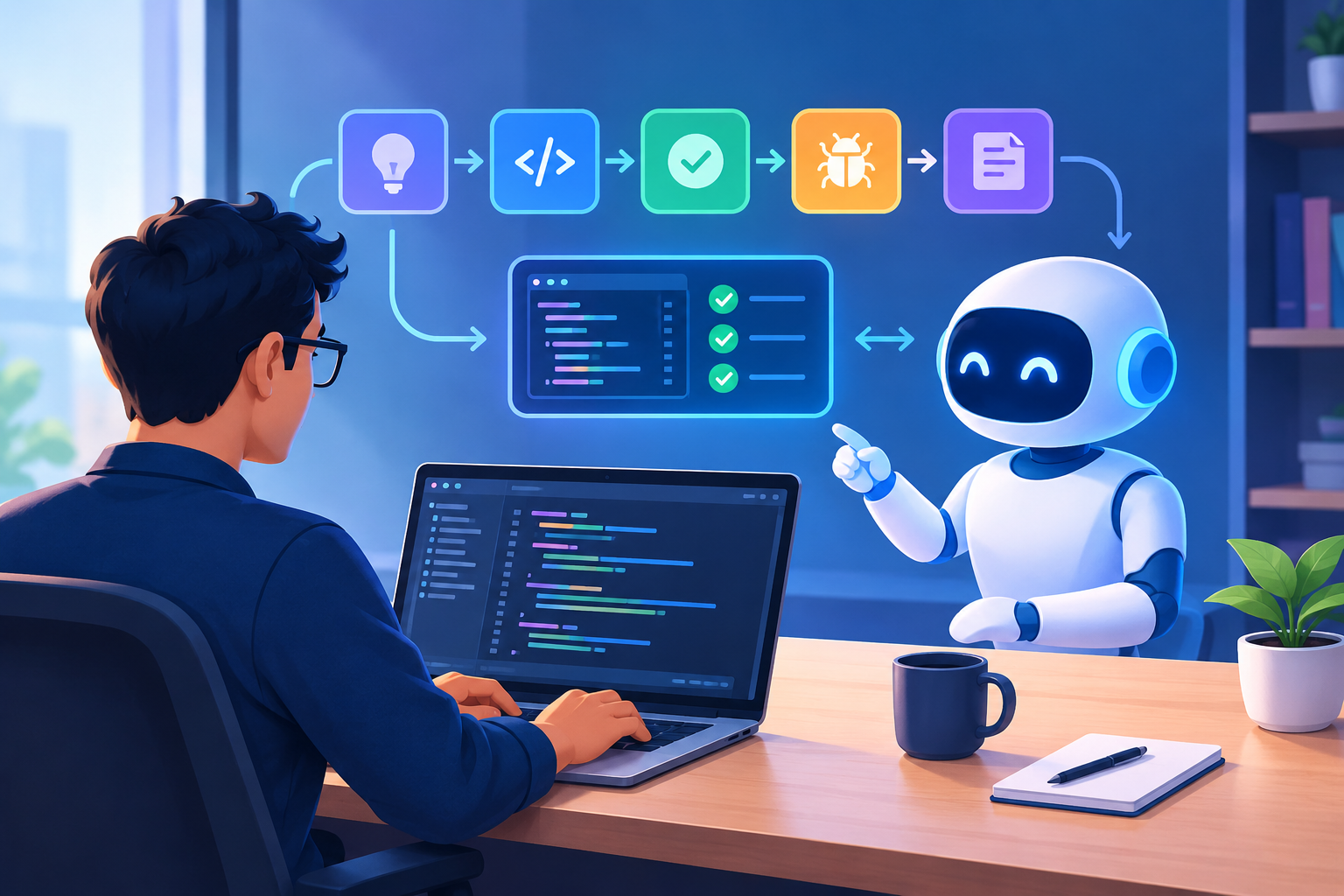
Goal → Agent analyzes repository → Agent plans tasks → Agent writes or changes code → Agent runs tests → Agent analyzes results → Developer reviews → Deployment
The agent is not simply generating a few lines of code. It can participate in multiple stages of the development lifecycle.
This is closely related to AI software engineering, where AI systems support activities such as coding, debugging, testing, documentation, and code review.
Research and engineering guidance from Anthropic distinguishes predefined workflows from agents that dynamically determine their actions and tool usage.
Agent-First Development vs. AI-Assisted Development
The two approaches are related, but they are not identical.
| AI-Assisted Development | Agent-First Development |
| AI suggests code | AI can work toward a defined goal |
| Developer directs most individual steps | Agent can plan multiple steps |
| Usually focused on the editor | Can involve the entire development environment |
| Human executes many actions | Agent can use tools and execute actions |
| Often task-by-task | Can support longer workflows |
For example, an AI coding assistant may generate a function when a developer asks for it. An agent-first system could receive a broader objective such as adding authentication, inspect the existing application, identify relevant files, implement changes, run tests, diagnose failures, and prepare the changes for review.
The developer remains responsible for deciding whether the implementation is appropriate.
This is why agent-first software development should be understood as a change in workflow design, not simply another name for autocomplete.
Why Agent-First Development Is Changing Software Engineering
The rise of agent-first development is connected to improvements in large language models, tool use, code generation, context management, and automated testing.
Large language models can already understand natural-language requirements and generate code across many programming languages. When connected to tools and a development environment, their role can expand considerably.
For example, an agent may be able to:
- Inspect a code repository
- Search for relevant files
- Create or modify source code
- Run tests
- Read error messages
- Make additional changes
- Generate documentation
- Review implementation details
- Prepare a pull request
This creates a different relationship between developers and software.
Instead of spending every development session manually translating requirements into individual commands, developers can increasingly define objectives and supervise execution.
The shift is also visible in current coding-agent adoption research. Anthropic’s 2026 State of AI Agents report describes widespread organizational use of coding agents and reports that organizations are using agents across different stages of the software development lifecycle.
However, agent-first development does not mean that every software task should be delegated to autonomous agents.
A simple task may still be faster to complete manually. A highly sensitive production change may require close human control. The appropriate level of autonomy depends on the task, risk, complexity, and quality requirements.
Anthropic similarly recommends starting with the simplest architecture that solves the problem and adding agentic complexity when it provides measurable value.
For developers, this makes AI software engineering less about replacing existing engineering practices and more about deciding where intelligent automation can safely improve them.
How an Agent-First Development Environment Works
An agent-first development environment combines the traditional software development stack with AI agents capable of interacting with that stack.
The environment can include:
- Code repositories
- IDEs and terminals
- Version-control systems
- Testing frameworks
- Documentation
- Issue trackers
- APIs
- Databases
- Deployment tools
- AI models
- Agent orchestration systems
The agent becomes a coordination layer between the developer’s goal and these resources.
1. Goal Definition
The process starts with a clearly defined objective.
For example:
Add a password-reset feature while maintaining the application’s existing authentication architecture.
The more precise the objective and constraints are, the easier it becomes for the agent to operate safely.
2. Repository Understanding
The agent examines the relevant project files, dependencies, documentation, and existing implementation.
This step is important because an agent should understand the existing system before making changes.
3. Planning
The agent creates a plan based on the available context.
For a feature request, that might include:
- Identify authentication components.
- Locate user-account models.
- Add password-reset logic.
- Create required API endpoints.
- Add tests.
- Run the test suite.
- Review failures.
- Prepare the changes for human review.
4. Tool Use
The agent can use tools to perform specific actions.
These might include repository search, code execution, testing, documentation retrieval, or API calls.
OpenAI’s official developer documentation describes building agents that can use tools and orchestration logic to perform actions on behalf of users.


5. Feedback and Iteration
An important difference between basic code generation and agentic development is the ability to react to feedback.
If a test fails, the agent can inspect the error, identify the likely cause, modify the implementation, and run the test again.
This feedback loop is one of the most important foundations of agent-first development.
7 Benefits of Agent-First Development for Developers
1. Faster Implementation
Agent-first development can reduce the amount of repetitive implementation work developers need to perform manually.
Agents can generate boilerplate, create files, update related components, and implement repetitive patterns.
Developers can therefore spend more time defining requirements and reviewing the resulting system.
2. Better Support for Multi-Step Tasks
Traditional coding assistants are often most useful for individual tasks.
Autonomous agents can work across multiple connected steps.
For example, an agent may update a database model, modify an API, update the frontend, create tests, and inspect the resulting errors.
This makes autonomous agents particularly relevant for complex development workflows.
3. Faster Testing and Debugging
Testing can become part of the agent’s working loop.
Instead of generating code and stopping, the agent can run tests and use the results as feedback.
Anthropic’s research describes coding agents as a particularly useful application because software outputs can often be evaluated through automated tests and iterative feedback.
4. Improved Developer Productivity
The objective is not simply to generate more code.
A stronger goal is to reduce unnecessary manual work throughout the development process.
Developers can delegate repetitive tasks while focusing on architecture, product requirements, security, system behavior, and technical decisions.
5. More Accessible Complex Workflows
Agent-first development can also make complex development processes easier to initiate.
A developer can describe a goal in natural language and allow an agent to investigate the codebase before suggesting or implementing changes.
This can be particularly useful when working with large repositories.
6. Better Coordination Between Development Tools
An agent can connect activities that were previously handled separately.
For example:
Issue tracker → Repository → Code changes → Tests → Review → Documentation
This creates more connected agentic workflows instead of isolated AI interactions.
7. New Opportunities for AI Software Engineering
The growth of agent-based development creates new roles and technical responsibilities.
Developers may increasingly need to understand:
- Agent architecture
- Tool integration
- Prompt and context design
- Evaluation
- Security
- Model selection
- Workflow orchestration
- Human approval systems
The AI agents and agentic AI guide from Eduonix provides additional background on how agents, frameworks, and workflows fit together.
Key Components of an Agent-First Development Platform
A practical agent-first development platform needs more than an LLM.
The model is only one component of the overall system.
Large Language Models
Large language models provide the reasoning and language capabilities that allow agents to interpret requirements and produce responses or actions.
Different models can be selected depending on cost, speed, context requirements, coding ability, and reliability.
Tools
Tools allow an agent to interact with the outside environment.
Examples include:
- File systems
- Git
- Browsers
- Terminals
- Databases
- APIs
- Testing frameworks
Without tools, an agent may understand a development task but have limited ability to execute it.
Context
Agents need relevant information about the project.
This can include source code, documentation, previous decisions, requirements, configuration files, and test results.
Poor context can lead to incorrect decisions even when the underlying model is capable.
Memory and State
Long-running tasks may require the system to retain information between steps or sessions.
Memory can help an agent understand what has already been attempted and what remains unfinished.
Evaluation
An agent-first development platform should also include ways to measure performance.
Teams can evaluate whether agents:
- Complete tasks correctly
- Introduce regressions
- Follow security requirements
- Use tools appropriately
- Stop when human approval is needed
Anthropic’s guidance on agent evaluation emphasizes structured evaluations because autonomous systems can behave across multiple steps and states.
Human Oversight
Human approval remains an important component.
An agent might be allowed to create a branch and run tests automatically while requiring approval before merging production changes.
This creates a practical balance between autonomy and control.
How to Build an Agent-First Software Development Workflow
Moving toward agent-first software development does not require rebuilding an engineering organization overnight.
Start with one workflow.
Step 1: Identify Repetitive Development Work
Look for tasks that are:
- Frequent
- Well-defined
- Easy to evaluate
- Time-consuming
- Low risk when automated
Examples include test generation, documentation updates, boilerplate implementation, issue investigation, and codebase searches.
Step 2: Define the Agent’s Role
An agent should have a clearly defined responsibility.
For example:
Analyze bug reports, locate relevant files, propose a fix, run tests, and stop for human approval before changing production configuration.
Clear boundaries make the workflow easier to evaluate.
Step 3: Connect Required Tools
Give the agent only the tools required for the task.
An agent handling code review may need repository access and testing tools. It may not need access to production credentials.
Step 4: Create Guardrails
Guardrails can define:
- What the agent can modify
- What it cannot access
- When it must ask for approval
- Which commands it can execute
- Maximum task duration
- Testing requirements
Step 5: Start With Human Review
During early adoption, keep humans involved at important checkpoints.
A developer can inspect the plan before execution and review the final changes before merging.
Step 6: Measure Results
Track practical metrics such as:
- Task completion rate
- Review time
- Test-pass rate
- Number of revisions
- Defect rate
- Developer time saved
The goal is not maximum autonomy.
The goal is a reliable development process.
Developers who want to strengthen their fundamentals alongside AI tools can also review 10 coding practices every senior developer should know.
Challenges and Best Practices for Agent-First Development
Although agent-first development can provide significant benefits, it introduces new engineering challenges.
Hallucinations and Incorrect Decisions
AI agents can misunderstand requirements or generate incorrect code.
Human review and automated testing are therefore essential.
Excessive Autonomy
Giving an agent too much authority can create unnecessary risk.
Permissions should be limited according to the task.
Context Limitations
A large repository may contain more information than an agent can effectively process at once.
Good context selection, documentation, retrieval, and project organization can reduce this problem.
Compounding Errors
A small mistake early in a multi-step workflow can affect later actions.
For this reason, agents should receive feedback from their environment and use checkpoints where appropriate.
Security
Agents may interact with sensitive source code, credentials, databases, and external services.
Security should therefore be considered when designing agentic workflows, not added after deployment.
Human Oversight
Autonomous systems should not automatically receive authority over every development decision.
A useful approach is to classify actions into different levels:
| Action | Suggested Control |
| Search repository | Automatic |
| Generate test | Automatic |
| Run local tests | Automatic |
| Create branch | Automatic |
| Modify production configuration | Human approval |
| Deploy production | Human approval |
| Change security controls | Human approval |
This model allows autonomous agents to handle repetitive work while developers retain control over high-impact decisions.
The CodeCondo guide comparing AI agents and AI workflows also explains the distinction between predefined workflows and systems that can make more dynamic decisions.
Another useful direction is specification-driven development. The CodeCondo guide to spec-driven development with AI agents explains how clear specifications can provide a shared reference for developers and AI agents.
Frequently Asked Questions
What is agent-first development?
Agent-first development is a software engineering approach where AI agents are designed as active participants in planning, coding, testing, debugging, and other development activities rather than being used only for code suggestions.
How is agent-first development different from AI-assisted coding?
AI-assisted coding often focuses on generating or completing code. Agent-first development gives AI agents broader responsibilities, including planning tasks, using tools, running tests, interpreting results, and iterating toward a defined objective.
What are autonomous agents in AI software development?
Autonomous agents in AI are systems that can determine and execute multiple actions toward a goal with limited step-by-step human direction. In software development, they can inspect repositories, modify code, run tests, and respond to development feedback.
What is an agent-first development environment?
An agent-first development environment combines an AI model with development tools such as code repositories, terminals, testing systems, documentation, APIs, and version control so an agent can participate directly in software development.
Will agent-first development replace software developers?
Agent-first development changes how developers work, but it does not eliminate the need for human engineering judgment. Developers still need to define requirements, evaluate architecture, review results, manage security, and make high-impact technical decisions.
Conclusion
Agent-first development represents a shift from using AI as a passive coding assistant toward building development workflows where AI agents can actively participate in software engineering.
The approach combines AI agents, large language models, tools, context, testing, automation, and human oversight.
Instead of asking an AI system to generate one function, developers can increasingly give an agent a larger objective and allow it to investigate, plan, implement, test, and refine its work.
The most practical path is not to automate everything immediately. Start with a clearly defined workflow, provide the necessary tools, establish boundaries, and measure the results.
As AI software engineering continues to develop, developers will increasingly need to understand not only how to write code but also how to design reliable systems in which humans and autonomous agents work together.
That is the central idea behind agent-first development: the developer remains responsible for the system, while intelligent agents become increasingly capable participants in building it.