

Introduction
Agentic AI for small teams is rewriting the rules of software delivery. In 2026, a five- or six-person engineering group can routinely match or exceed the output of departments ten times larger. The difference is not more hours or higher salaries. It is the deliberate use of autonomous agents, multi-agent systems, and tightly scoped AI automation for small teams.
Large organizations still carry heavy coordination costs, long review cycles, and layers of management. Small teams that treat agents as digital colleagues remove most of that friction. They keep humans focused on judgment, architecture, and product taste while agents handle planning, coding, testing, and documentation. This article explains exactly how the highest-performing lean teams achieve that leverage.
What Is Agentic AI for Small Teams?
Agentic AI for small teams refers to systems that plan, act, observe results, and iterate toward a goal with limited human prompting. Unlike simple chatbots or autocomplete tools, these systems use tools, maintain memory, and complete multi-step workflows.
For a small engineering group the practical result is clear. One senior engineer can supervise several specialized agents that together cover coding, testing, documentation, and even light product research. The team stays small while its effective capacity grows.
From Assistants to Autonomous Workers
Early AI coding tools acted as assistants. They waited for a prompt and returned a suggestion. Agentic systems take ownership of defined tasks. An agent can receive a ticket, read the relevant files, write code, run tests, open a pull request, and report status.
This shift turns the small team into a multiplier rather than a bottleneck. The humans set intent and review outcomes. The agents execute the volume of work that previously required many more people.
Why Size No Longer Guarantees Speed
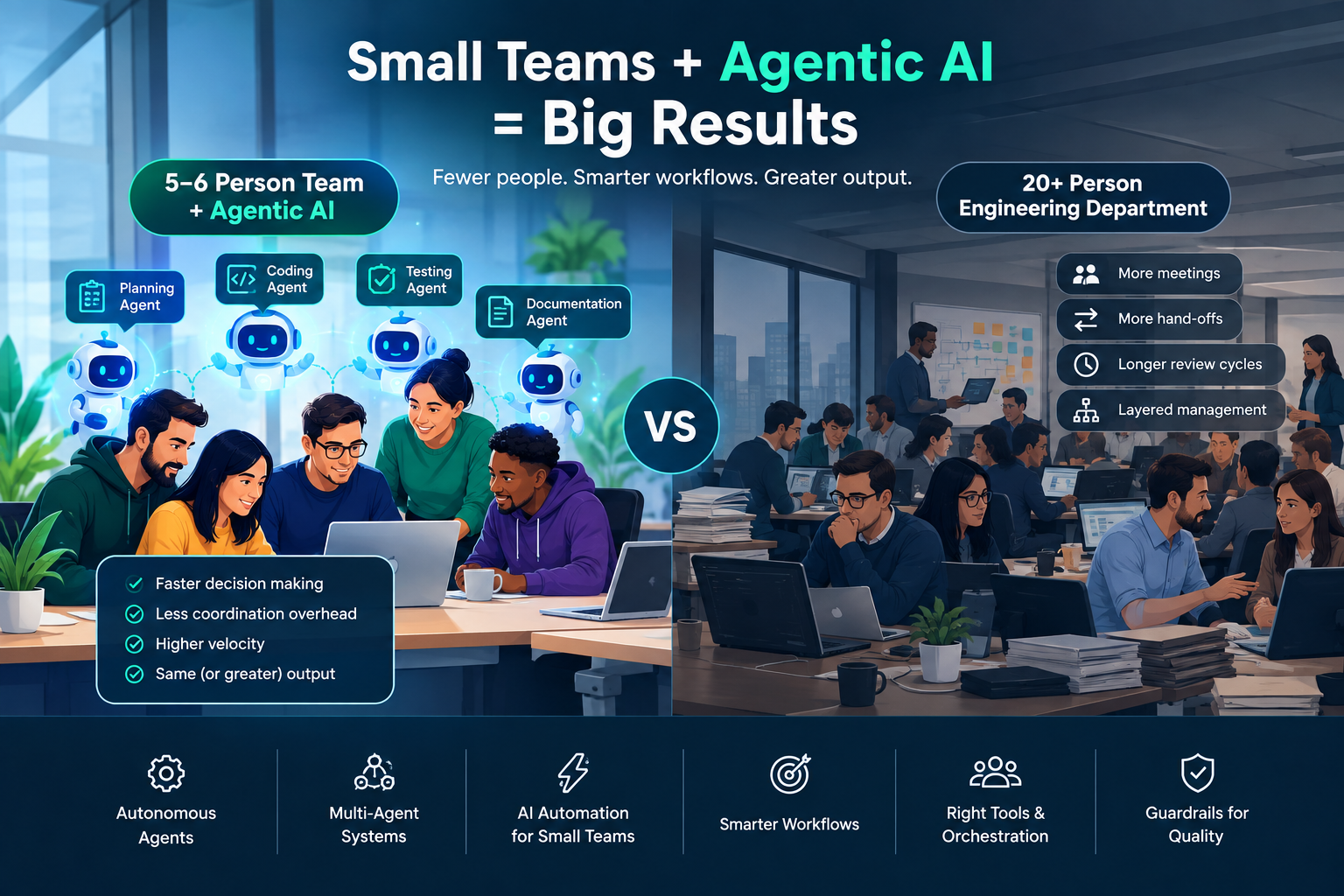
Traditional engineering wisdom said more developers equals more output. That equation broke once agents became reliable. Coordination overhead grows exponentially with headcount. A twenty-person team spends a large share of its time in meetings, hand-offs, and status updates.
A five-person team using agentic AI for small teams avoids most of that tax. Decisions happen in hours instead of days. Context stays tight. Feedback loops stay short. The result is higher velocity with lower organizational weight.

The Structural Advantage of Agentic AI for Small Teams
The real power of agentic AI for small teams is structural, not just technological. Small groups already enjoy fast communication and shared context. When they add autonomous agents and multi-agent systems, those natural advantages become decisive.
For growing startups and lean engineering groups, agentic AI for small teams creates a practical way to expand development capacity without immediately expanding headcount. Instead of adding people for every specialized task, teams can use AI agents to support planning, coding, testing, debugging, research, and documentation. This approach allows a small group to distribute work across multiple AI-driven workflows while keeping important technical and product decisions under human control.
Another advantage of agentic AI for small teams is that these workflows can scale as the product grows. Teams can start with one coding or testing agent and gradually introduce specialized agents for security checks, documentation, code review, and deployment preparation. By combining autonomous agents with clear instructions, shared context, and human oversight, small engineering teams can build a repeatable development process that improves efficiency without adding unnecessary coordination layers.
Lower Coordination Tax
In large departments every change must travel through multiple reviewers, managers, and process gates. Agents collapse many of those steps. A well-configured agent can generate the code, the tests, and the documentation in one continuous loop. The human only reviews the final package.
This reduction in hand-offs is the single biggest reason small teams now outpace larger ones. Time once lost to coordination is reclaimed for actual product work.
Faster Decision Loops
Small teams decide quickly by nature. Agentic systems make those decisions better informed. Agents can surface relevant data, generate options, and even draft the follow-up actions before the humans meet.
The combination of human judgment and agent preparation produces both speed and quality. Large organizations rarely achieve the same cycle time because their decision processes are designed for consensus rather than velocity.
Multi-Agent Systems That Multiply Output
Multi-agent systems are the practical engine behind agentic AI for small teams. Instead of one generalist agent trying to do everything, specialized agents collaborate. One plan, another code, a third test, and a fourth document.
Role Specialization in Practice
A typical small-team setup might include a planning agent that breaks tickets into tasks, a coding agent that implements changes, a testing agent that writes and runs checks, and a documentation agent that updates READMEs and changelogs.
Each agent has a narrow, well-defined role and clear success criteria. The human engineer acts as the orchestrator and final reviewer. This division of labor mirrors a larger team without the management overhead.
For a deeper look at how these systems work in practice, see this practical guide to multi-agent systems.
How Small Teams Orchestrate Agents
Successful small teams treat agent orchestration as a core skill. They maintain shared context stores, project-level rules, and clear escalation paths. When an agent is stuck, it surfaces the problem instead of guessing.
Tools that support multi-agent collaboration let the team monitor progress on a single board. The result feels less like managing software and more like leading a highly productive junior staff.
Autonomous AI Agents in Daily Engineering Work
Autonomous AI agents are the individual workers inside the multi-agent system. They can run for minutes or hours, use tools, and report results without constant supervision.
Real Examples of Autonomy
A common pattern is the “issue-to-PR” agent. The engineer assigns a well-scoped ticket. The agent reads the codebase, implements the change, runs the test suite, and opens a draft pull request. The human reviews only the final diff and the test results.
Other agents handle dependency updates, security scans, or documentation generation. Over time the team builds a library of reliable agent workflows that cover the majority of routine work.
You can explore more real-world patterns in this overview of autonomous coding approaches
Guardrails That Keep Quality High.
Autonomy without guardrails is dangerous. High-performing small teams require agents to open draft pull requests rather than merge directly. They enforce test coverage thresholds and architecture rules inside the agent prompts.
Human review remains mandatory for every change that reaches the main branch. This combination of autonomy and strict gates delivers both speed and safety.
AI Tools for Productivity That Actually Scale Output
Not every AI tool delivers the same leverage. The tools that matter for small teams are those that support long-running agents, multi-file editing, and shared team context.
Choosing the Right Stack
Many lean teams combine an AI-native IDE such as Cursor with terminal agents and a multi-agent orchestration layer. Others stay inside GitHub and use Copilot’s agent features for issue-to-PR workflows.
The key selection criteria are transparency of the agent’s plan, quality of codebase context, and the ability to enforce project rules. Price and model flexibility also matter when budgets are tight.
Measuring Real Gains
Successful teams track more than lines of code. They measure the percentage of pull requests opened by agents, the time from ticket creation to merge, and the volume of work completed per engineer.
When those metrics improve while headcount stays flat, the investment in agentic AI for small teams is clearly paying off.
AI Automation for Small Teams – Practical Playbooks
AI automation for small teams works best when it follows a clear operating model rather than ad-hoc prompting.
The Velocity Pod Model
A velocity pod is a small cross-functional unit—usually three to six humans—that governs a larger set of specialized agents. The humans set priorities, review outputs, and handle exceptions. The agents execute the bulk of the work across the software development lifecycle.
This model has become common among high-performing startups and product teams in 2026 because it preserves speed while still delivering production-quality software.
Additional insights on building such systems appear in this article on agentic software patterns
Common Implementation Pitfalls
The most frequent mistake is giving agents vague goals. Agents perform best with clear success criteria and explicit constraints. Another pitfall is skipping human review in the name of speed. Quality quickly erodes.
Teams also sometimes underestimate the need for shared context. Without project rules and memory, agents produce inconsistent results. Investing early in those foundations prevents later rework.
For practical workflow examples that save significant time, review these AI workflows for productivity
How to Start Using Agentic AI for Small Teams Today
Adoption does not require a complete organizational redesign. Most successful teams begin with a focused pilot.
30-Day Rollout Plan
Week one: select two or three well-scoped tickets and run them through a single agent with heavy human supervision.
Week two: introduce a second specialized agent and begin simple multi-agent hand-offs.
Week three: codify project rules and success criteria so agents inherit the team’s standards.
Week four: measure results, refine prompts, and expand the set of agent-ready work.
This gradual approach builds confidence and skill without disrupting ongoing delivery.
Skills Small Teams Must Build
The critical new skills are prompt engineering for long-horizon tasks, agent orchestration, and rigorous review of agent-generated changes. Senior engineers who master these skills become force multipliers for the entire group.
External resources such as the official documentation from leading agent platforms and current industry analyses of agentic workflows provide useful starting points for teams ready to experiment.
Two reliable external references are the Anthropic research on agentic systems and the Cursor documentation on agent workflows.
Conclusion – The New Competitive Reality
Agentic AI for small teams has inverted the traditional relationship between headcount and output. Lean groups that master multi-agent systems, autonomous agents, and disciplined AI automation now routinely outpace larger engineering departments weighed down by coordination overhead.
The advantage is available to any team willing to treat agents as colleagues rather than toys. Start with clear goals, strong guardrails, and continuous measurement. The teams that do so will set the pace for the rest of the decade.