
Introduction
AI agents are moving beyond simple conversations. In 2026, developers are building systems that can reason about tasks, use tools, access external information, write code, interact with software, and complete multi-step workflows.
As these systems become more capable, the AI model itself is only one part of the solution. Developers also need infrastructure to control how an agent receives information, selects tools, performs actions, handles errors, and evaluates results.
This is where AI Agent Harnesses become important.
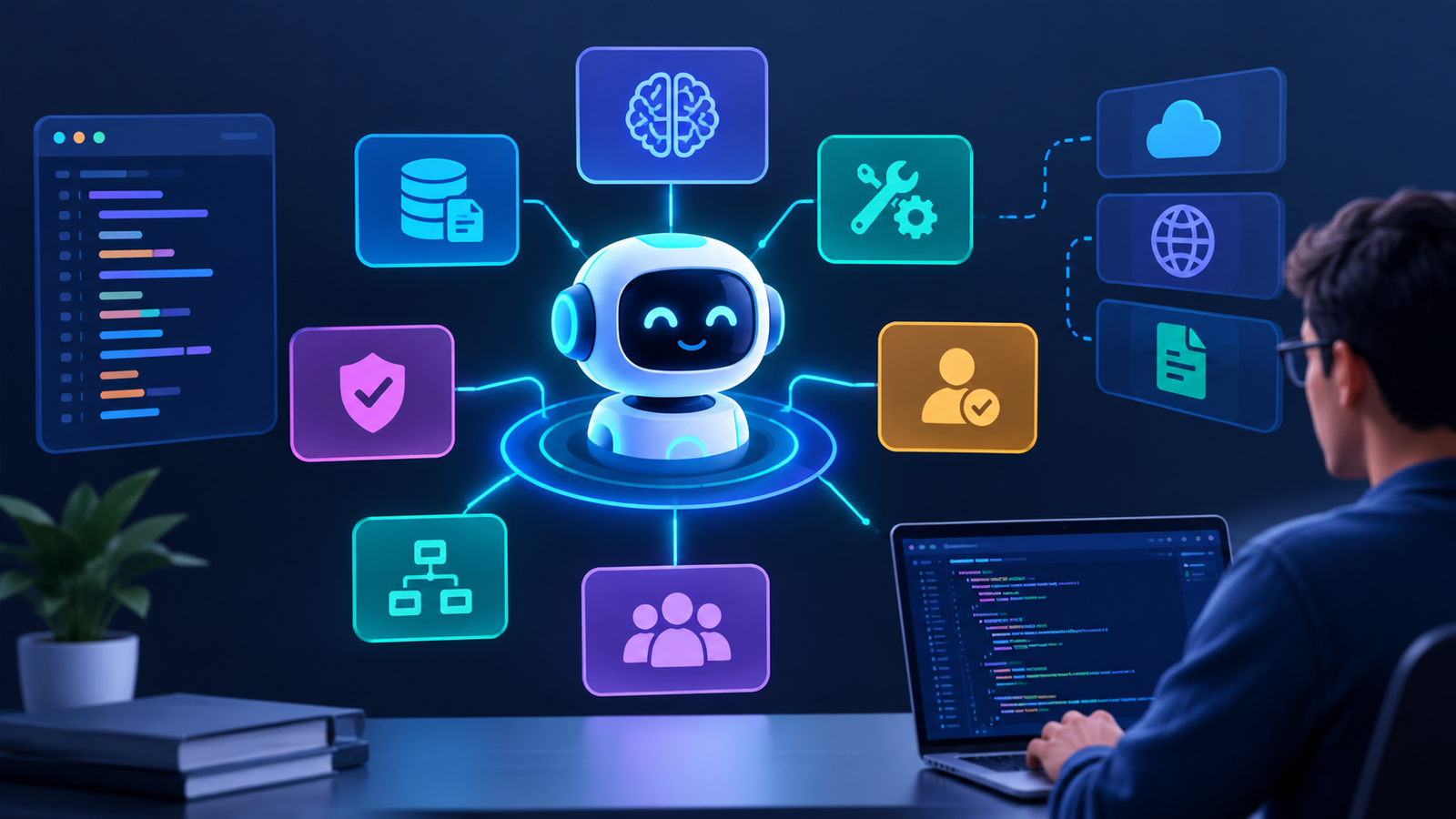
AI Agent Harnesses provide the surrounding control and execution environment that helps AI agents perform useful work. They can manage context, tools, permissions, memory, testing, and feedback.
For developers who are new to agentic systems, understanding how to build AI agents provides useful background before exploring the harness layer.
As AI applications become more autonomous, AI Agent Harnesses are becoming an important part of modern AI engineering.
What Are AI Agent Harnesses?
The simplest AI agent harness meaning is the software environment surrounding an AI agent that helps manage its actions and workflow.
An AI model can generate an answer, but an AI agent often needs to do much more. It may need to access files, call APIs, use databases, execute code, search for information, or interact with other software.
AI Agent Harnesses provide the mechanisms that connect the agent to these capabilities.
An ai agent harnesses definition can therefore be expressed simply:
An AI agent harness is a control and execution layer that manages an AI agent’s context, tools, actions, permissions, and feedback while it works toward a goal.
The exact implementation can differ between platforms. Some harnesses are lightweight loops around a model and its tools, while others include sophisticated context management, sandboxes, evaluation systems, persistent state, and multi-agent coordination.
The important idea is that AI Agent Harnesses surround the agent rather than replacing it.
An AI agent provides the reasoning and action capabilities. The harness provides the environment in which those capabilities operate.
This distinction becomes especially important when developers move from prototypes to production systems.
Why AI Agent Harnesses Matter in 2026
The growth of AI agents is increasing the complexity of modern AI applications.
A simple AI application might follow this pattern:
User prompt → AI response → End
An agentic application can look more like:
Goal → Planning → Tool selection → Action → Observation → Evaluation → Next action → Completion
This creates several engineering challenges.
An agent needs access to the right information. It needs appropriate tools. It needs to know what actions are allowed. It may need to recover from errors and maintain task state across multiple steps.
AI Agent Harnesses help developers organize these capabilities.
The importance of the harness becomes even clearer with AI automation. A workflow that automatically reads information, calls an API, updates a system, validates the result, and generates a response needs more than a language model.
It needs an environment that coordinates those actions.
OpenAI’s harness engineering approach provides a useful example of how developers can design environments, tools, repository knowledge, and feedback loops around coding agents.
Similarly, Anthropic’s research into effective harnesses for long-running agents demonstrates the importance of maintaining progress when agents work across extended tasks.
This is why AI Agent Harnesses matter in 2026: they help turn individual model capabilities into structured agent workflows.
How an AI Agent Harness Works
An AI agent harness explained in practical terms is easier to understand when its major components are separated.


Model and Agent Loop
The model provides the reasoning capability.
The agent loop determines what happens around the model.
A typical loop may involve:
- Receiving a goal.
- Understanding the current context.
- Deciding what to do next.
- Selecting a tool.
- Executing the action.
- Observing the result.
- Deciding whether another action is necessary.
AI Agent Harnesses manage this loop and provide the surrounding infrastructure.
For example, a coding agent may inspect a repository, modify a file, run tests, review the output, and make another change if the tests fail.
The harness helps keep these actions connected.
Context and Memory Management
Context is another major component of AI Agent Harnesses.
Agents need relevant information to complete tasks. That information might include:
- User instructions
- Project documentation
- Previous actions
- Files
- Tool results
- Task state
- Testing results
Without useful context, an agent may repeat work, misunderstand requirements, or lose track of its objective.
A well-designed harness determines what information should be provided to the agent and when.
This is particularly important for long-running workflows where a task may extend across multiple sessions.
Tools and External Systems
Modern AI agents become more useful when they can interact with external systems.
Tools can include:
- APIs
- Databases
- Search engines
- File systems
- Browsers
- Code execution environments
- Testing systems
- Business applications
AI Agent Harnesses can define which tools are available and how the agent should interact with them.
This makes tool management an important part of ai agent harness engineering.
A harness should make tools understandable and accessible without giving an agent unnecessary capabilities.
Permissions and Safety Controls
AI agents may be able to perform real actions, so permissions matter.
For example, a development agent might be allowed to:
- Read source files
- Create code
- Run tests
But it might require approval before:
- Deleting production data
- Deploying an application
- Changing security settings
- Sending external communications
AI Agent Harnesses can provide these boundaries.
Permission systems, approval checkpoints, sandboxing, and controlled environments can help developers determine how much autonomy an agent receives.
Execution, Testing, and Feedback
A useful harness should also provide feedback.
Suppose an AI coding agent changes a function and runs the project’s tests. If the tests fail, the result becomes new information for the agent.
The agent can inspect the failure, change the implementation, and run the tests again.
This creates a feedback loop.
For AI Agent Harnesses, execution and feedback are therefore closely connected. The agent does not simply perform an action; it receives information about the outcome and can use that information to determine what happens next.
Key Elements of AI Agent Harness Engineering
AI agent harness engineering is the process of designing and improving the environment around an AI agent.
Instead of focusing only on model selection, developers need to consider the complete system.
AI Agent Harness Design
Good ai agent harness design should make the agent’s environment clear and predictable.
Important design considerations include:
- Clear instructions
- Useful context
- Well-defined tools
- Structured task state
- Permission controls
- Testing
- Error handling
- Evaluation
- Human approval
A harness should not automatically become more complicated just because an agent becomes more capable.
Developers should identify the actual problem first and add infrastructure where it provides measurable value.
Context Engineering
Context engineering determines what information an agent receives during execution.
For example, a coding agent may need access to project documentation, architecture information, relevant source files, tests, and current task requirements.
Providing everything at once can create unnecessary noise.
AI Agent Harnesses can help select and organize the context required for each stage of a task.
Tool Management
Tool management determines what an agent can access.
A research agent may need search and document tools.
A coding agent may need a terminal, repository, and testing environment.
A customer-service agent may need CRM and ticketing tools.
AI Agent Harnesses can organize these tools and establish appropriate permissions.
Human Oversight
Not every task should be fully autonomous.
A harness can include human approval points when an action is sensitive or difficult to reverse.
For example, an agent might prepare a production deployment but wait for a developer to approve it.
This approach allows organizations to combine AI automation with human oversight.
Evaluation and Feedback Loops
Evaluation helps determine whether an agent is actually completing its task.
Developers can use tests, validation rules, quality checks, logs, and other evaluation methods.
These feedback loops can become part of AI Agent Harnesses, helping agents identify failures and continue working toward the intended outcome.
AI Agent Harnesses vs AI Agent Frameworks
AI Agent Harnesses and AI agent frameworks are related, but they serve different purposes.
An AI agent framework generally gives developers building blocks for creating agents, workflows, tools, and integrations.
A harness focuses more on how the agent operates within its environment.
A simple distinction is:
| Layer | Purpose |
| AI model | Generates reasoning and responses |
| AI agent | Uses reasoning and tools to pursue a goal |
| AI agent framework | Provides components for building agents |
| AI Agent Harness | Controls the agent’s execution environment |
LangChain is an example of an ecosystem developers can use to build agent applications and workflows.
CrewAI is another framework focused on creating collaborative AI agents and structured workflows.
This does not mean that frameworks and harnesses are completely separate. A framework can provide some harness-like capabilities, while a developer may build a custom harness around a framework.
The important distinction is the function each layer performs.
Developers who want to understand the difference between conversational AI and systems that can take actions can also explore AI agents vs chatbots.
AI Agent Harness Examples
There are many practical AI agent harness example scenarios.
Coding Agents
Coding agents are one of the clearest examples.
A coding agent may need access to:
- Source code
- Documentation
- Terminal commands
- Testing tools
- Version control
- Project requirements
AI Agent Harnesses can control this environment.
The agent can inspect a project, implement a change, run tests, analyze failures, and make improvements.
This creates a structured development workflow rather than simply asking an AI model to generate code.
Research Agents
Research agents can use search systems, documents, databases, and other information sources.
A harness can manage which tools are available and how research results are stored.
The agent can then gather information, evaluate findings, organize results, and produce a final output.
Multi-Agent Systems
In Multi-agent systems, multiple specialized AI agents can work together.
One agent might research information while another analyzes it. A third agent could review the result.
AI Agent Harnesses can provide the coordination layer between these agents.
The harness can manage task assignment, context sharing, tool permissions, and evaluation.
AI Automation Workflows
An AI automation workflow can combine AI reasoning with business processes.
For example:
- An incoming request is received.
- An agent identifies the request type.
- Relevant information is retrieved.
- An external system is updated.
- The result is checked.
- A response is generated.
AI Agent Harnesses can coordinate these steps.
For another example of an AI-powered workflow, see CodeCondo’s guide to AI agents for freelancers and workflow automation.
How to Evaluate an AI Agent Harness
An ai agent harness benchmark should evaluate the complete agent system rather than looking only at the underlying model.
A developer can ask:
- Does the agent complete tasks?
- Does it use the correct tools?
- Does it recover from errors?
- Does it maintain useful context?
- Does it follow permissions?
- Can humans understand what it did?
AI Agent Harness Benchmark
An AI agent harness benchmark should use realistic tasks.
For a coding agent, this might involve fixing bugs, implementing features, running tests, and reviewing results.
For an automation agent, it might involve processing requests, calling APIs, updating records, and handling exceptions.
The benchmark should measure the complete workflow.
AI Agent Harness Comparison
An ai agent harness comparison should consider more than features.
Developers can compare harnesses based on:
| Area | What to Measure |
| Task completion | Percentage of tasks completed successfully |
| Tool use | Accuracy of tool selection |
| Context | Quality and relevance of provided information |
| Reliability | Consistency across repeated tasks |
| Security | Permission and approval controls |
| Evaluation | Testing and validation capabilities |
| Observability | Logs and execution visibility |
| Scalability | Performance as workload increases |
The goal of an AI agent harness comparison is to understand how each environment performs against real requirements.
What Developers Should Measure
Useful measurements include:
- Task success rate
- Error rate
- Human intervention
- Tool-call accuracy
- Execution time
- Cost
- Test results
- Recovery from failures
These measurements make AI Agent Harnesses easier to evaluate objectively.
AI Agent Harnesses and Multi-Agent Systems
The relationship between AI Agent Harnesses and Multi-agent systems becomes especially important when applications contain several agents.
A multi-agent architecture might contain:
- A planning agent
- A research agent
- A coding agent
- A testing agent
- A review agent
Each agent may have different tools and responsibilities.
The harness can coordinate these roles.
For example, a planning agent could create a task list. A coding agent could implement the work. A testing agent could evaluate the implementation. A review agent could inspect the result.
This type of architecture can make complex workflows easier to divide into smaller tasks.
However, adding more agents also increases coordination complexity.
AI Agent Harnesses can help manage this complexity by controlling communication, task assignment, context, and evaluation.
The result is an environment where agents can collaborate without every agent receiving every tool or piece of information.
The Future of AI Agent Harnesses
The future of AI Agent Harnesses is closely connected to the development of more capable AI agents.
As models become better at reasoning, coding, planning, and tool use, developers may need to rethink which capabilities should be handled by the model and which should remain in the harness.
This is an important point in AI agent harness engineering.
A feature that is necessary today may become unnecessary as models improve.
At the same time, new capabilities may create new requirements.
Future AI Agent Harnesses may increasingly support:
- Longer-running tasks
- Better context management
- More capable tools
- Sandboxed execution
- Multi-agent coordination
- Automated testing
- Better observability
- More flexible permission systems
- Human-agent collaboration
Anthropic’s research into harness design for long-running application development shows how developers are experimenting with planning, generation, evaluation, and structured handoffs for extended agent tasks.
The future of AI Agent Harnesses is therefore not simply about adding more features.
It is about creating environments where agents can operate reliably while developers retain appropriate control.
FAQs
What is an AI agent harness?
An AI agent harness is the control and execution environment surrounding an AI agent. It can manage context, tools, permissions, task execution, memory, testing, and feedback.
What is the meaning of the AI agent harness?
The ai agent harness meaning refers to the infrastructure that helps an AI agent operate within a controlled environment rather than simply generating a response.
What is AI agent harness engineering?
AI agent harness engineering is the process of designing the environment around an AI agent, including its tools, context, permissions, execution loop, testing, and feedback mechanisms.
What is an AI agent harness example?
A coding-agent environment is a practical AI agent harness example. It can give an AI agent controlled access to source code, a terminal, documentation, testing tools, and project instructions.
Are LangChain and CrewAI AI Agent Harnesses?
LangChain and CrewAI are primarily AI agent development frameworks. However, frameworks can provide capabilities that form part of a larger harness. A complete harness may combine a framework with tools, context management, execution controls, testing, and permissions.
Why are AI Agent Harnesses important?
AI Agent Harnesses help developers control increasingly autonomous AI systems. They can provide structured context, tool access, permissions, testing, feedback, and execution management for complex agent workflows.
Conclusion
AI Agent Harnesses are becoming an important control layer for modern AI applications.
AI agents can reason and take actions, but they need an environment that determines what information they receive, which tools they can use, what actions they can perform, and how their results are evaluated.
That is where AI Agent Harnesses fit.
From coding agents and research systems to AI automation and Multi-agent systems, harnesses can provide the structure required for increasingly complex workflows.
Understanding ai agent harness meaning, ai agent harness engineering, ai agent harness design, and ai agent harness framework concepts can help developers make better architectural decisions.
As AI agents become more autonomous, AI Agent Harnesses will remain an important part of building systems that are not only capable, but also controllable, testable, and maintainable.