
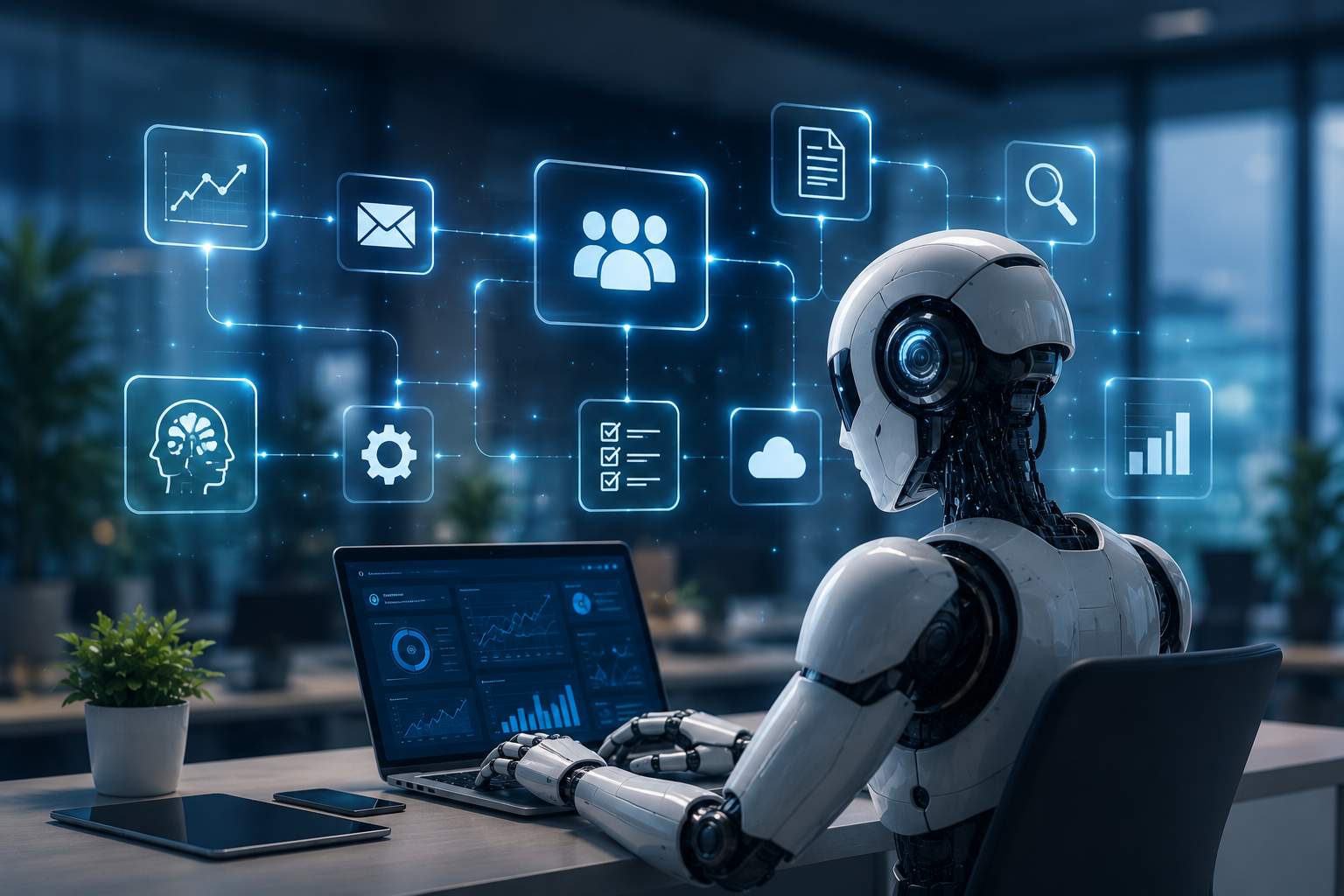
Explore the future of intelligent automation with AI-Agents & Agentic AI Masterclass-2026!
Introduction: AI Is No Longer Just a Tool
Over the past few years, artificial intelligence has quietly reshaped how modern work gets done. What started as simple text generation has evolved into a daily companion for writing, research, analysis, and decision support. Tools like ChatGPT, Claude, and Google Gemini have reduced the time it takes to move from idea to execution.
But if you look closely, that phase was only the beginning.
A more meaningful shift is now underway—one that moves beyond prompts, replies, and one-off outputs. AI is no longer limited to assisting with isolated tasks. It is beginning to act, decide, and execute workflows with minimal human intervention.
This marks a transition from interaction to delegation.
Instead of asking AI to help you do something, you can now design systems where AI completes the work for you—end to end.
Welcome to the era of AI agents—where intelligence is not just responsive, but operational.
What Are AI Agents?
AI agents are intelligent systems designed to plan, make decisions, and execute tasks autonomously. Unlike traditional AI tools that rely on constant user prompts, agentic AI systems can operate independently once given a goal.
At their core, AI agents combine reasoning, memory, and tool usage to complete multi-step workflows without continuous supervision.
A well-designed AI agent can:
- Break down complex objectives into actionable steps
- Interact with external tools, APIs, and software platforms
- Make context-aware decisions based on real-time inputs
- Execute tasks from start to finish with minimal intervention
This is what separates AI agents from standard automation.
Traditional automation follows fixed rules. AI agents, on the other hand, are adaptive—they can adjust based on context, learn from interactions, and improve outcomes over time.
In simple terms, AI agents don’t just support your work—they own parts of it.
Why AI Agents Are the Next Big Shift?
The transition from prompt-based AI to agent-based systems represents one of the most important shifts in modern technology adoption.
For the past few years, the focus has been on making individuals more productive. Now, the focus is shifting toward building systems that produce results independently.
This change is already visible across industries:
- A majority of organizations are integrating AI agents into IT operations and DevOps workflows
- Businesses are expanding agentic AI into customer support, marketing, and internal operations
- Investment in AI automation and agent frameworks continues to accelerate year over year
These aren’t early experiments anymore. They are signals of a broader transition.
Companies are moving from testing AI tools to deploying AI-driven systems that handle real workloads, which is why many experts now see AI agents as the new powerhouse redefining business success.
The reason is simple: AI agents unlock something traditional tools cannot—leverage.
Instead of improving how fast tasks are completed, they reduce how many tasks need human involvement at all.
From Using AI to Delegating Work
Despite rapid advancements, most people still interact with AI in a limited, manual way:
- Asking questions and refining prompts
- Copying outputs into other tools
- Manually completing the remaining steps
While effective, this approach keeps humans at the center of every action.
AI agents fundamentally change this dynamic.
With the right workflows in place, you can shift from doing tasks with AI to assigning outcomes to AI.
This means:
- Automating repetitive and time-consuming workflows
- Connecting multiple tools into a single, cohesive system
- Allowing processes to run independently once initiated
- Reducing hours of manual work into minutes of oversight
This is where real productivity gains begin—not from faster execution, but from less direct involvement.
Real-World Examples of AI Agent Workflows
To understand the practical impact of AI agents, it helps to look at how they operate in real scenarios.
Imagine a marketing workflow where an AI agent:
- Researches trending topics in your niche
- Generates content ideas and drafts posts
- Designs visuals using integrated tools
- Schedules content across multiple platforms
- Tracks performance and suggests optimizations
Or a sales workflow where an agent:
- Captures incoming leads from forms or campaigns
- Enriches data using external sources
- Sends personalized follow-up emails
- Updates your CRM automatically
- Flags high-priority prospects for human review
Even research-heavy tasks can be automated:
- Gathering information from multiple sources
- Summarizing insights into structured reports
- Highlighting key trends and recommendations
These are not isolated automations—they are connected, intelligent workflows where AI agents coordinate work across software systems to move tasks forward autonomously.
This is the real power of AI workflow automation: systems that don’t just assist you, but actively move work forward in the background.
And once implemented, they continue to deliver value without requiring constant attention.


How AI Agents Work?
To truly understand the value of AI agents, it’s important to look at how they operate beneath the surface. Unlike traditional tools, AI agents are built as multi-layered systems that combine reasoning, memory, and execution into a continuous workflow.
At a high level, most AI agents function through four core components:
1. Planning
Every task begins with a goal. The agent takes that goal and breaks it down into a sequence of smaller, actionable steps.
Instead of requiring step-by-step instructions, the agent determines how to approach the task on its own—making it far more flexible than rule-based automation.
2. Tool Usage
AI agents extend their capabilities by interacting with external tools and platforms.
This can include:
- Communication tools like Slack or email
- Productivity platforms like Notion or Google Docs
- CRMs, databases, and APIs
This ability allows agents to move beyond text generation and actively operate within real-world systems.
3. Memory
Memory enables agents to retain context across tasks and over time.
This means they can:
- Recall previous interactions
- Adapt based on past outcomes
- Maintain consistency across workflows
Memory transforms AI from a stateless assistant into a system capable of learning and adapting over time, which is a major step toward cognitive AI agents with real understanding.
4. Execution
Once a plan is created and tools are connected, the agent executes the workflow—often without requiring constant human input.
This is where the real shift happens: tasks are no longer manually triggered at every step. Instead, the system runs in the background, delivering outcomes with minimal supervision.
Frameworks like LangChain, AutoGen, and CrewAI are accelerating the development of these systems, making it possible for both developers and non-technical users to build powerful AI workflow automation solutions.
Benefits of AI Agents for Businesses and Individuals
As AI agents become more accessible, their impact is being felt across both individual productivity and organizational efficiency.
Increased Productivity
AI agents take over repetitive and time-consuming tasks, allowing individuals and teams to focus on higher-value work such as strategy, creativity, and decision-making.
Scalable Systems
Once an AI workflow is built, it can run continuously without additional effort. Unlike human-driven processes, agent systems don’t slow down with scale—they become more valuable.
Smarter Decision-Making
By analyzing large amounts of data in real time, AI agents can surface insights, identify patterns, and support faster, more informed decisions.
Cost Efficiency
Automation reduces reliance on manual processes, lowering operational costs while increasing output. Over time, this creates a compounding return on investment.
In essence, AI agents don’t just improve productivity—they redefine how work is structured and executed.
Use Cases Across Industries
One of the strongest advantages of AI agents is their versatility. They are not limited to a single domain—they can be applied anywhere workflows, data, and decisions exist.
Business Operations
AI agents can streamline internal processes by:
- Automating repetitive workflows
- Acting as internal knowledge assistants
- Managing CRM updates and operational tracking
Marketing
In marketing, AI agents enable scalable growth systems:
- Content creation and multi-platform scheduling
- SEO research and keyword analysis
- Ad campaign testing and optimization
Sales
Sales teams can leverage AI agents to improve efficiency and conversion rates:
- Lead generation and enrichment
- Automated outreach and follow-ups
- Pipeline tracking and prioritization
Software Development
Developers can integrate AI agents into technical workflows:
- Code generation and debugging assistance
- Automated testing and QA processes
- Documentation and knowledge management
These examples highlight a key idea: AI agent use cases are expanding rapidly, and early adopters are already gaining a measurable advantage.
No-Code AI Agents: A Game Changer
A common misconception is that building AI agents requires advanced programming skills.
That assumption no longer holds true.
With the rise of no-code and low-code platforms, creating AI agents has become significantly more accessible. Tools like Zapier, Make, and OpenClaw allow users to design and deploy AI-powered workflows without writing complex code.
This shift is important because it democratizes access to AI automation.
It enables:
- Professionals to streamline their daily tasks
- Founders to build scalable systems without large teams
- Marketers to automate campaigns and content workflows
- Freelancers to increase output without increasing workload
- Students to develop future-ready skills
In short, no-code AI agents are lowering the barrier to entry, making intelligent automation available to anyone willing to think in systems.
Thinking in Systems, Not Tasks
The real shift isn’t just technological—it’s mental.
Instead of focusing on individual tasks, successful users of AI will think in terms of systems:
- What can be automated?
- What tools can be connected?
- How can workflows run independently?
This mindset creates leverage.
And leverage is the ultimate advantage in the age of AI.


The Future of Agentic AI
AI agents will continue to evolve rapidly.
We are moving toward a world where:
- AI systems that can collaborate
- Workflows are fully automated end-to-end
- Humans focus on strategy, creativity, and decision-making
Those who understand this early will be better positioned to adapt and thrive.
If you’re looking to go deeper and actually build these systems, there are now structured ways to learn how AI agents work in real-world scenarios.
Conclusion: Don’t Just Use AI—Make It Work for You
AI is no longer just about faster outputs.
It’s about building systems that execute work on your behalf.
The shift from assistance to autonomy is already happening—and those who embrace it will gain a significant edge.
If you’re ready to move beyond prompts and start building real AI-powered systems, now is the time to act.