
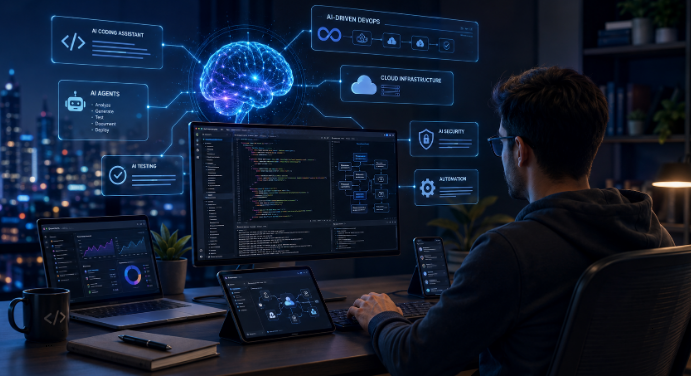
The way software is built is changing faster than most developers realize.
For years, coding meant manually writing code line by line, debugging everything yourself, and spending hours solving repetitive engineering problems. But in 2026, the development landscape looks completely different.
Today, developers are building applications with AI coding assistants, autonomous workflows, AI agents, and intelligent development systems that can generate, test, debug, and even deploy software faster than ever before.
The future of coding is no longer just about writing code.
It’s about orchestrating intelligence.
This massive shift is exactly why programs like All In One Coding 6.0 are gaining attention among developers, students, and professionals looking to adapt to AI-first software development workflows.
But beyond the hype, an important question remains:
What does AI coding actually mean for developers in the real world?
Let’s break it down.
What Is AI Coding?
AI coding refers to the use of artificial intelligence tools and workflows to assist, automate, or accelerate software development.
Instead of building every feature manually from scratch, developers now work alongside AI systems that can:
- Generate code
- Suggest architecture patterns
- Debug applications
- Write documentation
- Create tests
- Automate deployments
- Build UI components
- Optimize performance
- Analyze vulnerabilities
Modern AI coding tools, including advanced AI coding agents, are transforming developers from “manual coders” into system designers and workflow orchestrators.
This doesn’t mean developers are becoming obsolete.
It means developers are becoming more powerful.
Why AI Coding Is Exploding in 2026
Several major shifts are driving the rapid adoption of AI-powered development.
1. AI Tools Have Become Surprisingly Good
Modern tools like:
- GitHub Copilot
- Cursor
- Claude Code
- OpenAI Codex
can now generate functional applications, explain complex systems, and significantly reduce repetitive work.
Developers are no longer using AI just for small code snippets.
They’re using it to accelerate entire workflows.
2. Engineering Teams Need Faster Delivery
Modern startups and companies are under constant pressure to:
- Ship products faster
- Reduce engineering costs
- Automate repetitive work
- Build leaner teams
- Iterate rapidly
AI-assisted development enables smaller teams to build software at speeds that previously required much larger engineering organizations.
This is one reason why AI-integrated engineering roles are growing rapidly across the tech industry.
3. The Nature of Software Development Is Changing
Traditional coding focused heavily on:
- Syntax memorization
- Boilerplate writing
- Manual implementation
AI-first development focuses more on:
- System architecture
- Workflow design
- Prompt engineering
- Automation
- Integration
- Product thinking
The most valuable developers in 2026 are not necessarily the ones writing the most code.
They’re the ones building the best systems.
The Rise of AI-Powered Development Workflows
One of the biggest misconceptions about AI coding is that developers simply “ask ChatGPT for code.”
Real AI-powered development is much more advanced.
Modern workflows combine multiple layers of automation:
AI Coding Assistants
Developers use tools like:
- GitHub Copilot
- Cursor
- Claude Code
- Replit AI
to accelerate coding, debugging, and refactoring.
AI Agents
Developers now create autonomous workflows that can:
- Analyze repositories
- Write features
- Generate tests
- Monitor deployments
- Automate documentation
AI-Driven DevOps
AI-powered business transformations are also transforming:
- CI/CD pipelines
- Cloud deployments
- Infrastructure management
- Monitoring systems
- Security automation
AI-Powered Design & Frontend Workflows
Tools can now:
- Generate UI components
- Convert prompts into interfaces
- Create responsive layouts
- Improve UX automatically
The result?
Developers spend less time on repetitive implementation and more time building scalable systems.
Why Developers Still Need Real Engineering Skills
Here’s the important reality many people misunderstand:
AI can generate code.
But it still cannot replace engineering thinking.
To build production-ready software, developers still need to understand:
- APIs
- Databases
- Security
- Cloud infrastructure
- System design
- Architecture
- Scalability
- DevOps
- Testing
- Performance optimization
AI accelerates skilled developers.
It does not eliminate the need for skill.
In fact, developers with strong engineering fundamentals are benefiting the most from AI-assisted workflows.
The Developers Who Will Win in the AI Era
The industry is splitting into two groups.
Developers Who Adapt Early
These developers:
- Learn AI-first workflows
- Build automation systems
- Work effectively with AI tools
- Use AI across the entire stack
- Increase productivity dramatically
Developers Who Resist the Shift
These developers continue relying entirely on traditional workflows while the industry rapidly evolves around them.
Historically, every major technology transition creates a similar divide:
- Cloud computing
- Mobile development
- DevOps
- AI engineering
AI coding is now becoming the next major transition.
Go with the previous pointer-style structure.
Why? Because:
- It matches the flow and formatting style of the rest of the article.
- It is more scannable for SEO readers and mobile users.
- It naturally increases keyword density without looking forced.
- It keeps the article looking “industry-report/professional blog” style instead of becoming too essay-like.
- Tool names become visually prominent, which is good for both readers and search relevance.
But yes — you should slightly expand each tool category with 1-2 contextual lines + tiny explanations beside important tools.
That will give you the best balance of:
- readability
- SEO
- authority
- engagement
- professional tone
This version would fit perfectly into your article flow:
The Most Important AI Coding Tools in 2026
The AI development ecosystem is expanding rapidly.
Modern developers are no longer relying on a single programming language or framework. Instead, they are combining AI tools for developers, autonomous agents, cloud infrastructure, vector databases, and DevOps workflows to build faster and more intelligently.
Some of the most influential tools include:
AI Coding & Pair Programming
These tools help developers accelerate coding, debugging, testing, documentation, and application development workflows using AI assistance.
- GitHub Copilot — AI-powered pair programming and code suggestions directly inside the IDE
- Cursor — AI-first code editor built for intelligent development workflows
- Claude Code — Advanced AI coding assistant for large-scale reasoning and code generation
- OpenAI Codex — AI model designed for software engineering and automation tasks
- Replit AI — Browser-based AI development environment for rapid prototyping and deployment
Developers are increasingly using these tools to reduce repetitive work and focus more on architecture, systems, and execution.
AI Frameworks & Agent Systems
These frameworks help developers build AI agents, autonomous workflows, and intelligent applications powered by LLMs.
- LangChain — Framework for building LLM-powered applications and AI pipelines
- CrewAI — Multi-agent orchestration framework for collaborative AI systems
- AutoGen — Framework for autonomous AI agents and multi-step reasoning workflows
These tools are becoming essential for building next-generation AI applications beyond traditional chatbots.
AI Infrastructure & Vector Databases
Modern GenAI applications rely heavily on vector databases and semantic retrieval systems.
- Pinecone — Managed vector database for scalable AI retrieval systems
- Chroma — Open-source vector database for embeddings and RAG workflows
- Weaviate — AI-native vector search engine for semantic applications and AI memory systems
These platforms help AI systems retrieve relevant context, improve accuracy, and enable advanced RAG architectures.
AI Cloud & DevOps Stack
AI-powered software development also depends heavily on cloud infrastructure, automation, and scalable deployment systems.
- Docker — Containerization platform for portable application environments
- Kubernetes — Container orchestration system for scaling distributed applications
- Terraform — An infrastructure-as-code platform for automated cloud provisioning
- Jenkins — CI/CD automation server for deployment workflows
- AWS — Cloud infrastructure platform for scalable applications and AI workloads
- Azure — Enterprise cloud ecosystem with integrated AI services
- Google Cloud — AI and data-focused cloud platform for modern application development
Developers who understand how these tools connect together will have a major advantage over the next few years.
Because the future will not belong to developers who only know how to write code manually.
It will belong to developers who know how to combine AI, automation, cloud systems, and intelligent workflows into scalable real-world products.
Why AI Coding Is Bigger Than Just Developers
AI-powered development is no longer limited to software engineers.
Today:
- Entrepreneurs are building MVPs faster
- Freelancers are scaling output
- Designers are prototyping products with AI
- Students are entering tech faster
- Non-coders are building applications using AI-first tools
The barrier to entry for building software is dropping dramatically.
But the ability to design intelligent systems remains extremely valuable.
That’s why structured learning ecosystems focused on AI-first development — such as All In One Coding 6.0 — are becoming increasingly relevant for modern learners.
The Future of Coding Is About Leverage
The future of coding isn’t about replacing developers.
It’s about increasing leverage.
Developers who understand:
- AI-assisted workflows
- System design
- Automation
- Cloud infrastructure
- AI agents
- Modern engineering practices
will build faster, scale more effectively, and adapt more effectively than traditional developers who rely entirely on manual coding.
The question is no longer: “Can you write code?”
The real question in 2026 is: “Can you build systems that use AI to create, automate, and scale software efficiently?”
Because that’s where the industry is heading. And it’s moving faster than most people expect.
Final Thoughts
AI coding is not a temporary trend.
It’s a structural shift in how software gets built.
The developers who learn to combine:
- AI tools
- Engineering fundamentals
- Automation workflows
- System-level thinking
will define the next generation of software development.
The opportunity right now is massive for developers, students, creators, and professionals willing to adapt early.
And as AI-first development becomes the new standard, learning ecosystems like All In One Coding 6.0 are positioning themselves around the exact skills modern builders will increasingly need in the coming years.