

DevOps with AI combines artificial intelligence with DevOps practices to automate repetitive tasks, improve decision-making, and accelerate software delivery. Organizations across the US and UK are increasingly adopting AI-powered DevOps to streamline development, reduce downtime, and build more reliable applications in today’s fast-moving digital landscape. By using AI for tasks such as testing, monitoring, deployment, and incident detection, teams can collaborate more effectively while delivering higher-quality software faster. This guide explains the fundamentals of DevOps with AI, explores its key benefits, highlights real-world use cases, discusses popular tools and best practices, and helps you understand how AI is transforming modern software development and IT operations.
What Is DevOps with AI?
Understanding DevOps
DevOps is a modern approach to software development that brings development and IT operations teams together to work as one. Instead of working separately, both teams collaborate throughout the entire software lifecycle, from planning and coding to testing, deployment, and maintenance. By following effective DevOps practices, organizations can automate repetitive tasks, reduce errors, release software more frequently, and respond to customer needs faster. This collaborative approach improves communication, increases efficiency, and helps deliver reliable, high-quality applications.
What Is the Role of AI in DevOps?
The role of AI in DevOps is to make software development and IT operations smarter by automating routine tasks and providing data-driven insights. AI can analyze large volumes of system data to predict potential failures, identify performance issues, and detect unusual behavior before it affects users. It also supports continuous monitoring, intelligent testing, and faster incident response, helping teams make informed decisions more quickly. For example, AI can automatically prioritize alerts, suggest fixes for recurring problems, and optimize deployment schedules. This reduces manual effort, improves operational efficiency, and enables teams to deliver reliable software with greater speed and confidence.
Why Businesses Are Adopting AI-Driven DevOps
Businesses are increasingly adopting AI-driven DevOps to manage growing IT complexity while delivering software more quickly and reliably. As cloud environments, applications, and customer expectations continue to expand, AI helps automate infrastructure management, identify potential issues early, and reduce unplanned downtime. It also improves release planning by analyzing system performance and deployment risks, allowing teams to deliver updates with greater confidence. Across the US and UK, many organizations are investing in AI-powered DevOps to increase operational efficiency, strengthen service reliability, and provide faster, more consistent digital experiences without compromising software quality.
Understanding AIOps
AIOps Definition
The AIOps definition refers to the use of artificial intelligence, machine learning, and big data analytics to improve and automate IT operations. AIOps platforms collect and analyze data from applications, servers, networks, and cloud services to detect patterns, identify issues, and recommend solutions in real time. Instead of relying only on manual monitoring, IT teams can use AI-powered insights to resolve problems faster, reduce downtime, and improve system performance. This helps organizations manage complex technology environments more efficiently while delivering reliable digital services.
How AIOps Works
AIOps works by collecting operational data from applications, servers, networks, cloud platforms, and monitoring tools. It then analyzes logs, performance metrics, and system events using artificial intelligence and machine learning to identify patterns and detect unusual behavior. When an anomaly appears, AIOps predicts potential issues, performs root cause analysis to determine the source of the problem, and can automatically trigger predefined responses, such as restarting a service or sending alerts to the appropriate team. For example, if an online shopping website experiences unusually high server traffic, AIOps can recognize the abnormal activity, identify the affected system, recommend or initiate corrective actions, and help restore normal performance before customers notice significant disruptions.
Difference Between Traditional Monitoring and AIOps
Traditional IT monitoring relies on predefined rules and manual analysis to identify system issues, often requiring IT teams to investigate alerts and determine the root cause themselves. In contrast, AIOps uses artificial intelligence to analyze large volumes of operational data in real time, detect anomalies, predict potential failures, and automate many routine tasks. This results in faster incident detection, greater accuracy, improved scalability across complex environments, and quicker resolution of problems. By reducing alert fatigue and minimizing manual effort, AIOps enables organizations to maintain more reliable systems while responding to incidents more efficiently than conventional monitoring methods.
| Traditional Monitoring | AIOps |
| Manual log analysis | AI-powered log analysis |
| Reactive troubleshooting | Predictive issue detection |
| Multiple disconnected tools | Unified intelligent monitoring |
| Human-driven decisions | AI-assisted decision-making |
| Slow root cause analysis | Automated root cause identification |
Key Benefits of DevOps with AI

Faster Software Development
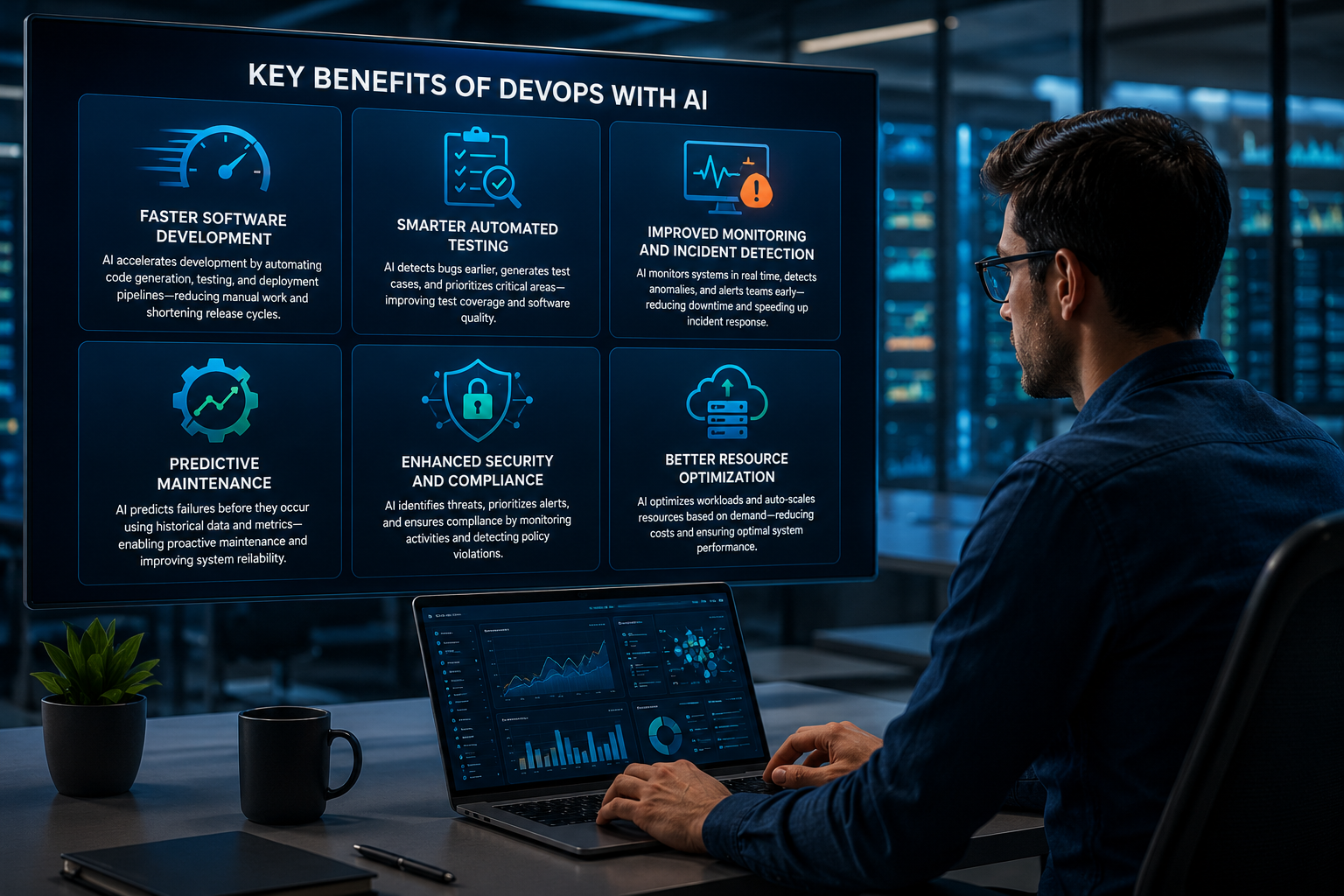
AI helps accelerate software development by assisting with code generation, automating testing, identifying bugs earlier, and optimizing deployment pipelines. These capabilities reduce repetitive manual work and shorten development cycles without compromising quality. As a result, development teams can release new features, updates, and security fixes more quickly while maintaining reliable and consistent software performance.
Smarter Automated Testing
AI-powered automated testing improves software quality by detecting bugs earlier, generating relevant test cases, and prioritizing the most critical areas to test based on code changes and historical data. This reduces repetitive manual testing while increasing test coverage and accuracy. As a result, development teams can identify issues faster, shorten release cycles, and deliver more reliable applications with greater confidence.
Improved Monitoring and Incident Detection
AI continuously monitors applications, servers, networks, and cloud infrastructure to identify unusual patterns that may indicate potential problems. By detecting anomalies in real time, it can alert IT teams before minor issues develop into major incidents. This proactive approach reduces downtime, speeds up incident response, and helps maintain stable, reliable software performance.
Predictive Maintenance
AI uses historical data, system logs, and performance metrics to predict potential equipment or application failures before they occur. This allows IT teams to perform maintenance proactively instead of reacting to unexpected outages. As a result, organizations can reduce downtime, improve system reliability, extend infrastructure lifespan, and lower maintenance and operational costs.
Enhanced Security and Compliance
AI strengthens cybersecurity by continuously monitoring systems for unusual behavior, suspicious activities, and potential security threats. It can quickly identify risks, prioritize critical alerts, and support faster incident response. Continuous monitoring also helps organizations maintain compliance by tracking system activities, detecting policy violations, and generating valuable insights for security audits and regulatory requirements.
Better Resource Optimization
AI improves infrastructure utilization by analyzing workload patterns and automatically adjusting computing resources based on demand. It can optimize application performance, balance workloads, and scale resources up or down without manual intervention. This helps organizations reduce unnecessary infrastructure costs, improve system efficiency, and ensure reliable performance during changing workloads.
| Traditional DevOps | DevOps with AI |
| Manual monitoring | Intelligent monitoring |
| Reactive issue resolution | Predictive issue prevention |
| Manual testing | Automated testing |
| Fixed resource allocation | Dynamic optimization |
| Human analysis | AI-powered insights |
Popular AI Applications Across the DevOps Lifecycle
AI in CI/CD Pipelines
AI enhances Continuous Integration and Continuous Delivery (CI/CD) pipelines by automating code validation, identifying potential defects, and recommending deployment decisions based on risk analysis. It can also optimize release schedules, monitor deployment performance, and detect issues during software releases. This helps teams deliver high-quality applications faster while reducing deployment failures and manual effort.
Automated Testing
AI enhances automated testing by generating intelligent test cases based on application changes and user behavior. It can identify high-risk code changes, prioritize critical tests, and reduce the time spent on regression testing. This enables development teams to detect defects earlier, improve software quality, and release reliable applications more efficiently with less manual testing effort.
Infrastructure Monitoring
AI continuously monitors servers, cloud resources, containers, and applications to track system health and performance in real time. By analyzing operational data, it can detect unusual behavior, identify performance bottlenecks, and predict potential failures before outages occur. This proactive monitoring helps IT teams respond quickly, minimize downtime, and maintain reliable infrastructure.
Log Analysis
AI simplifies log analysis by processing millions of log entries from applications, servers, and network devices in real time. It identifies hidden patterns, detects unusual activity, and correlates related events that might be missed through manual review. This enables IT teams to troubleshoot problems faster, identify root causes more accurately, and improve overall system reliability.
Capacity Planning
AI improves capacity planning by analyzing historical usage patterns, workload trends, and performance data to forecast future infrastructure requirements. These insights help organizations allocate resources more effectively, avoid performance bottlenecks during periods of high demand, and prevent unnecessary spending on unused infrastructure. As a result, businesses can maintain efficient, cost-effective IT operations.
Security Monitoring
AI strengthens security monitoring by continuously analyzing system activity, user behavior, and network traffic to identify suspicious patterns and potential cyber threats. It can detect anomalies in real time, prioritize critical security alerts, and support faster incident response. This proactive approach helps DevOps teams reduce security risks, minimize the impact of attacks, and maintain a more secure software delivery environment.
Performance Optimization
AI continuously analyzes application performance, user behavior, and infrastructure metrics to identify bottlenecks and recommend optimizations. It helps teams improve response times, balance workloads, and maintain a consistent user experience even during peak demand.
Mini Scenario: An e-commerce company uses AI throughout its CI/CD pipeline to automatically test new code, monitor application health, deploy updates during low-risk periods, and optimize system performance after release. If AI detects unusual behavior, it alerts the team or initiates predefined corrective actions, enabling smooth software delivery with minimal human intervention.
Read More: Mastering Modern Web Development:Best Practices, Tools, and Communities For Every Developer
| DevOps Stage | AI Contribution |
| Planning | Predictive analytics |
| Development | AI-assisted coding |
| Testing | Intelligent automated testing |
| Deployment | Risk-based deployment |
| Monitoring | Predictive monitoring |
| Operations | Self-healing automation |
Generative AI in DevOps
Writing Infrastructure as Code
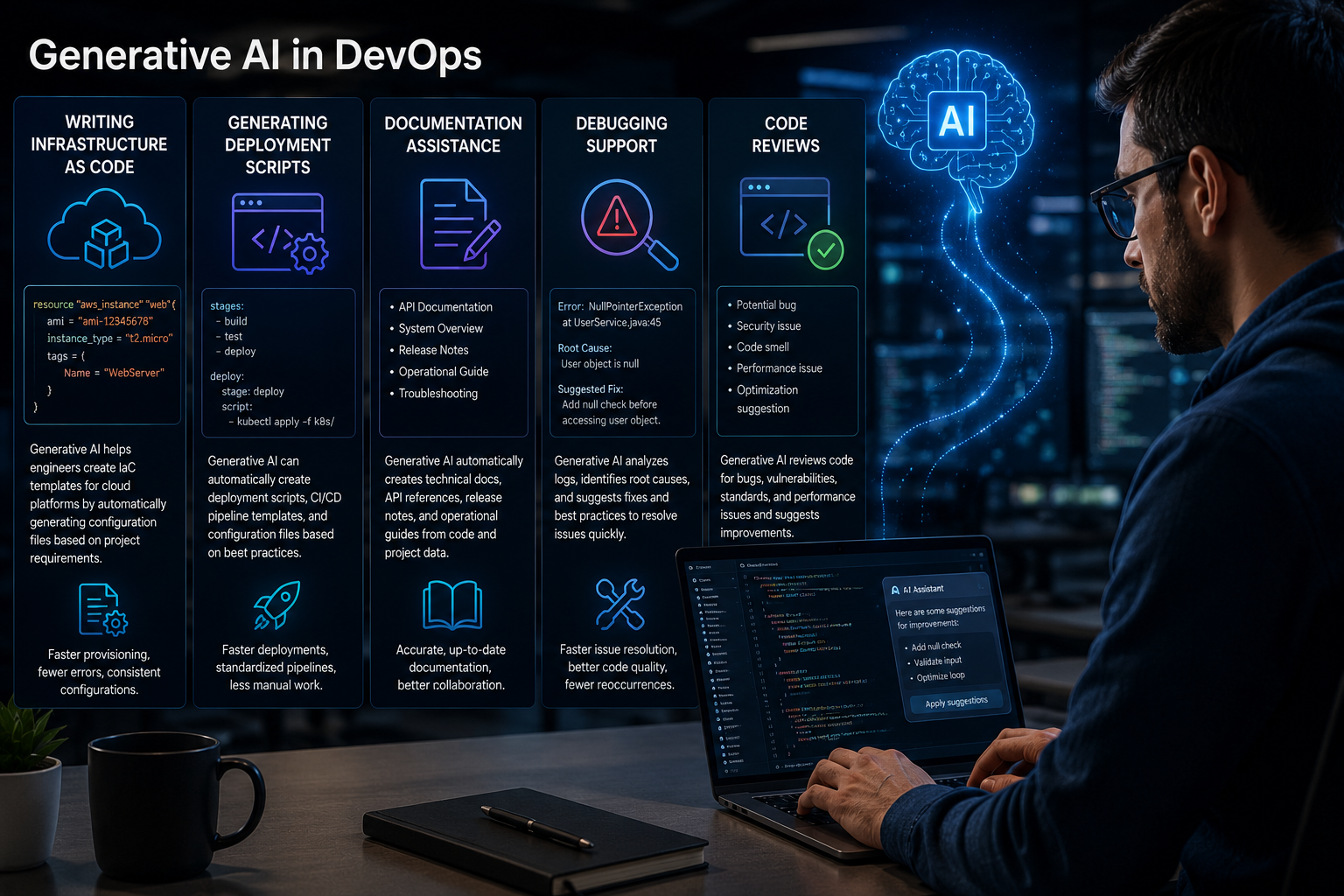
Generative AI helps engineers create Infrastructure as Code (IaC) templates for cloud platforms by automatically generating configuration files based on project requirements. This reduces manual coding, minimizes configuration errors, improves consistency, and speeds up infrastructure provisioning. For example, an engineer can describe the need for a cloud server, and AI can generate an IaC template that deploys the required resources with the correct settings in minutes.
Generating Deployment Scripts
Generative AI can automatically create deployment scripts, configuration files, and CI/CD pipeline templates based on project requirements and best practices. This reduces repetitive manual work, minimizes configuration errors, and speeds up software deployment. By generating standardized deployment artifacts, AI helps development teams maintain consistency across environments, simplify collaboration, and deliver reliable software releases more efficiently.
Documentation Assistance
Generative AI automatically creates technical documentation, API documentation, release notes, and operational guides from code, system changes, and project data. This reduces manual documentation effort while improving accuracy and consistency. Clear, up-to-date documentation helps developers and operations teams collaborate more effectively, simplifies knowledge sharing, and supports faster troubleshooting and software maintenance.
Debugging Support
Generative AI assists developers by analyzing error logs, identifying likely root causes, and suggesting potential fixes for coding and configuration issues. It can also recommend best practices to improve code quality and prevent similar problems in future releases. This reduces debugging time, improves software reliability, and helps development teams resolve issues more efficiently.
Code Reviews
Generative AI enhances code reviews by analyzing source code for potential bugs, security vulnerabilities, coding standard violations, and performance issues. It also suggests optimization opportunities before deployment, helping development teams improve code quality, reduce production risks, and deliver more secure, reliable software releases.
| Traditional Development | Generative AI in DevOps |
| Manual scripting | AI-generated scripts |
| Manual documentation | Auto-generated documentation |
| Human-only code reviews | AI-assisted code reviews |
| Manual debugging | AI-powered troubleshooting |
| Time-consuming configuration | Intelligent automation |
Popular AIOps Platforms
Leading AIOps Platforms
Several AIOps platforms help organizations automate IT operations, improve observability, and reduce incident response times. IBM AIOps uses artificial intelligence to detect issues, identify root causes, and automate remediation across complex IT environments. Dynatrace specializes in full-stack observability, application performance monitoring, and predictive analytics.
Datadog provides unified monitoring for cloud infrastructure, applications, logs, and security. Splunk ITSI focuses on log analytics, event correlation, and service intelligence to help teams identify critical incidents quickly. New Relic delivers real-time application monitoring, performance insights, and troubleshooting tools for modern software environments.
Moogsoft uses AI-driven event correlation and intelligent automation to reduce alert noise and accelerate incident management. Together, these platforms help businesses improve system reliability, operational efficiency, and the overall performance of their IT infrastructure.
Features to Look for in an AIOps Platform
When evaluating an AIOps platform, organizations should look for AI-powered monitoring, predictive analytics, and automated incident response to improve operational efficiency. The platform should also support scalability, integrate seamlessly with cloud environments, and include security monitoring capabilities. User-friendly dashboards, real-time insights, and compatibility with existing DevOps tools are equally important for simplifying IT management and enabling faster, data-driven decision-making.
Choosing the Right Platform
Choosing the right AIOps platform depends on your organization’s size, infrastructure complexity, budget, existing DevOps tools, cloud strategy, and long-term business goals. A small business may prioritize ease of use, while larger enterprises often need advanced automation and scalability. Compare features such as AI capabilities, integrations, security, analytics, and support instead of focusing only on cost to ensure the platform delivers long-term value.
| Platform | Best For | Key Strength |
| IBM AIOps | Large enterprises | AI-driven incident management |
| Dynatrace | Cloud environments | Full-stack observability |
| Datadog | Cloud-native teams | Unified monitoring |
| Splunk ITSI | Log analytics | Event correlation |
| New Relic | Application monitoring | Performance insights |
| Moogsoft | Incident management | Noise reduction |
Mainframe AIOps Explained
What Is Mainframe AIOps?
Mainframe AIOps applies artificial intelligence to monitor, analyze, and automate the management of mainframe systems. Although many organizations have adopted cloud computing, industries such as banking, healthcare, government, and insurance continue to rely on mainframes for mission-critical applications because of their reliability, security, and processing power. AIOps helps these organizations improve performance, reduce downtime, and simplify complex mainframe operations.
Benefits for Enterprise Systems
AI enhances enterprise mainframe systems by continuously monitoring performance, predicting potential failures, and optimizing workloads based on resource usage. It helps detect issues before they affect critical business operations, reducing downtime and improving system reliability. By automating routine operational tasks and providing actionable insights, AI enables organizations to maintain stable, efficient, and high-performing enterprise environments.
Supporting Legacy System Modernization
AIOps helps organizations modernize legacy systems by adding intelligent monitoring, automation, and predictive analytics without requiring the replacement of critical infrastructure. This allows businesses to improve performance, enhance reliability, and integrate older systems with modern cloud and DevOps environments. By reducing operational risks and minimizing disruption, AIOps enables a gradual, cost-effective approach to digital transformation while extending the value of existing technology investments.
Real-World AIOps Use Cases
Banking
Banks use AIOps to monitor financial systems, detect unusual transaction patterns that may indicate fraud, and identify potential issues before they affect customers. Continuous monitoring improves system uptime, supports faster incident response, and helps maintain secure, reliable banking services. This enables financial institutions to deliver safer digital experiences while reducing operational risks.
Healthcare
Hospitals use AIOps to continuously monitor healthcare systems, identify performance issues, and prevent unexpected outages that could disrupt patient care. AI-powered insights improve system reliability, support faster incident resolution, and help protect sensitive patient data through continuous security monitoring. This enables healthcare providers to deliver safe, efficient, and uninterrupted digital services.
E-commerce
Online retailers use AIOps to monitor website performance, analyze customer traffic, and detect potential issues before they affect shoppers. During peak shopping seasons, AI helps optimize infrastructure, automatically scale resources, and prevent service disruptions. This ensures faster page loading, reliable transactions, and a smooth shopping experience even during periods of high demand.
Telecommunications
Telecommunications providers use AIOps to continuously monitor network performance, detect unusual activity, and predict equipment or service failures before they occur. AI-powered insights help optimize network resources, reduce service interruptions, and accelerate incident response. This improves network reliability, enhances customer service, and ensures consistent connectivity for businesses and consumers.
Cloud Service Providers
Cloud service providers use AI to automate infrastructure management, monitor resource utilization, and optimize workloads across large-scale environments. AI continuously analyzes system performance to detect anomalies, predict potential failures, and trigger automated responses before service disruptions occur. These capabilities improve resource efficiency, maintain high service availability, reduce operational costs, and deliver reliable cloud services for businesses and individual users.
| Industry | Primary AIOps Use |
| Banking | Fraud detection |
| Healthcare | System reliability |
| E-commerce | Website optimization |
| Telecommunications | Network monitoring |
| Cloud Services | Infrastructure automation |
Essential DevOps Practices Enhanced by AI
Continuous Integration and Continuous Delivery
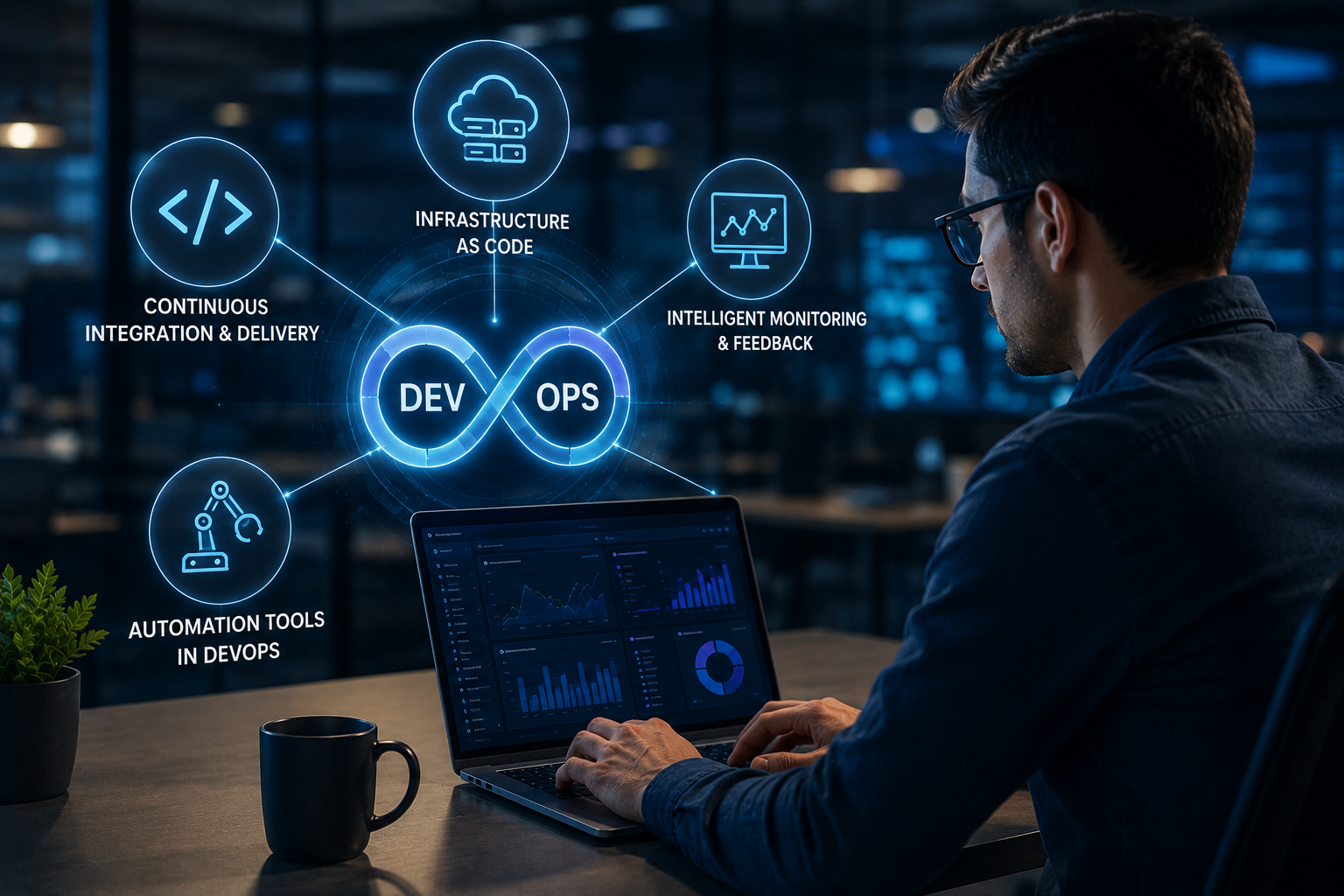
AI enhances Continuous Integration and Continuous Delivery (CI/CD) by automating software testing, validating code changes, and supporting intelligent release management. It can identify potential deployment risks, verify application quality, and recommend the safest release strategies based on historical data and system performance. By reducing manual intervention throughout the pipeline, AI helps development teams deliver software faster, improve deployment reliability, and maintain consistent application quality.
Infrastructure as Code
AI simplifies Infrastructure as Code (IaC) by generating infrastructure templates, validating configurations, and identifying potential errors before deployment. It also recommends best practices to improve consistency across cloud environments. By reducing manual configuration work and deployment mistakes, AI helps teams provision infrastructure more quickly, reliably, and with greater confidence.
Intelligent Monitoring and Feedback
AI continuously monitors applications, infrastructure, and user experience after deployment to collect performance data and operational feedback. It detects anomalies, identifies recurring issues, and analyzes trends that may affect reliability or performance. Using these insights, AI recommends improvements for future releases, helping development and operations teams continuously optimize applications, enhance stability, and deliver a better user experience.
Automation Tools in DevOps
Automation tools are essential in DevOps because they streamline repetitive tasks, improve consistency, and accelerate software delivery. AI enhances these tools by automating testing, optimizing deployment decisions, continuously monitoring applications, and managing infrastructure more intelligently. This reduces manual effort, speeds up development cycles, minimizes errors, and enables development and operations teams to focus on innovation and delivering high-quality software.
| DevOps Practice | AI Enhancement |
| CI | Intelligent build validation |
| CD | Smart deployment decisions |
| IaC | AI-generated templates |
| Monitoring | Predictive analytics |
| Feedback | Continuous optimization |
Skills Needed to Work in AI-Powered DevOps
Technical Skills
A strong foundation in Linux, networking, cloud computing, scripting, containers, and CI/CD helps professionals understand AI-powered DevOps. These core technical skills make it easier to automate workflows, manage infrastructure, and work effectively with modern development and operations tools.
AI and Machine Learning Basics
DevOps professionals should understand basic AI and machine learning concepts, including predictive analytics and intelligent automation. This knowledge helps them use AI-powered tools effectively, improve decision-making, and optimize software delivery without requiring advanced data science expertise.
Cloud Platforms
Knowledge of cloud platforms such as AWS, Azure, and Google Cloud helps DevOps professionals automate infrastructure, support scalable deployments, and efficiently manage AI-powered applications across modern cloud environments.
Automation Tools
Automation tools in DevOps streamline testing, deployment, monitoring, and infrastructure management. AI enhances these tools by improving accuracy, reducing manual effort, and enabling faster, more reliable software delivery across development and operations workflows.
Scripting Languages
Scripting languages like Python and Bash automate DevOps workflows, simplify repetitive tasks, and support the integration of AI-powered tools into development and infrastructure processes.
DevOps Engineer Jobs in USA
The demand for DevOps engineer jobs in USA and the UK continues to grow as organizations adopt AI-powered development practices. Professionals with DevOps and AI skills are well positioned for stronger career opportunities, higher employability, and long-term career growth across multiple industries.
Best Ways to Learn DevOps with AI
Enroll in a DevOps with AI Course
Choose a structured DevOps with AI course that combines DevOps fundamentals, AI concepts, cloud technologies, and hands-on labs. Practical learning helps build real-world skills and prepares learners for modern DevOps roles.
Gain Hands-On Experience Through Labs
Practice with cloud labs, CI/CD pipelines, and AI-powered automation tools to apply theoretical concepts in real-world scenarios. Hands-on experience builds confidence, strengthens technical skills, and improves problem-solving abilities.
Explore Open-Source DevOps Projects
Contribute to open-source DevOps projects to gain practical experience, improve technical skills, collaborate with experienced professionals, and build a stronger professional portfolio.
Earn Industry-Recognized Certifications
Industry-recognized certifications validate your expertise in DevOps, cloud computing, and AI-powered operations. They strengthen your professional credibility, demonstrate practical skills to employers, and improve career advancement opportunities.
Practice with Cloud and Automation Tools
Experimenting with cloud services, automation platforms, and monitoring tools helps build practical DevOps skills through real-world experience. Regular practice improves confidence, strengthens problem-solving abilities, and prepares professionals to manage modern software delivery environments effectively.
Join DevOps and AI Communities
Join online communities, technical forums, webinars, and local meetups to learn from experts, share knowledge, and stay updated on evolving DevOps and AI trends.
Common Challenges of Implementing DevOps with AI
Data Quality and AI Accuracy
AI depends on accurate, high-quality operational data to produce reliable predictions and automation. Poor-quality or incomplete data can reduce accuracy, leading to incorrect insights, ineffective decisions, and unreliable system performance.
Integration with Existing DevOps Tools
Integrating AI with existing DevOps workflows, legacy systems, and cloud infrastructure can be challenging. Organizations must ensure compatibility, smooth data exchange, and minimal disruption while maintaining reliable and efficient operations.
Managing AI Implementation Costs
Adopting AI involves infrastructure, software licensing, integration, and employee training costs. But increased automation, better efficiency, less down time and long-term operational savings, can often provide a strong return on investment.
Team Skill and Adoption Building
Organizations should build confidence and technical confidence through training employees, cross-functional collaboration and a phased approach to AI adoption. Phased implementation leads to better adaptation of teams and is more likely to result in successful AI implementation.
Privacy, Compliance and Security
Organizations must protect sensitive data through strong access controls, encryption, and continuous security monitoring. Industry regulations and compliance requirements help to ensure that AI-powered DevOps is secure, reliable, and trustworthy.
Robustness of AI models over time
AI models need ongoing monitoring, periodic updates, and re-training as applications, workloads, and infrastructure change over time. Regular maintenance helps maintain the accuracy of predictions, the quality of automation, and the reliability of AI insights as the environment changes. The Future of DevOps and AI Autonomous and Self-Healing Infrastructure
The Future of DevOps with AI
Autonomous and Self-Healing Infrastructure
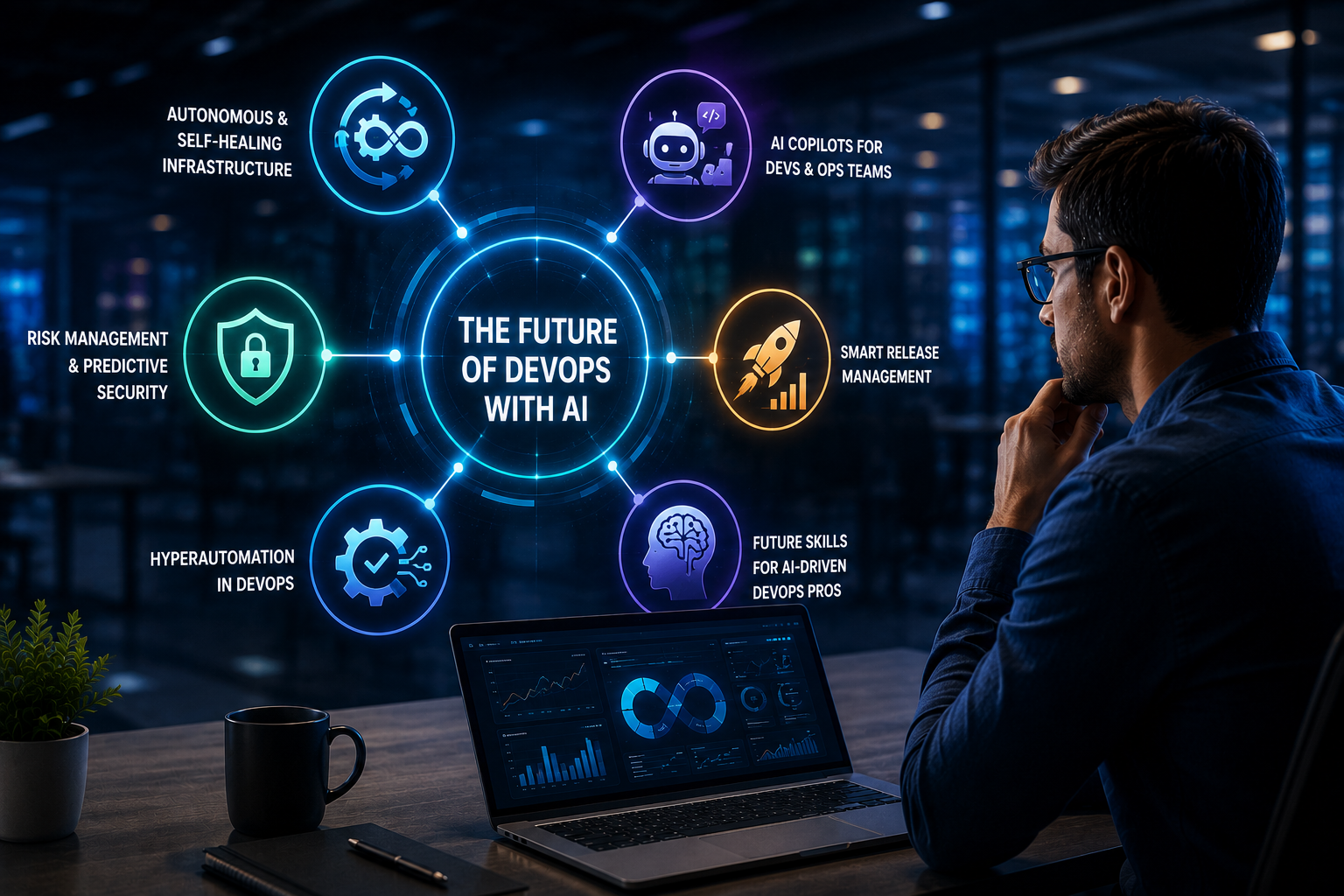
AI will handle more of the infrastructure management duties, identifying issues and determining causes and correcting problems without human intervention. This will boost system reliability, lower downtime and accelerate incident resolution.
AI Copilots for Devs & Ops Teams
AI copilots will help developers and operations teams code, debug, deploy, document and make operational decisions. These smart assistants will improve productivity, lower manual effort, and enable faster, more reliable software delivery.
Risk Management and Predictive Security
AI will enhance cybersecurity by enabling the early detection of threats, vulnerabilities and abnormal activity. Predictive risk analysis allows organizations to prevent attacks, improve incident response, and proactively address security risks before they impact critical systems.
Smart Release Management
AI will optimize deployment timing by analyzing application performance, deployment risks, and historical data. This helps reduce release failures, improve software delivery reliability, and ensure smoother production deployments.
Hyperautomation in DevOps
Hyperautomation combines AI with advanced automation technologies to streamline development, testing, deployment, monitoring, and infrastructure management. This creates highly efficient DevOps workflows, reduces manual intervention, improves operational consistency, and accelerates software delivery.
Future Skills for AI-Driven DevOps Professionals
Professionals should develop expertise in AI, cloud computing, automation, data analysis, cybersecurity, and modern DevOps practices. Continuous learning and hands-on experience will remain essential for long-term career success.
Frequently Asked Questions (FAQ)
What Is DevOps with AI?
DevOps with AI combines artificial intelligence with DevOps practices to automate software development, testing, deployment, monitoring, and operations. It helps organizations deliver reliable applications faster while reducing manual effort and improving operational efficiency.
What Is AIOps?
AIOps employs artificial intelligence, machine learning, and data analytics to automate IT operations. It enables organizations to monitor systems, detect anomalies, predict issues, and respond to incidents much faster than traditional monitoring methods.
AIOps Definition: What Is It?
AIOps is defined as applying AI and machine learning to IT operations. It can understand operational data, detect trends, predict failures, and automate actions, helping organizations improve system reliability and operational performance.
How AI Improves DevOps
AI helps DevOps teams with automating testing, monitoring applications, analyzing logs, predicting failures, and optimizing deployments. These capabilities cut down on repetitive work, improve the quality of the software, and enable faster, more reliable delivery of software.
Best AIOps Tools?
Some popular AIOps platforms include IBM AIOps, Dynatrace, Datadog, Splunk ITSI, New Relic, and Moogsoft. All platforms provide capabilities such as observability, predictive monitoring, log analytics and intelligent automation for modern IT environments.
What are common use cases for AIOps?
Typical AIOps use cases include infrastructure monitoring, incident detection, predictive maintenance, log analysis, capacity planning, security monitoring, and application performance optimization in cloud and enterprise environments.
What is AIOps for Mainframe?
AIOps for mainframes leverages AI to monitor and optimize enterprise mainframe systems. It improves operational stability, predicts failures, automates routine management tasks and helps organizations modernize critical infrastructure without replacing existing systems.
IBM AIOps: What Is It?
IBM AIOps is an AI-powered platform that helps organizations monitor IT environments, detect issues, identify root causes, and automate remediation. It delivers faster incident resolution and greater operational resilience.
What is AI’s role in DevOps?
AI in DevOps automates the repetitive tasks, enhances decision making, predicts system problems, optimizes deployments and improves monitoring. This assists teams in delivering software more efficiently with reliability.
Is DevOps with AI a Good Career in USA and UK?
Yes. As companies increasingly adopt AI-enabled DevOps, demand keeps rising in the US and UK. Cloud, automation, and AI professionals can find good career options and long-term professional growth.
Read More: How to Secure Your API: Authentication, Rate Limiting, JWT & Modern Best Practices
Conclusion
AI-powered DevOps is revolutionizing modern software delivery by combining intelligent automation with collaborative DevOps practices. From AIOps-powered monitoring and incident management to generative AI that improves coding, testing and documentation, organizations can deliver software faster, more reliably and more efficiently. As AI continues to revolutionize development and IT operations, professionals at all levels will increasingly value ongoing learning and hands-on experience. As DevOps with AI plays an increasingly larger role in enabling intelligent, resilient and scalable software delivery across industries, you can develop hands-on skills and adopt AI-augmented workflows now to stay future-ready.