
Introduction
Python Backend Skills remain a dependable foundation for developers who want lasting career value. Frameworks and tools shift, yet the ability to design reliable services continues to matter. This guide shows American and European developers which skills stay relevant beyond short-term trends and how to strengthen them for 2027.
Is Python Good for Backend Development?
Yes. Python Backend Skills give teams a practical advantage when building services that must stay maintainable. The language offers clear syntax and a mature ecosystem used widely across the United States and Europe. Many organization choose it for APIs, internal tools, and data pipelines because development speed and long-term readability both remain strong.
Its standard library and community packages cover common backend needs without forcing unnecessary complexity. When projects move from prototype to production, solid Python Backend Skills help reduce friction. The language works smoothly with modern deployment practices and cloud platforms. Developers who combine language knowledge with disciplined engineering habits continue to find steady demand.
Essential Python Backend Developer Skills Required
Strong Python Backend Skills start with clear fundamentals. Developers need a solid understanding of HTTP, REST design, authentication patterns, and basic security. These foundations support every framework and database decision that follows.
Beyond syntax, teams value the ability to design clean service boundaries and manage state carefully. Error handling, structured logging, and automated testing form part of daily work. Employers in both American and European markets often prefer candidates who can explain trade-offs clearly.
Practical experience with version control and container workflows also matters. When these elements combine, Python Backend Skills become transferable across projects. Consistent practice on real systems remains the most reliable way to develop them. For additional learning paths, see the Best Resources To Learn Python Programming guide on Eduonix.
Python Backend Skills List for Long-Term Success
A focused Python Backend Skills list helps developers priorities. Core items include proficiency with at least one major web framework, comfort with relational databases, and the ability to containerize applications. Data-handling libraries and basic performance awareness complete the foundation.
Secondary strengths such as asynchronous patterns and caching strategies add resilience. Soft skills, clear documentation and collaborative debugging amplify technical ability. This list stays useful because it emphasizes principles over short-lived tools.
Reviewing the list against current requirements keeps learning intentional. Developers who treat it as a living checklist maintain stronger Python Backend Skills over time.
Core Technologies That Define Modern Python Backend Skills
Docker Containerization and What Is Docker Compose
Docker containerization packages an application with its dependencies so it runs the same way in every environment. This practice removes common deployment surprises and forms a core part of modern Python Backend Skills. Official configuration details appear in the Docker documentation
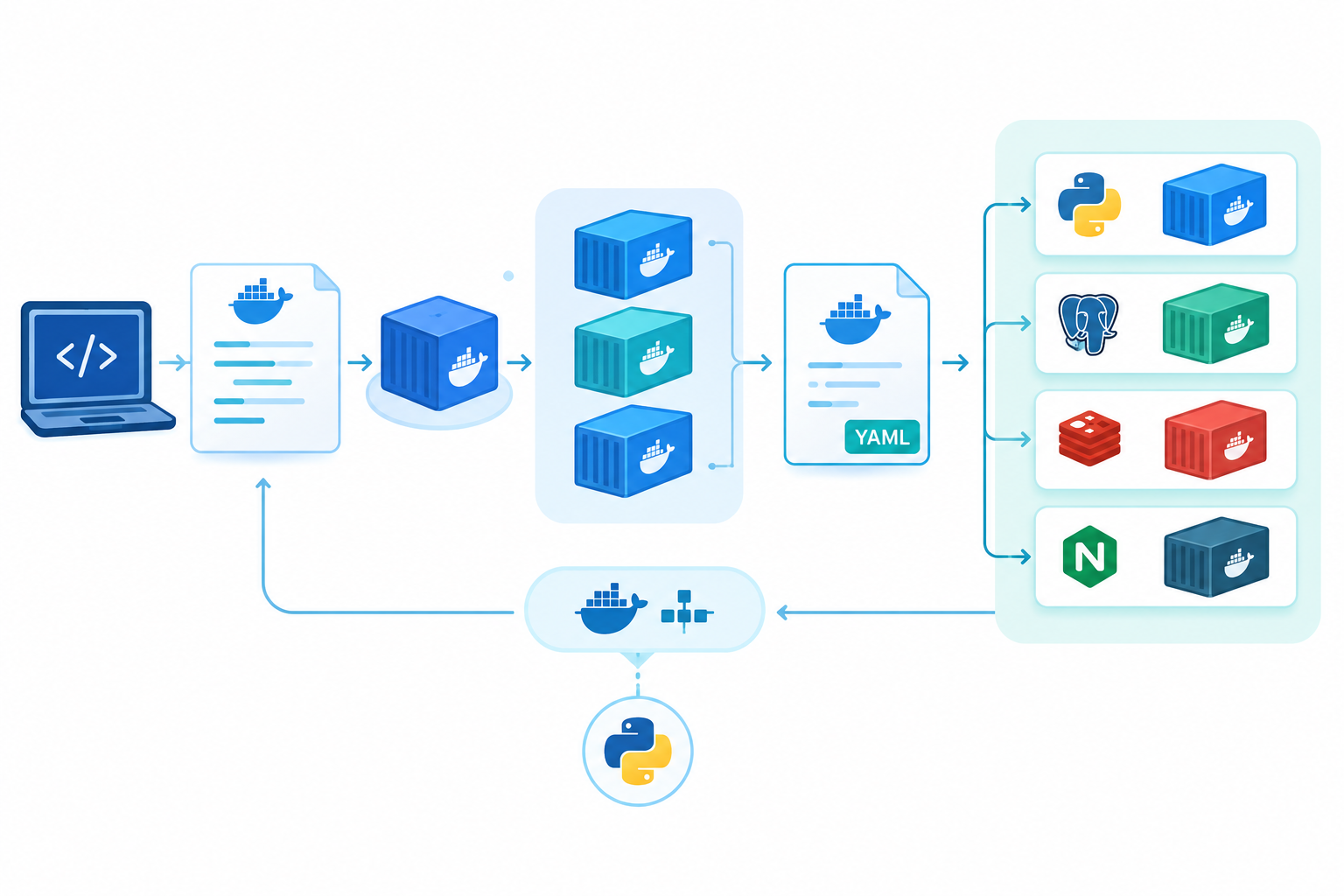

What is Docker Compose? It is a tool that defines multi-container applications in a single YAML file. Developers describe services, networks, and volumes once and start the full stack with one command. This approach speeds local development and simplifies testing across teams.
Teams that master Docker containerization gain portability and clearer release paths. The skill pairs naturally with continuous integration pipelines used throughout the industry.
PostgreSQL with Python – Reliable Database Foundations
PostgreSQL with Python provides a stable combination for data-driven services. The database offers strong transactional guarantees, flexible indexing, and support for complex queries. Python developers typically connect through mature drivers and ORMs that keep application code readable.
Official reference material is available in the PostgreSQL documentation. Understanding connection management, schema migrations, and basic query planning strengthens Python Backend Skills. These practices help services stay responsive as data volume grows.
When teams treat the database as a design concern rather than an afterthought, systems become easier to maintain over multiple years.
Pandas for Efficient Backend Data Handling
Pandas remains useful inside backend services that process tabular data or prepare reports. Knowing the current Pandas version and its core structures helps developers write clear transformation logic. In many organisation, backend jobs use Pandas for batch processing or internal analytics endpoints.
Clean, tested Pandas code reduces errors and improves readability for future maintainers. This skill complements rather than replaces dedicated data-engineering tools. Developers who understand when to apply Pandas and when to move work elsewhere demonstrate mature Python Backend Skills.
Leading Python Web Development Frameworks
FastAPI – High-Performance API Development
FastAPI has become a popular choice for high-performance APIs. It uses Python type hints to generate interactive documentation and delivers strong speed for asynchronous workloads. Many teams adopt it for microservices and public interfaces.
Its design encourages clear contracts between services. Developers appreciate the reduced boilerplate and built-in validation. When combined with proper testing, FastAPI supports production systems that remain maintainable. Mastering it expands the range of projects a developer can handle and strengthens overall Python Backend Skills. Practical product-building advice appears in Best Practices For Building Software Products With Python on CodeCondo.
Django Meaning and When to Choose the Batteries-Included Approach
Django meaning centers on the batteries-included philosophy. The framework supplies an ORM, admin interface, authentication system, and many supporting components. This approach accelerates development of full-featured applications.
Teams choose Django when they need rapid progress on content-heavy or administrative systems. Its conventions reduce decision fatigue and promote consistent structure. Understanding when Django fits and when a lighter framework serves better marks experienced developers. The framework continues to evolve while preserving the stability long-term projects require. Free hosting options for Django projects are summarized in Best Platforms That Provide Free Django App Hosting on CodeCondo.
Python Web Development Framework List – Quick Comparison
A practical Python web development framework list usually includes Django, FastAPI, and Flask. Django suits full applications that benefit from built-in features. FastAPI excels at modern APIs that need speed and automatic documentation. Flask remains popular for smaller services that require maximum flexibility.
Each option has clear strengths. Evaluating project needs against these strengths helps teams avoid unnecessary complexity. Developers who understand the trade-offs can recommend the right tool rather than defaulting to a single favourite. This comparative knowledge forms part of well-rounded Python Backend Skills.
Building Scalable Python Backend Architecture
Scalable architecture combines clear service boundaries, efficient data access, and thoughtful container use. Python Backend Skills include the ability to design systems that grow without constant rewrites. Horizontal scaling, caching layers, and asynchronous processing all play useful roles.
Teams that document interfaces and measure performance early avoid costly surprises. Regular reviews of bottlenecks keep systems healthy. Architecture decisions made with both current needs and future growth in mind produce more durable results. American and European organizations increasingly expect developers to join these conversations rather than simply implement tickets.
Best Practices for Future-Proof Python Backend Skills
Future-proof practices center on readable code, automated testing, and steady learning. Writing functions that do one thing well reduces cognitive load for future maintainers. Automated tests catch regressions before they reach users.
Staying current with security updates and language improvements protects both applications and careers. Participating in code reviews and sharing knowledge inside teams multiplies individual growth. These habits turn temporary knowledge into lasting Python Backend Skills. Developers who treat learning as ongoing practice rather than a crisis response stay relevant longer. Additional container guidance is available in Eduonix’s Introduction to Containerization: Using Docker for Development
Conclusion
Python Backend Skills that emphasize fundamentals, practical tooling, and thoughtful architecture continue to matter. Docker, PostgreSQL, Pandas, FastAPI, and Django each contribute specific strengths, yet the underlying ability to design and maintain reliable services is what lasts.
Developers who keep learning, write clear code, and understand trade-offs position themselves well for 2027 and beyond. The path remains open to anyone willing to practice deliberately and share knowledge with others.
Frequently Asked Questions
How long does it take to build solid Python Backend Skills?
Most developers see meaningful progress within six to twelve months of consistent, project-based practice.
Should I learn Django or FastAPI first?
Either works. Choose according to the type of projects you want to build next.
Is Docker required for every Python backend role?
Not always, yet familiarity with containerization is increasingly expected.
Do I need deep Pandas knowledge for backend work?
Basic proficiency is useful; advanced data-science expertise is usually optional.
How important is PostgreSQL compared with other databases?
Strong relational database skills remain valuable and transfer well across industries.