
Introduction
Real-time graphics are becoming increasingly detailed. Modern games can contain enormous environments, dense foliage, complex buildings, tiny objects, and millions of triangles. Rendering those scenes becomes particularly difficult when developers add ray tracing, because every additional piece of geometry can increase the work required to build and update acceleration structures.
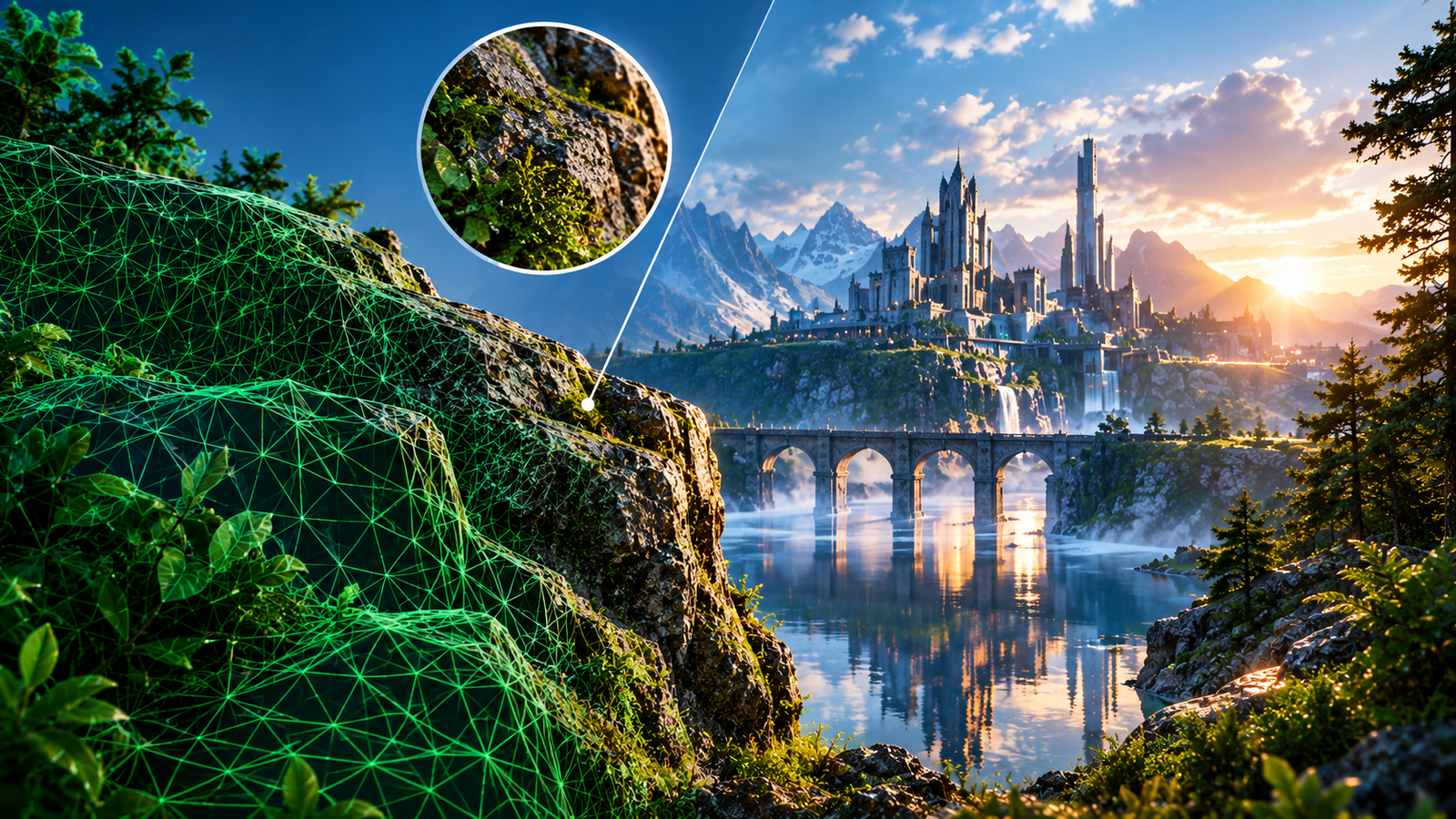
RTX Mega Geometry addresses this challenge by improving how highly detailed geometry is prepared for ray-traced rendering. NVIDIA describes the technology as a way to accelerate BVH construction and enable substantially more ray-traced triangles in demanding scenes. (NVIDIA Developer)
The technology is especially interesting alongside Unreal Engine’s Nanite virtualized geometry system. Instead of treating detailed geometry and ray tracing as separate problems, RTX Mega Geometry provides a path toward using much more of that geometry directly in ray-traced effects.
This article explains RTX Mega Geometry, how it works, how it relates to Nanite, what NVIDIA Blackwell brings to the ecosystem, and why the technology could matter for future real-time rendering.
What Is RTX Mega Geometry?
RTX Mega Geometry is a graphics technology from NVIDIA designed to make extremely detailed geometry more practical for ray-traced scenes.
Traditional rasterized rendering can handle huge amounts of geometry using techniques such as level-of-detail systems, culling, and virtualized geometry. Ray tracing introduces another requirement: the GPU needs acceleration structures that help determine which geometry a ray can intersect.
For very complex scenes, continuously rebuilding or updating those structures can become expensive.
NVIDIA’s approach organizes detailed meshes into geometry clusters and accelerates the construction and updating of the structures used for ray tracing. NVIDIA says its RTX Mega Geometry technology can enable up to 100x more ray-traced triangles with better performance in heavily ray-traced scenes.
That does not mean every game automatically becomes 100 times faster. Instead, the figure describes the potential increase in ray-traced geometric capacity enabled by the technology.
The important idea is simple:
RTX Mega Geometry makes it more practical to ray trace highly detailed geometry instead of relying heavily on simplified representations.
This matters because geometric detail directly affects the accuracy of shadows, reflections, indirect lighting, and path-traced effects.
How RTX Mega Geometry Works
The technical foundation of RTX Mega Geometry revolves around managing massive amounts of geometry efficiently.
Geometry Clustering and BVH Construction
Ray tracing commonly relies on bounding volume hierarchies, or BVHs, to organize geometry so rays can be tested efficiently.
A scene containing millions or billions of triangles cannot simply be treated as one enormous unstructured collection. The geometry must be organized into structures that allow the GPU to quickly determine which objects and triangles need to be considered.
RTX Mega Geometry organizes geometry into clusters and accelerates BVH-related operations. NVIDIA says this approach can dramatically increase the amount of geometry available to ray tracing.
Streaming Level-of-Detail Geometry
Another important concept is streaming.
Large environments cannot necessarily keep every possible level of geometric detail active in every location at every moment. The renderer needs to manage what is needed based on the scene and camera.
RTX Mega Geometry 2.0 adds support for streaming continuous level-of-detail clusters for high-density meshes, according to NVIDIA’s developer information.
This is particularly important for large environments because geometric detail can change continuously as the player moves through a world.
More Triangles in the Ray-Tracing Scene
The practical objective is to make more detailed geometry available to ray tracing.
With traditional approaches, a highly detailed object may be rendered with significant geometric detail on screen while ray-traced effects use a simplified representation.
RTX Mega Geometry is designed to reduce that gap.
That can produce more accurate results when detailed objects cast shadows, appear in reflections, or contribute to path-traced lighting.


RTX Mega Geometry vs Nanite
RTX Mega Geometry and Nanite are closely related concepts, but they are not the same technology.
Nanite is Unreal Engine’s virtualized geometry system. Epic describes Nanite as a system designed to manage extremely detailed meshes while automatically handling geometric detail and level of detail. (Epic Games Developers)
What Nanite Does
Nanite allows developers to work with highly detailed assets without manually creating traditional levels of detail for every object.
This is particularly useful for:
- Large environments
- Rocks and terrain
- Buildings
- Foliage
- Props
- Dense architectural scenes
- Highly detailed scanned assets
For traditional rendering, Nanite can efficiently determine the geometric detail required for the current view.
Where Traditional Nanite Ray Tracing Has Limitations
Ray tracing historically created a complication.
Epic’s documentation explains that ray tracing against Nanite meshes has traditionally relied on a fallback mesh, which can contain fewer triangles than the original Nanite geometry. This can produce differences between the visible object and the geometry used by ray-traced effects.
Imagine a highly detailed tree.
The player sees thousands of leaves and branches, but the ray-traced representation may contain substantially less geometric detail.
The result can be:
- Incomplete shadows
- Simplified reflections
- Missing small objects
- Less accurate occlusion
- Visual artifacts
How RTX Mega Geometry Complements Nanite
This is where RTX Mega Geometry becomes particularly interesting.
NVIDIA explains that its technology is intended to make full-fidelity ray tracing of Nanite-style geometry more practical. So the relationship can be summarized as:
| Technology | Primary role |
| Nanite | Efficiently manages extremely detailed virtualized geometry |
| RTX Mega Geometry | Makes large amounts of that geometry more practical for ray tracing |
| Ray tracing | Uses geometry to calculate realistic lighting interactions |
| GPU architecture | Provides the hardware needed to process the workload |
Rather than replacing Nanite, RTX Mega Geometry can be viewed as a complementary technology for ray-traced rendering.
7 Major Benefits of RTX Mega Geometry
1. Higher Geometric Detail
The most obvious benefit of RTX Mega Geometry is the ability to expose more geometric detail to ray-traced effects.
Small objects that might previously have been simplified can potentially contribute more accurately to shadows and reflections.
This is especially valuable for scenes containing:
- Dense foliage
- Rocks
- Detailed architecture
- Small environmental objects
- Complex props
- High-resolution scanned assets
The result can be a closer relationship between what the camera sees and what the ray-tracing system actually calculates.
2. More Accurate Ray-Traced Shadows
Shadows depend heavily on the geometry available to the ray-tracing system.
If a tree is represented using a simplified mesh, the resulting shadow can look different from the actual tree.
With more detailed geometry, RTX Mega Geometry can improve the representation of small branches, leaves, objects, and other details.
NVIDIA demonstrated this advantage in Gears of War: E-Day, where RTX Mega Geometry increases geometric detail available to ray tracing and improves the accuracy of shadows
3. Better Reflections
Reflections are another area where geometry matters.
A reflective surface can only show details that exist in the ray-traced scene.
If a ray-traced reflection uses simplified geometry, the reflection may omit small objects or surface details that are visible directly.
RTX Mega Geometry can allow reflections to use substantially more detailed geometry.
This is particularly useful for:
- Wet surfaces
- Glass
- Polished metal
- Mirrors
- Vehicles
- Indoor environments
NVIDIA’s Gears of War: E-Day demonstrations show ray-traced reflections benefiting from higher-detail Nanite geometry.
4. Improved Dense Foliage Rendering
Foliage is one of the hardest problems for real-time ray tracing.
A forest can contain enormous numbers of leaves, branches, plants, and trees. Many of these objects can also move because of wind or animation.
NVIDIA has been developing an RTX Mega Geometry foliage system specifically for these workloads.
The company says the system uses partitioned top-level acceleration structures to handle massive quantities of animated foliage for path tracing.
This could have major implications for open-world games.
Instead of treating foliage as mostly decorative geometry, future rendering systems can potentially incorporate much more of it into ray-traced lighting calculations.
5. Faster BVH Updates
A major advantage of RTX Mega Geometry is not simply having more triangles. The technology also addresses the cost of managing those triangles.
NVIDIA’s RTX Kit describes Mega Geometry as a technology for accelerating BVH building for cluster-based geometry systems.
This is important because ray-traced scenes can change continuously.
Characters move.
Vehicles move.
Foliage moves.
Objects can break.
Buildings can change.
Lighting can change.
The acceleration structure must therefore remain useful as the scene changes.
Reducing the cost of these updates creates more headroom for complex ray-traced scenes.
6. Better Large-World Rendering
Large worlds create a difficult combination of problems: distance, geometry density, streaming, memory, and ray tracing.
RTX Mega Geometry can contribute to this workflow by allowing geometry to be organized and streamed more efficiently.
This is especially relevant to open-world games where the player can move through forests, cities, interiors, and outdoor environments without traditional loading boundaries.
The technology does not eliminate all memory or performance limitations. Developers still need appropriate asset management, culling, streaming, and GPU optimization.
However, it provides another mechanism for handling geometric complexity.
7. Greater Potential for Real-Time Path Tracing
Path tracing is significantly more demanding than conventional rendering because it can involve many rays and lighting interactions.
More detailed geometry therefore increases the workload.
RTX Mega Geometry is designed to make high-density geometry more practical for ray-traced and path-traced workloads.
NVIDIA says the technology can support full-fidelity path tracing with advanced geometric detail and real-time tessellation.
That could help narrow the gap between offline-quality rendering and real-time graphics.
RTX Mega Geometry and NVIDIA Blackwell
The development of RTX Mega Geometry is closely connected to modern NVIDIA GPU architecture.
NVIDIA RTX and GPU Architecture
NVIDIA RTX GPUs provide hardware acceleration for ray tracing, while newer architectures continue to add capabilities aimed at increasingly complex real-time graphics.
NVIDIA describes Blackwell as an architecture combining AI, ray tracing, and neural graphics capabilities.
For developers, this means GPU architecture is becoming increasingly important to the rendering pipeline.
Performance is no longer determined only by shader throughput.
Modern real-time rendering can depend on:
- Ray-tracing acceleration
- Memory bandwidth
- VRAM capacity
- Tensor acceleration
- BVH processing
- Geometry management
- AI-assisted rendering
- Neural graphics
Why Blackwell Matters
Blackwell GPUs are designed for demanding AI and graphics workloads, including real-time ray tracing.
NVIDIA’s Blackwell architecture documentation specifically describes Mega Geometry as a technology aimed at increasing geometric detail in ray-traced applications.
However, developers should avoid assuming that RTX Mega Geometry is exclusively a “Blackwell feature.” The technology is part of NVIDIA’s broader RTX ecosystem and RTX Kit.
What Developers Should Know About Hardware
GPU support is only one part of the equation.
A developer considering RTX Mega Geometry should also evaluate:
- VRAM requirements
- Unreal Engine version
- RTX SDK integration
- Ray-tracing workload
- Scene complexity
- Streaming requirements
- Target frame rate
- Target resolution
For example, NVIDIA states that Gears of War: E-Day requires a GeForce RTX GPU with at least 12GB of VRAM to enable RTX Mega Geometry.
That requirement is game-specific and should not be interpreted as a universal minimum for every RTX Mega Geometry implementation.
RTX Mega Geometry in Unreal Engine
Unreal Engine is one of the most important environments for this technology because Nanite is already deeply integrated into the engine’s rendering workflow.
Epic’s documentation explains that Nanite supports highly detailed virtualized geometry, while hardware ray tracing has historically had limitations around Nanite meshes and fallback representations.
NVIDIA also provides an RTX branch of Unreal Engine containing experimental RTX Mega Geometry functionality for real-time path tracing of Nanite geometry.
Developers interested in real-time graphics can also compare this technology with broader game-engine rendering workflows. For background, Eduonix’s Top 5 Game Development Engines comparison discusses Unreal Engine, Unity, Godot, and other development environments.
Another useful introductory resource is Eduonix’s Complete Guide to Unreal Engine, particularly for readers who want to understand how Unreal’s broader development environment fits into modern game creation.
RTX Mega Geometry for Unreal Engine Workflows
The workflow can involve several layers:
- Artists create detailed assets.
- Nanite manages virtualized geometry.
- The renderer determines appropriate geometric detail.
- RTX Mega Geometry organizes geometry for ray-traced workloads.
- The GPU builds and updates acceleration structures.
- Ray tracing uses the geometry for lighting calculations.
This pipeline allows developers to think about geometry as a continuously managed resource rather than a static collection of meshes.
RTX Mega Geometry Games and Real-World Examples
The strongest way to understand RTX Mega Geometry is to examine where it is being used.
Alan Wake 2
NVIDIA has highlighted Alan Wake 2 as an early application of RTX Mega Geometry.
According to NVIDIA, Remedy Entertainment applied the technology to existing assets in Alan Wake 2, with reported improvements including a 5–20% FPS increase and a 300 MB reduction in VRAM usage in the cited implementation. (NVIDIA Developer)
The game is particularly relevant because its environments use demanding path-traced lighting and dense vegetation.
Gears of War: E-Day
Gears of War: E-Day provides another major example.
NVIDIA says the game uses Unreal Engine 5, Nanite, ray tracing, and RTX Mega Geometry. The technology allows more detailed geometry to participate in ray-traced shadows and reflections.
NVIDIA’s demonstrations show improvements involving objects such as foliage, rocks, vehicles, small props, and other environmental details.
Future Foliage and Open-World Applications
The future may be even more interesting.
NVIDIA has announced work with CD PROJEKT RED on an RTX Mega Geometry foliage system for The Witcher 4. The objective is to make dense, detailed foliage more practical for path-traced environments.
This could make forests and other natural environments substantially more important to the ray-traced scene rather than treating them as simplified background elements.
For developers learning about modern graphics programming more broadly, CodeCondo’s What Is WebAssembly and how it is changing web development is also useful background on performance-intensive applications and browser-based graphics workloads.
CodeCondo’s Top 5 Exciting Tech Products launched in 2024 provides broader hardware and technology context, although it is not specifically about RTX Mega Geometry.
Is RTX Mega Geometry Worth It?
For developers working with highly detailed ray-traced environments, RTX Mega Geometry is a significant development.
However, it should not be viewed as a universal performance switch.
Its value is greatest when a project has:
- Very detailed geometry
- Heavy ray tracing
- Dense foliage
- Large environments
- Nanite assets
- Path-traced lighting
- Complex reflections
- Frequently changing geometry
For simpler games, the additional complexity may not provide a meaningful benefit.
Developers also need to consider hardware requirements and compatibility.
The technology is most interesting when the goal is not simply higher polygon counts, but higher-quality ray-traced geometry without making acceleration-structure management prohibitively expensive.
For players, the biggest benefit is potentially visual.
For developers, the bigger benefit is flexibility.
Instead of choosing between extremely detailed rasterized geometry and simplified ray-traced geometry, developers can move closer to a workflow where the two representations are much more closely aligned.
Frequently Asked Questions
What is RTX Mega Geometry?
RTX Mega Geometry is an NVIDIA technology designed to accelerate the management of highly detailed geometry for ray-traced scenes. It uses clustered geometry and accelerated BVH construction to make substantially more ray-traced triangles practical.
Is RTX Mega Geometry the same as Nanite?
No. Nanite is Unreal Engine’s virtualized geometry system, while RTX Mega Geometry is an NVIDIA technology focused on making high-density geometry more practical for ray tracing. The two technologies can work together.
Does RTX Mega Geometry improve ray tracing?
It can improve the quality and scalability of ray tracing by allowing more detailed geometry to participate in ray-traced effects. This can produce more accurate shadows, reflections, and other lighting effects.
Which GPUs support RTX Mega Geometry?
Support depends on the specific implementation, game, driver, SDK, and hardware. For example, NVIDIA states that Gears of War: E-Day requires a GeForce RTX GPU with at least 12GB of VRAM for its RTX Mega Geometry feature.
Therefore, users should check the requirements of the specific game or application rather than assuming that every RTX GPU offers identical support.
Is RTX Mega Geometry available in Unreal Engine?
Yes. NVIDIA provides RTX-related Unreal Engine development resources, including an RTX branch with experimental RTX Mega Geometry functionality for real-time path tracing of Nanite geometry.
Developers should check the current NVIDIA and Epic documentation for supported engine versions and implementation requirements.
Conclusion
RTX Mega Geometry represents an important step in the evolution of real-time ray tracing.
The central problem is straightforward: modern games are using increasingly complex geometry, while ray tracing needs efficient acceleration structures to process that geometry. Traditional approaches can force developers to use simplified representations for ray-traced effects.
RTX Mega Geometry tackles this challenge by improving geometry organization, BVH construction, and the management of high-density meshes.
Its relationship with Nanite is particularly important. Nanite makes massive amounts of geometric detail practical for modern game engines, while RTX Mega Geometry helps make more of that detail available to ray-traced rendering.
The technology can improve:
- Geometric fidelity
- Ray-traced shadows
- Reflections
- Dense foliage
- BVH updates
- Large-world rendering
- Real-time path tracing
NVIDIA’s work with games such as Alan Wake 2 and Gears of War: E-Day demonstrates that this is moving beyond a theoretical concept.
As GPU architecture, game engines, and ray-tracing APIs continue to evolve, RTX Mega Geometry could become an important part of how developers build highly detailed real-time worlds.
The bigger story is not simply about adding more triangles. It is about making high geometric detail and real-time ray tracing work together efficiently.