
Introduction
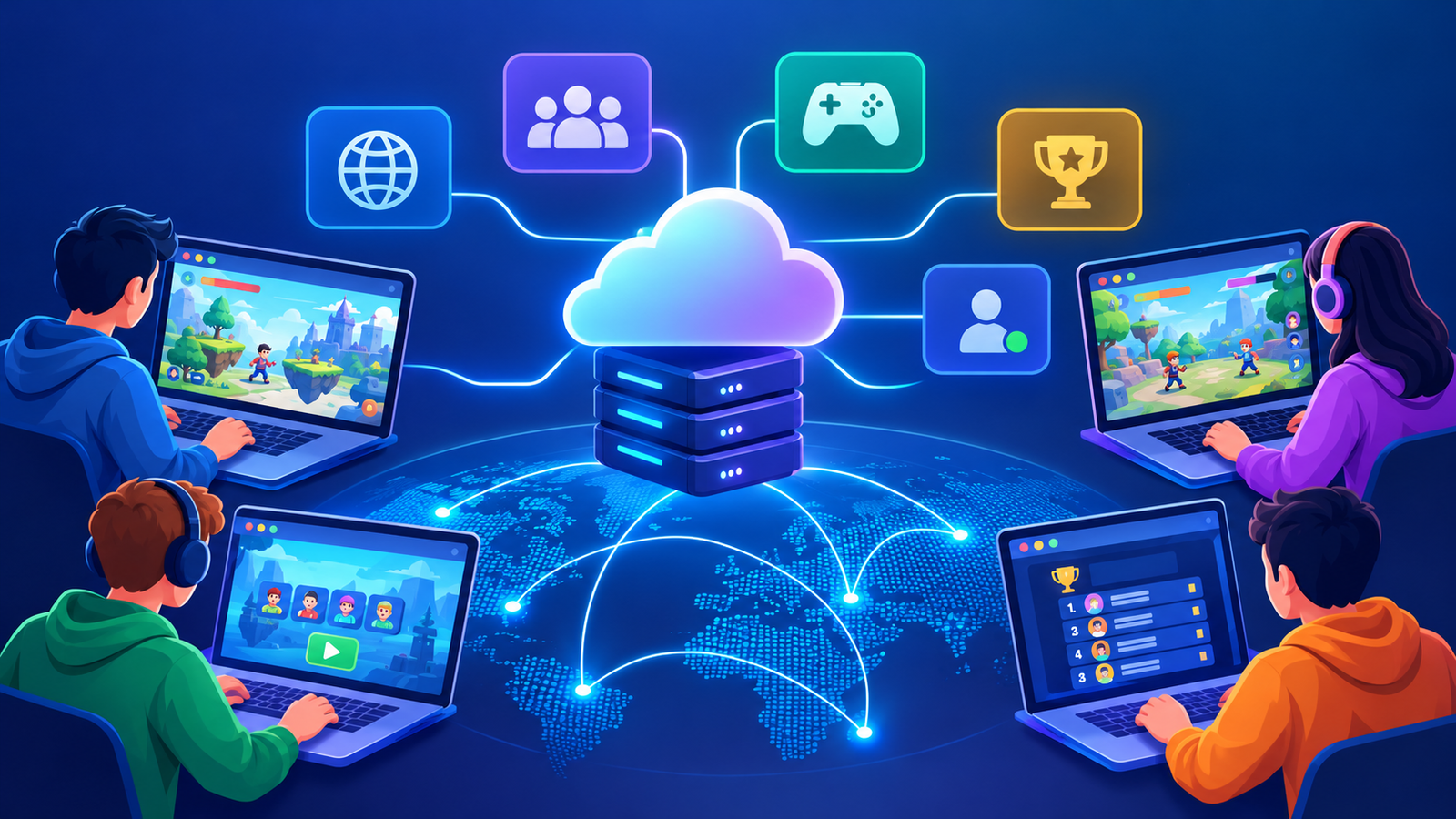
Browser games have evolved beyond single-player experiences. Players increasingly expect multiplayer rooms, live leaderboards, instant matchmaking, and presence indicators that show who is online. Building these features traditionally required maintaining game servers, managing connections, and scaling infrastructure as player activity increased.
Serverless Real-Time architecture offers another approach. By combining edge computing, managed execution environments, and lightweight stateful services, developers can create responsive multiplayer features without managing an entire fleet of servers.
For indie developers and small studios, this approach can reduce infrastructure maintenance while making it easier to experiment with multiplayer gameplay. However, serverless systems still require careful decisions about latency, state consistency, security, and cost.
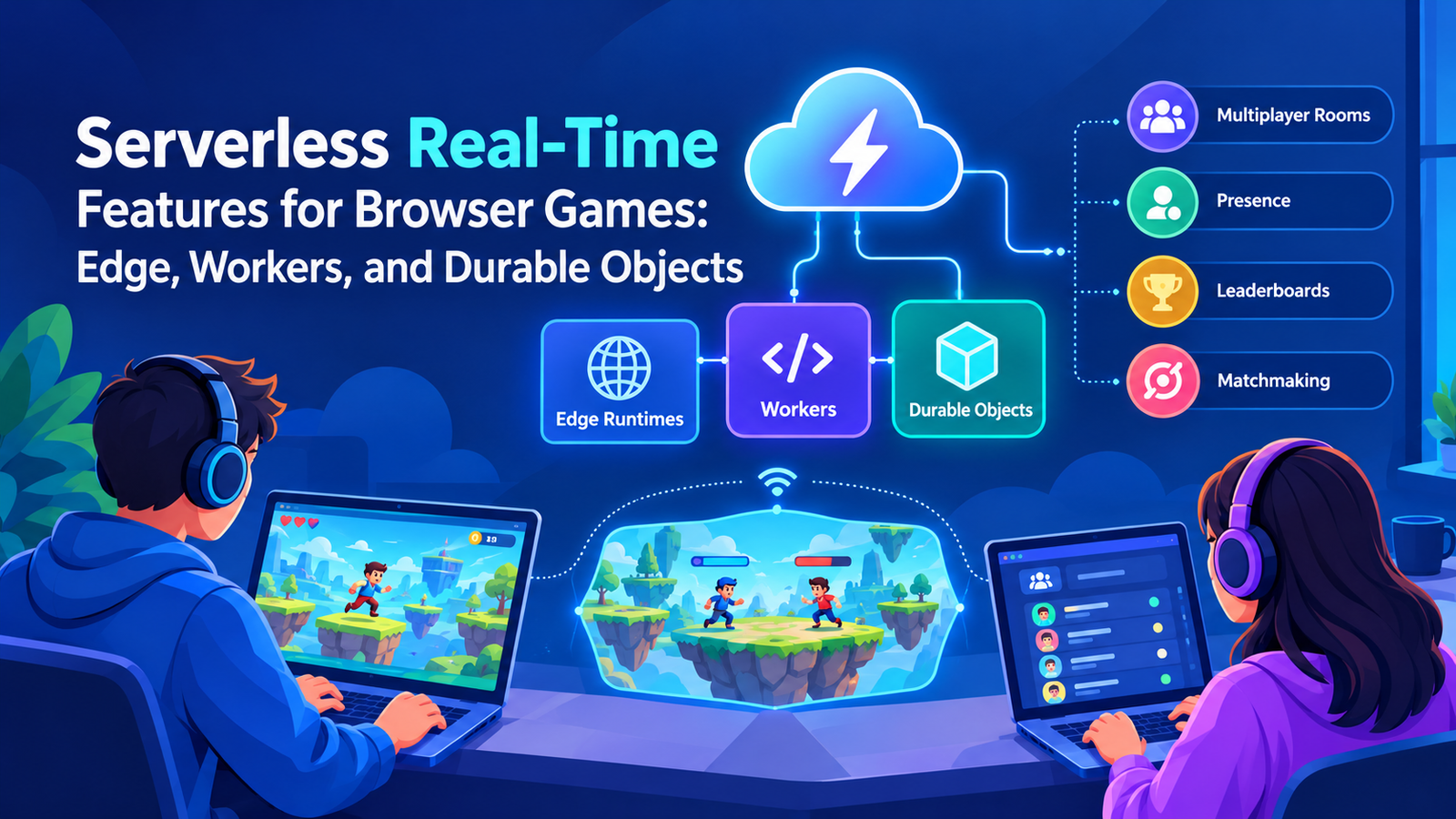
This guide explains how to use Cloudflare Workers, Durable Objects, and other serverless technologies to build practical real-time features for browser games.
Serverless Real-Time architecture is becoming an effective choice for developers who want to build responsive browser games without managing complex server infrastructure. By combining edge computing, managed cloud functions, and stateful coordination, Serverless Real-Time systems make it easier to support multiplayer rooms, live player interactions, and synchronized game events. This approach allows indie developers to focus more on gameplay while maintaining a flexible backend.
1. What Is Serverless Real-Time Architecture?
Serverless Real-Time architecture uses managed cloud services to process events, coordinate player activity, and deliver updates without requiring developers to operate conventional application servers directly.
The term serverless does not mean that servers disappear. Instead, the infrastructure provider manages much of the provisioning, scaling, and maintenance.
A browser game might use serverless services for:
- Player login and session validation.
- Matchmaking and room creation.
- Online-player lists and presence indicators.
- Shared game state and turn management.
- Score submission and leaderboard updates.
- Notifications when players join or leave a match.
These features have different performance requirements. A turn-based strategy game can tolerate more delay than a competitive action game where every movement matters.
A useful Serverless Real-Time design therefore separates gameplay responsibilities instead of sending every event through the same backend service.
Stateless functions versus stateful coordination
Stateless functions process requests without retaining authoritative application state between executions. They work well for validating requests, retrieving profiles, and submitting completed scores.
Stateful coordination is different. A multiplayer room needs a shared place to track connected players, current turns, and accepted actions.
That is where technologies such as Cloudflare Durable Objects become useful. They provide persistent, addressable coordination for workloads that need shared state and controlled access.
A serverless application example might involve a player entering a room, receiving the current game state, and sending an action that the backend validates before broadcasting the result.
For indie studios, this model can simplify deployment and reduce operational overhead. It also fits the broader growth of independent development discussed in The Rise of Indie Game Developers.
2. How Edge Computing Supports Browser Games
Edge computing runs application logic closer to users through geographically distributed infrastructure. Instead of sending every request to a single distant server, an edge platform can process suitable requests nearer to the player.
For browser games, this can improve responsiveness for room discovery, authentication checks, matchmaking requests, and other short interactions.
However, proximity alone does not guarantee low latency. Network routing, database location, persistent connections, and the amount of work performed by each request all affect the final experience.
Serverless Real-Time architecture helps developers build responsive browser games by combining distributed computing with efficient backend communication. With Serverless Real-Time services, developers can process player requests, manage multiplayer connections, and deliver game events through scalable cloud infrastructure. This approach reduces infrastructure management and makes it easier to support players connecting from different geographical regions.
Understanding Cloudflare Workers
Cloudflare Workers are a serverless execution platform for running application logic across Cloudflare’s network. Developers can use them to process HTTP requests, validate player actions, and connect browser clients to backend services.
Typical game-development uses include:
- Creating and joining multiplayer rooms.
- Validating requests before they reach game-state services.
- Applying rate limits to prevent request abuse.
- Coordinating matchmaking and session management.
- Serving game configuration and public leaderboard data.
Workers are particularly useful when the backend needs to handle many small, independent operations. For stateful multiplayer rooms, they can work alongside Durable Objects.
Where WebSockets fit
HTTP requests are useful for discrete operations, but games often need persistent, bidirectional communication. WebSockets allow the browser and server to exchange messages over an established connection.
For example, a room service can broadcast a player’s arrival to everyone already connected. The server can also distribute validated moves, countdown events, and round-completion notifications.
Developers building browser-based graphics experiences can explore WebGPU and WebAssembly browser games for the client-side rendering and computation side of the architecture.
The key is to use edge execution where it helps, rather than assuming that every physics update or frame must pass through a remote service.
3. Building Multiplayer Rooms with Cloudflare Workers
A multiplayer room is a shared environment in which players connect, submit actions, and receive updates. Its backend must determine which actions are valid and what the current game state should be.
This is where Cloudflare Workers and Durable Objects can complement each other.
Workers can handle incoming requests and route clients to the appropriate service. A Durable Object can coordinate the state of a specific room, including connected participants and the sequence of accepted actions.
Why Durable Objects matter
A Durable Object provides a unique identity and storage capabilities for coordinating related work. A game can assign one object to each room, giving that room a consistent place to manage shared state.
This approach is useful for:
- Turn-based board games.
- Cooperative puzzle rooms.
- Small arena games.
- Lobby systems and ready checks.
- Race sessions and score challenges.
It avoids the complexity of having multiple independent function executions update the same room state without coordination.
Establishing an authoritative game room
An authoritative backend decides which gameplay actions are accepted. The browser sends an intention, such as moving a character or placing a game piece, rather than dictating the final result.
The server validates that intention against the current game state. If the action is legal, it updates the state and sends the result to connected players.
A simplified message flow looks like this:
- The browser requests access to a room.
- The backend verifies the player’s identity and permissions.
- The room coordinator accepts the connection.
- The player submits an action.
- The server validates the action and updates authoritative state.
- Connected players receive the resulting event.
This structure reduces opportunities for cheating because clients cannot simply declare their own scores or overwrite shared state.
Example: validating a turn-based action
The following pseudocode illustrates the server-side decision process. It is language-neutral pseudocode rather than a complete Cloudflare deployment implementation.
// Initial multiplayer game state
const gameState = {
players: ["player1", "player2"],
currentTurn: "player1",
moves: []
};

// Check whether the player belongs to the room
function isPlayerInRoom(state, playerId) {
return state.players.includes(playerId);
}

// Validate the submitted move
function isLegalMove(move) {
return typeof move === "string" && move.trim().length > 0;
}

// Apply the move to the game state
function applyMove(state, move) {
state.moves.push(move);
return state;
}

// Switch to the next player's turn
function nextPlayer(state) {
const currentIndex = state.players.indexOf(state.currentTurn);
return state.players[(currentIndex + 1) % state.players.length];
}

// Mock multiplayer room
const room = {
state: gameState,

async loadState() {
return {
...this.state,
players: [...this.state.players],
moves: [...this.state.moves]
};
},

async saveState(state) {
this.state = state;
},

broadcast(message) {
console.log("Broadcasting:", message);
}
};

// Submit a multiplayer move
async function submitMove(room, player, move) {
let state = await room.loadState();

if (!isPlayerInRoom(state, player.id)) {
throw new Error("Player is not in this room");
}

if (state.currentTurn !== player.id) {
throw new Error("Not this player's turn");
}

if (!isLegalMove(move)) {
throw new Error("Invalid move");
}

state = applyMove(state, move);
state.currentTurn = nextPlayer(state);

await room.saveState(state);

room.broadcast({
type: "move-accepted",
state: state
});

return state;
}

// Run the example
async function main() {
try {
const player = { id: "player1" };
const move = "Move character forward";

const result = await submitMove(room, player, move);

console.log("\nUpdated Game State:");
console.log(JSON.stringify(result, null, 2));

} catch (error) {
console.error("Error:", error.message);
}
}

main();
The example demonstrates the essential sequence: verify membership, check turn ownership, validate the move, save the updated state, and broadcast the accepted result. A production implementation must also handle concurrent messages, reconnects, persistence failures, authorization, and message validation.
For competitive real-time games, developers should evaluate whether their chosen runtime and networking model can meet the required update frequency. A turn-based room is considerably easier to support than a fast-paced shooter.

4. Implementing Player Presence and Matchmaking
Presence tells players who is online, who is waiting, and who is currently participating in a match. It supports familiar features such as friends lists, lobby rosters, party invitations, and ready indicators.
A browser game should not treat a successful login as proof that a player remains online. Network interruptions, closed tabs, suspended devices, and browser crashes can all leave stale presence records.
A reliable Serverless Real-Time backend helps browser games maintain smooth communication between connected players. Developers can use managed services to track online sessions, coordinate matchmaking requests, and deliver important gameplay notifications. With Serverless Real-Time technology, even smaller development teams can build multiplayer experiences that support changing player activity without operating a large dedicated server fleet.
Designing reliable presence
A practical presence system can combine connection events with timestamps or expiring leases.
When a player connects, the backend records the session. Periodic heartbeats can indicate that the client remains active. When a connection closes, the service attempts to remove the session. A timeout provides a fallback when the disconnection event never arrives.
For multiple devices or tabs, track sessions separately so that closing one connection does not incorrectly mark the entire account offline.
A serverless architecture can support this pattern through stateful room coordinators and managed data stores. Keep presence updates lightweight, because frequent writes from large numbers of connected players can increase cost.
Matchmaking without unnecessary complexity
Matchmaking groups suitable players before a session begins. For a small game, a waiting-room queue might be enough. More advanced games can match players by skill, region, party size, or expected wait time.
A simple workflow is:
- Validate the player’s session.
- Add the player to a suitable queue.
- Check whether enough eligible players are available.
- Reserve a room and assign participants.
- Notify players and remove their queue entries.
The backend must prevent the same player from being assigned to several matches simultaneously. Room creation and queue updates should be coordinated carefully to avoid duplicate assignments.
Cloudflare Workers can handle queue requests, while Durable Objects can coordinate a room or another shared resource. A database may store longer-lived player profiles, match history, and statistics.
5. Creating Real-Time Leaderboards
Leaderboards give players a reason to return, compete, and improve. They can display daily scores, weekly rankings, tournament results, or rankings among friends.
The main challenge is not displaying a list. It is accepting trustworthy scores while keeping updates efficient as participation grows.
Serverless Real-Time technology also makes leaderboard synchronization easier by connecting verified score updates with active multiplayer sessions. Developers can use Serverless Real-Time services to distribute ranking changes, notify players about new achievements, and keep tournament results updated. This creates a more engaging browser gaming experience without requiring every leaderboard request to trigger a complete backend refresh.
Separate score validation from ranking queries
A browser client should never be trusted to submit an arbitrary score as authoritative truth. For a puzzle game, the backend might validate completion time and move count. For a competitive game, it may need to verify the match result using server-controlled state.
A robust workflow includes:
- Accept a score submission tied to an authenticated player and match.
- Verify that the match is complete and the score is plausible.
- Prevent duplicate submissions using a unique match identifier.
- Store the validated result.
- Update the relevant leaderboard.
- Notify connected clients if a live ranking change is needed.
The leaderboard database should be designed for its query patterns. A small game might use a managed SQL or key-value store. Larger systems may need separate write processing, ranking indexes, caching, and scheduled aggregation.
Making leaderboard updates feel live
Real-time data processing can update connected players when a new verified score changes the rankings. The system does not necessarily need to broadcast every database write to every user.
For example, a room can receive immediate score updates during a tournament, while the global leaderboard refreshes periodically or when a player opens the rankings page.
This distinction helps balance responsiveness against infrastructure cost.
Use separate leaderboards for different periods or game modes when appropriate. Define tie-breaking rules, handle suspicious results, and preserve an audit trail for competitive events.
For casual browser games, the goal is to make rankings feel responsive without allowing client-side manipulation to undermine fair competition.
6. Choosing Between Firebase, Vercel, and Cloudflare
Different serverless platforms solve overlapping but distinct problems. Choosing one depends on whether the game needs persistent connections, coordinated room state, managed data synchronization, or a broader web application deployment workflow.
Cloudflare Workers and Durable Objects
Cloudflare Workers can execute backend logic close to users, while Durable Objects provide coordination for stateful workloads. This combination is a strong candidate for browser games that need room-based communication, presence, and authoritative session state.
Review the official Cloudflare Workers documentation and Durable Objects documentation before designing the system.
Cloudflare also offers Workers AI, which may support optional features such as AI-generated game dialogue or non-critical content assistance. The Cloudflare Workers AI API and its available models are separate considerations from the real-time game networking architecture. An AI response should not sit in the critical path of a latency-sensitive gameplay action unless the design explicitly supports that delay.
Firebase Cloud Functions
Firebase Cloud Functions runs backend code in response to events and requests within the Firebase ecosystem. It can be useful for account-related operations, score processing, notifications, and game services that integrate with Firebase Authentication or supported databases.
Firebase’s other products may provide real-time data synchronization, but Cloud Functions alone should not be assumed to provide the same room-coordination model as a dedicated stateful service.
Read the official Firebase Cloud Functions documentation and assess the complete Firebase services you plan to use.
Vercel Functions
Vercel Functions are designed to run backend logic alongside applications deployed through Vercel. They can support account endpoints, match history, tournament administration, and other web application features.
For persistent multiplayer connections and authoritative game rooms, verify the platform’s current runtime and connection capabilities before committing to the architecture. A function endpoint is not automatically a replacement for a continuously connected game server.
Consult the official Vercel Functions documentation.
Comparison table
| Capability | Cloudflare Workers + Durable Objects | Firebase Cloud Functions | Vercel Functions |
| Typical strength | Edge logic and coordinated room state | Event-driven backend integrated with Firebase | Backend functions alongside web apps |
| Multiplayer room coordination | Durable Objects can coordinate shared room state | May require additional Firebase services or a separate coordinator | May require a separate stateful service |
| Player presence | Can coordinate sessions and room connections | Can use appropriate Firebase data and event services | Usually requires a separate state store or service |
| Leaderboards | Can validate and route score updates with a suitable database | Useful for event-driven score processing with a suitable database | Useful for score APIs and web application workflows |
| Best fit | Room-based browser games with stateful coordination | Games already using Firebase services | Games with a Vercel-hosted web application |
The best solution is the one that fits the game’s communication pattern and operational requirements. Teams should compare connection limits, data consistency, deployment regions, observability, and pricing before making a final decision.
7. Performance, Security, and Cost Considerations
A serverless design can reduce server administration, but it does not automatically make a game fast, secure, or inexpensive.
When implementing Serverless Real-Time features, developers should monitor network performance, concurrent connections, and backend resource consumption. Serverless Real-Time infrastructure can help manage changing player demand, but efficient message handling and secure state management remain essential. Testing these areas before launch helps ensure that multiplayer rooms, matchmaking, and live updates remain reliable as the player base grows.
Keep latency-sensitive work small
Avoid unnecessary database queries inside frequently executed gameplay handlers. Cache safe, reusable data and keep room messages compact. Place stateful coordination close to the relevant players where the platform supports it, while accounting for the location of persistent storage.
For competitive action games, measure actual round-trip latency and jitter from target regions. A traditional dedicated server or specialized game-hosting solution may be more appropriate when the game requires highly frequent authoritative simulation.
Protect the game from abuse
Use authenticated sessions, room-level authorization, rate limits, input validation, and server-side score verification. Do not expose secret API keys in browser JavaScript or trust a client-provided player ID as proof of identity.
Cloudflare Workers AI API keys and other provider credentials should remain on trusted server-side systems. AI services should be treated as optional supporting capabilities, not as substitutes for authoritative gameplay logic.
Understand Cloudflare Workers cost
Cloudflare Workers cost depends on the plan, usage, execution, and applicable resource limits. Stateful room coordination, storage operations, outbound traffic, and persistent connections may introduce additional considerations.
Before launch, estimate:
- Concurrent players and rooms.
- Messages sent per player per minute.
- Average message size and broadcast fan-out.
- State reads and writes per action.
- Storage requirements and retention.
- Monitoring, abuse protection, and development environments.
Load-test realistic scenarios and monitor usage as player activity grows. Also review the current pricing and limits of the selected services rather than assuming that serverless means unlimited or free.
8. A Practical Implementation Roadmap
A small, controlled prototype is the most effective way to validate a Serverless Real-Time design.
Step 1: Start with one game mode. Choose a turn-based game, a cooperative puzzle, or a small lobby. Avoid beginning with a large matchmaking system and complex competitive simulation.
Step 2: Build the room lifecycle. Implement room creation, joining, leaving, and reconnection. Define what happens when the host disconnects or a player loses connectivity.
Step 3: Establish server authority. Keep the canonical game state on the backend. Validate each action before updating shared state, and define how duplicate or out-of-order messages are handled.
Step 4: Add presence and matchmaking. Introduce heartbeats, stale-session cleanup, and a simple queue. Test multiple tabs, reconnects, and simultaneous room requests.
Step 5: Add score validation. Record completed matches and reject duplicate or implausible submissions. Build the leaderboard around validated results rather than raw client messages.
Step 6: Test under realistic conditions. Simulate players from different regions, network interruptions, bursts of room creation, and high message volume. Measure latency, error rates, and costs.
Step 7: Expand carefully. Add tournaments, friends lists, analytics, or AI-assisted content only after the core multiplayer experience is reliable.
Developers comparing engines and web technologies can also explore Godot vs Unity when deciding how their client should communicate with a backend. Those who want to strengthen their development fundamentals can learn game development online while building a small end-to-end prototype.
Another advantage of Serverless Real-Time development is its flexibility when expanding multiplayer features. Developers can introduce new rooms, matchmaking options, player notifications, and leaderboard updates without redesigning the entire backend. By choosing suitable Serverless Real-Time services and monitoring resource usage, development teams can maintain a reliable gaming experience as their player communities grow.
Frequently Asked Questions
1. What is Serverless Real-Time architecture in browser games?
It is an approach that uses managed cloud services to process events, coordinate multiplayer state, and send live updates without requiring a team to manage conventional servers directly. Stateful coordination is still necessary when players share a game room.
2. Are Cloudflare Workers suitable for multiplayer games?
They can be suitable for room creation, request validation, matchmaking, and other backend operations. Combined with Durable Objects, they can also support coordinated room state. The best fit depends on the game’s latency, connection, and simulation requirements.
3. What is the role of Durable Objects in a browser game?
Durable Objects provide addressable stateful coordination. A game can use one to manage room membership, accepted actions, shared state, and communication among connected players.
4. Can Firebase Cloud Functions or Vercel Functions replace a game server?
They can handle many backend tasks, including score processing and application APIs. However, a game that requires persistent connections, frequent state updates, or authoritative simulation may need additional services or a specialized networking architecture.
5. Is serverless always cheaper than dedicated game servers?
No. Serverless can reduce infrastructure management and suit variable workloads, but high message volume, continuous connections, storage operations, and heavy computation can change the cost equation. Benchmark both approaches against realistic traffic.
Conclusion
Serverless Real-Time architecture gives browser-game developers a practical way to build multiplayer rooms, presence, matchmaking, and leaderboards without managing every part of the underlying infrastructure.
Cloudflare Workers can handle request-driven logic, while Durable Objects provide a useful model for coordinating stateful rooms. Firebase Cloud Functions and Vercel Functions can complement other game backends, particularly when teams already use those platforms for application services.
The right design depends on the game. Start with a small authoritative room, validate player actions on the server, add reliable presence, and build leaderboards from verified results. Then measure latency, scalability, security, and cost before expanding.
A carefully designed serverless backend can make real-time browser games easier to operate and evolve—but successful multiplayer experiences still depend on sound networking principles, disciplined testing, and a clear understanding of what must happen on the server.
Choosing the right Serverless Real-Time architecture requires balancing performance, scalability, and infrastructure costs. Developers should evaluate connection management, state synchronization, database performance, and regional latency before selecting a platform. A well-planned Serverless Real-Time implementation can support multiplayer rooms, player presence, matchmaking, and live leaderboards while keeping backend operations manageable.