

Introduction
AI is changing how software is designed, developed, tested, and delivered. Large language models can generate code in seconds, while AI coding agents can work across repositories, create files, run tests, identify errors, and make iterative changes. But faster code generation does not automatically mean better production software.
This is where spec-driven development with AI becomes important. Instead of giving an AI agent a short prompt and expecting it to understand an entire feature, developers first define what needs to be built, why it is needed, what constraints apply, and how success will be measured.
The specification then becomes a shared reference for both developers and AI agents. This approach combines the speed of AI-assisted coding with the discipline of software engineering, making it easier to move from requirements to tested and maintainable production code.
The specification then becomes a shared reference for both developers and AI agents. Spec-driven development with AI combines the speed of AI-assisted coding with the discipline of software engineering, making it easier to move from requirements to tested and maintainable production code.
Spec-Driven Development with AI gives developers a structured way to work with AI coding agents. By defining requirements, constraints, expected behavior, and acceptance criteria before implementation, developers can give AI agents clearer context and reduce misunderstandings during the development process. This approach helps connect AI-assisted coding with a more organized software development workflow.
How Spec-Driven Development With AI Agents Works
Spec-driven development with AI is a software development approach where structured specifications guide AI systems through planning, implementation, testing, and validation. Instead of treating the AI prompt as the complete definition of a task, developers create a detailed specification that describes the expected outcome.
GitHub’s Spec Kit documentation describes an SDD workflow built around specifying, planning, creating tasks, implementing, and converging on the intended result.
With Spec-Driven Development with AI, developers can provide AI agents with the requirements and constraints they need before implementation begins. The specification acts as a shared reference throughout planning, coding, testing, and validation, helping the agent stay aligned with the intended outcome.
The specification can include functional requirements, technical constraints, user expectations, acceptance criteria, edge cases, and testing requirements. The AI agent uses this information to understand the task before generating or modifying code.
This makes Spec-Driven Development with AI particularly useful for features that require consistency and repeatability.
How Spec-Driven Development Works
The basic process is:
Requirements → Specification → Plan → Tasks → Implementation → Testing → Validation
This makes specification driven development with AI different from simply asking an AI model to generate an application from a short prompt.
The goal is not to eliminate AI flexibility. Instead, the goal is to give AI systems enough context to make their implementation decisions within clearly defined boundaries.
Why Specifications Matter for AI Coding Agents
AI coding agents can perform multi-step tasks, but they still depend on the quality of the context they receive. A vague request can produce an implementation that technically works but does not match the actual product requirement.
A specification provides a more stable source of truth. When requirements change, developers can update the specification and use it to guide subsequent implementation and testing.
Why AI Agents Are Changing Software Development
The role of AI in software development is expanding beyond autocomplete and simple code suggestions. Modern agents can assist with coding, debugging, testing, refactoring, documentation, and repository-level tasks.
For a practical explanation of how AI coding agents differ from traditional AI workflows, see CodeCondo’s guide to AI Coding Agents. It explains how agents can handle coding-related tasks with greater autonomy.
The Rise of AI-Assisted Coding
AI-assisted coding allows developers to delegate repetitive implementation work to AI while maintaining control over architecture and engineering decisions.
AI can generate boilerplate, explain unfamiliar code, suggest fixes, create tests, and help developers explore different implementation approaches.
However, AI assistance works best when developers understand the code being generated and validate it before production use.
AI-assisted development is also becoming part of broader AI-powered development workflows, where developers combine coding assistants, AI agents, automated testing, debugging, and deployment tools. These workflows shift the focus from simply generating code to coordinating multiple AI capabilities throughout the software development lifecycle.
How LLMs Support Software Development
An LLM for software development can translate natural-language requirements into programming concepts and implementation ideas. Developers can use LLMs for code generation, debugging, documentation, testing, code explanation, and technical research.
When an LLM is connected to tools such as a repository, terminal, code editor, and testing environment, it can become part of an agentic workflow.
For developers exploring the wider ecosystem, Eduonix’s guide to AI tools for developers covers coding assistants, AI agents, code-generation tools, testing tools, and other development technologies.
From AI Coding Assistants to AI Agents
An AI coding assistant generally responds to a developer’s request, while an AI agent can perform multiple connected actions toward a defined objective.
An agent might inspect a repository, understand the relevant files, create an implementation plan, modify code, run tests, analyze failures, and iterate.
As agents become more capable, specifications become increasingly valuable because they define the objective the agent is working toward.
How Spec-Driven Development Works With AI Agents
A spec driven development with ai agents workflow gives the AI a structured path from requirements to implementation.
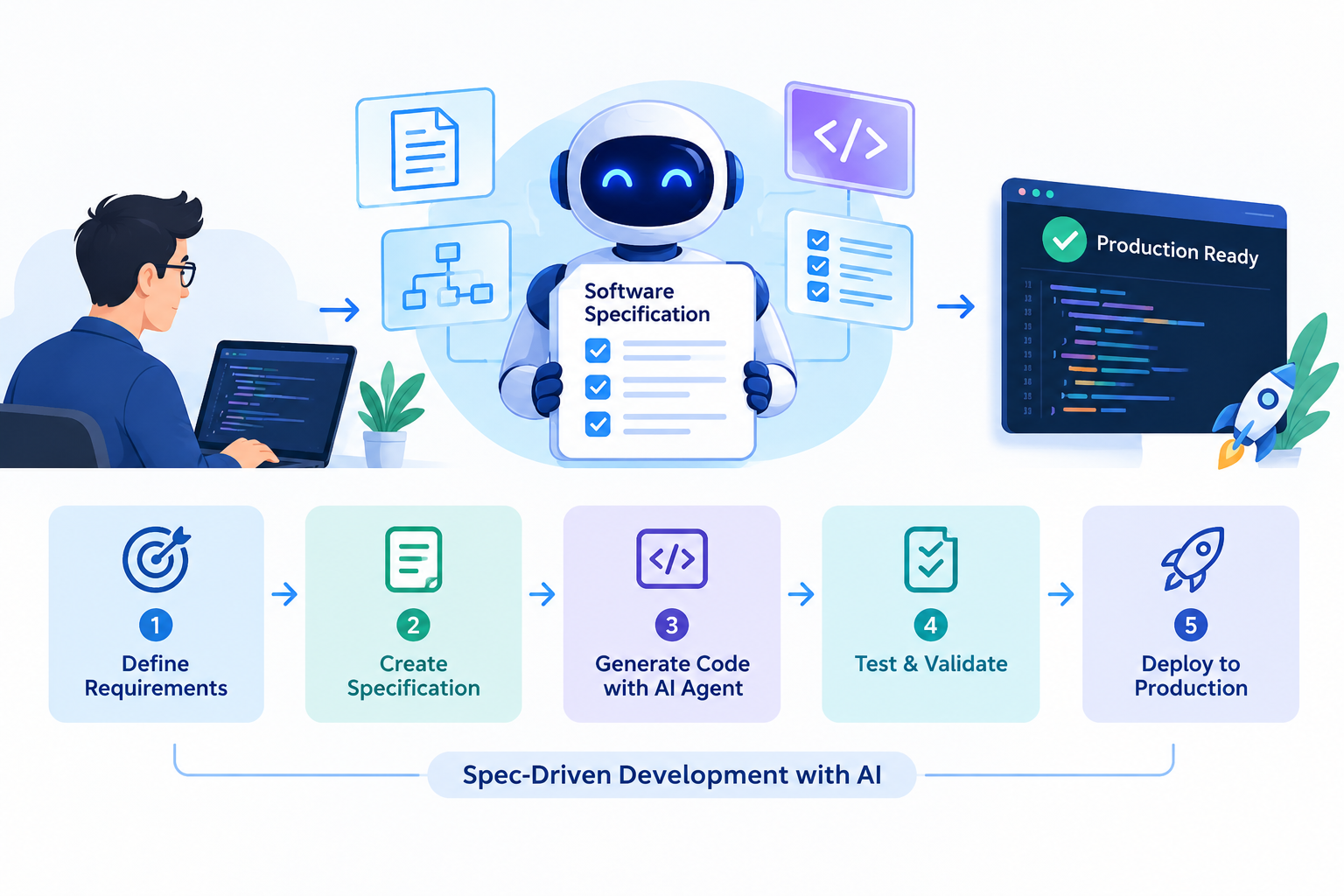

Define Requirements and Project Goals
Start by defining the problem. Identify the users, desired functionality, business rules, technical constraints, and expected outcomes.
For example, instead of asking an agent to “build a login system,” define authentication requirements, password rules, session behavior, error handling, security expectations, and acceptance criteria.
Spec-Driven Development with AI makes documented requirements especially valuable because AI agents can use them as context when planning and implementing software. Clear requirements help describe the expected behavior, technical constraints, and acceptance criteria before the coding process begins.
Create a Clear Software Specification
The next step is turning those requirements into a structured specification.
A useful specification should explain:
- What the feature must do
- Who will use it
- What inputs and outputs are expected
- What constraints must be followed
- What edge cases need to be handled
- How the feature will be tested
- What conditions determine successful completion
This is the foundation of spec based development with AI.
Generate Code With an AI Coding Agent
Once the specification is ready, the AI coding agent can use it as context while creating an implementation plan and generating code.
GitHub’s official Spec Kit follows a structured process in which specifications are turned into plans and actionable tasks before implementation.
This separates the what and why from the technical how, allowing developers to refine requirements before committing to an implementation.
Test, Review, and Validate the Code
Generated code should not automatically be considered production-ready.
The agent can create or run tests, but developers should review the implementation against the specification. The final validation should consider functionality, security, performance, maintainability, and compatibility with the existing system.
The Role of Software Requirements Engineering in AI Development
Software requirements engineering becomes especially important when AI systems are responsible for generating or modifying software.
A developer may understand an informal requirement because they have business or technical context that an AI model does not. Writing that context down makes the intended behavior easier for an AI agent to interpret.
Turning Requirements Into AI-Friendly Specifications
An AI-friendly specification should use clear language and avoid unnecessary ambiguity.
Instead of:
“Make the dashboard fast and user-friendly.”
A stronger requirement might define expected response behavior, supported devices, key user actions, accessibility requirements, and measurable performance expectations.
Defining Acceptance Criteria and Constraints
Acceptance criteria define what must be true for a feature to be considered complete.
Constraints can include:
- Programming language
- Framework
- Database
- API requirements
- Security rules
- Performance requirements
- Coding standards
- Deployment requirements
These details help keep AI-generated implementations aligned with the existing system.
Managing Edge Cases and Expected Behavior
Specifications should explain what should happen when normal conditions fail.
Examples include invalid input, authentication failures, unavailable APIs, duplicate records, network failures, and unexpected data.
The more important the feature, the more valuable explicit edge-case requirements become.
How AI Enables Automated Code Generation
Automated code generation is one of the most visible benefits of AI-assisted development. AI systems can produce boilerplate, functions, API endpoints, tests, documentation, and other implementation components.
Generating Code From Specifications
When code generation is based on a specification rather than a short prompt, the AI agent receives more context about the intended result.
The specification can guide the agent toward a particular architecture, expected behavior, and set of constraints.
This makes spec driven software development with AI particularly useful for features that require consistency and repeatability.
Automating Testing and Code Validation
AI agents can generate unit tests, integration tests, test data, and validation logic. They can also execute existing tests and use failures as feedback.
Testing still needs human oversight because an AI-generated test can fail to cover an important business scenario.
Debugging and Refining AI-Generated Code
When an implementation fails a test, an AI agent can inspect the error, identify relevant files, suggest a fix, and rerun validation.
This creates an iterative process rather than a one-shot code-generation workflow.
AI-Assisted Coding Best Practices for Production Software
AI can accelerate development, but effective results depend on how developers structure the workflow.
Give AI Agents Clear Context and Requirements
Provide the specification, relevant architecture information, project structure, coding standards, and technical constraints.
Avoid expecting an AI agent to infer important requirements that have never been documented.
Break Complex Features Into Smaller Specifications
Large projects are easier to manage when they are divided into smaller, well-defined features.
Each specification can have its own acceptance criteria and testing requirements, making it easier for both developers and AI agents to understand what needs to be completed.
Review and Test AI-Generated Code
Developers should review generated code for correctness, security, performance, maintainability, and compatibility.
Eduonix’s discussion of AI-powered development similarly emphasizes combining AI capabilities with software engineering fundamentals rather than treating generated code as a substitute for engineering judgment.
Keep Specifications Updated and Version-Controlled
A specification should evolve with the application.
If requirements change but the specification remains outdated, an AI agent may implement behavior that no longer matches the product.
Keeping specifications under version control also allows teams to understand how requirements changed over time.
Benefits and Challenges of Spec-Driven Development With AI
Faster Software Development and Delivery
AI agents can reduce repetitive implementation work and help developers move from defined requirements to working software more quickly.
The advantage comes from combining structured requirements with AI-driven implementation and automated validation, rather than simply generating more code.
Reduced Rework and Improved Consistency
A shared specification gives developers and AI agents a common reference point. This can reduce misunderstandings and make changes easier to evaluate.
It also creates consistency when multiple developers or AI tools work on the same project.
AI-Generated Code Quality and Security Challenges
AI-generated code can contain bugs, insecure patterns, incorrect assumptions, or unnecessary complexity.
Developers therefore need automated tests, code reviews, security checks, dependency validation, and other quality controls.
Why Human Oversight Still Matters
AI agents can assist with implementation, but developers remain responsible for architectural decisions, product requirements, security, compliance, and production risk.
The objective is not to remove developers from the process. It is to give developers greater leverage.
Spec-Driven Development vs. Traditional AI-Assisted Coding
Prompt-Based Coding vs. Specification-Based Development
Traditional AI-assisted coding often starts with a developer prompt. This can work well for small tasks, experimentation, and quick prototypes.
Spec-driven development starts with a more complete definition of the problem and expected outcome.
The difference is not that prompts disappear. Prompts can still be used throughout the workflow, but they operate within a broader specification-driven process.
How Specifications Improve AI Agent Workflows
Specifications provide persistent context that can be reviewed and updated.
GitHub describes its Spec Kit workflow as Specify → Plan → Tasks → Implement → Converge, with each stage producing artifacts that help provide structured context to the coding agent.
For teams interested in the official implementation, GitHub’s guide to spec-driven development with AI explains how Spec Kit works with coding agents such as GitHub Copilot, Claude Code, and Gemini CLI.
The Future of Spec-Driven Software Development With AI
The development process is moving toward increasingly capable AI systems that can perform multi-step engineering tasks.
From AI Coding Assistants to Autonomous Development Agents
AI systems are increasingly capable of understanding repositories, creating implementation plans, modifying multiple files, running tests, and iterating on their work.
As their autonomy increases, structured specifications can provide a clearer definition of objectives and constraints.
The Growing Role of AI-Native Development
AI-native development does not mean eliminating traditional software engineering.
Developers still need to understand architecture, requirements, security, testing, performance, and system design.
What changes is how implementation work is performed.
Instead of manually writing every component, developers can increasingly focus on defining the problem, designing systems, directing AI agents, reviewing results, and validating production behavior.
Conclusion: Building Better Software With Spec-Driven AI Development
Spec-driven development with AI provides a structured way to combine software engineering principles with AI-powered implementation.
The process begins with requirements rather than code. Developers define what needs to be built, create a specification, establish acceptance criteria, and then allow AI agents to assist with planning, implementation, testing, and refinement.
This approach can make AI-assisted development more predictable because the agent has a clearer understanding of the desired outcome.
The biggest opportunity is not simply generating code faster. It is creating a development workflow where humans define intent and constraints while AI handles more of the repetitive implementation and validation work.
As AI coding agents become more capable, the ability to write clear specifications, evaluate generated code, and manage AI-driven workflows will become increasingly important for software teams.
Overall, Spec-Driven Development with AI provides a structured workflow for combining clear software requirements with AI-assisted implementation. Developers can define the intended outcome and constraints while AI agents assist with planning, code generation, testing, and refinement. This creates a more organized process for using AI throughout software development.
Frequently Asked Questions
What is spec-driven development with AI?
Spec-driven development with AI is a software development approach where structured specifications guide AI agents through planning, implementation, testing, and validation.
How does spec-driven development work with AI agents?
Developers define requirements, create a specification, establish acceptance criteria, provide the context to an AI agent, review the implementation, and validate the result through testing.
What is the role of an LLM for software development?
An LLM can help with code generation, debugging, documentation, testing, code explanation, and problem-solving. When connected to development tools, it can also become part of an AI-agent workflow.
Is AI-assisted coding the same as spec-driven development?
No. AI-assisted coding broadly means using AI during software development. Spec-driven development makes structured specifications a central part of the development process.
Can AI agents generate production-ready code?
AI agents can generate significant amounts of functional code, but production readiness still requires testing, security validation, code review, performance checks, and human engineering judgment.
What should a specification for an AI coding agent include?
A specification can include project goals, functional requirements, technical constraints, expected behavior, edge cases, acceptance criteria, dependencies, and testing requirements.
What are the benefits of automated code generation?
Automated code generation can reduce repetitive implementation work and help developers move faster from defined requirements to working software. Generated code still needs appropriate testing and review.
How can developers use AI coding agents safely?
Developers should provide clear requirements, control agent permissions, review generated changes, run automated tests, validate dependencies, and maintain human oversight for important production decisions.
What is the difference between spec-driven development and traditional software development?
Traditional development generally relies on developers translating requirements into design and code. Spec-driven AI development adds structured specifications that AI agents can use during planning, implementation, and validation.
How does spec-driven development improve AI-generated code?
A detailed specification gives AI agents clearer requirements, constraints, expected behavior, and acceptance criteria. This gives developers a stronger basis for evaluating whether the generated implementation meets the intended requirements.