
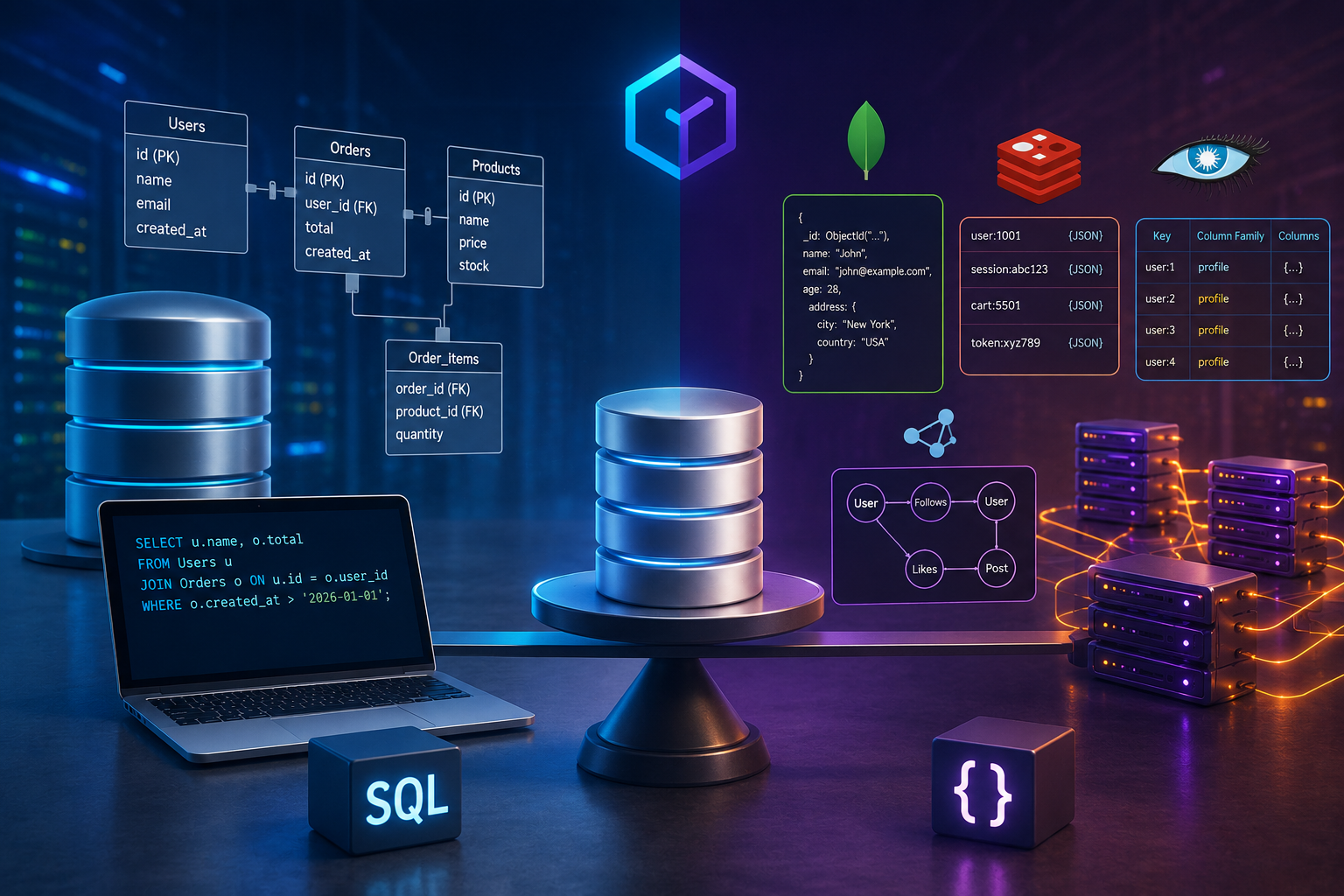
In the world of software development, one of the most fundamental decisions you will make is choosing the right database for your application. The database you select affects everything, from how your data is structured and stored to how quickly your application scales and how easily your team can query and maintain it.
For decades, SQL (Structured Query Language) databases were the undisputed standard. However, with the explosion of big data, real-time applications, and distributed systems in the 2010s, a new category emerged: NoSQL databases. Today, both coexist in the technology landscape, each serving different needs and use cases.
In this article, we break down the key differences between SQL vs NoSQL databases, compare their strengths and weaknesses, and help you decide which one is the right fit for your next project.
What is SQL?
SQL stands for Structured Query Language, and SQL databases are also known as relational databases. They store data in structured tables made up of rows and columns, much like a spreadsheet. Each table has a predefined schema that defines what kind of data can be stored, and relationships between tables are established through foreign keys.
SQL databases follow the ACID model (Atomicity, Consistency, Isolation, Durability), which ensures that database transactions are processed reliably and that data integrity is maintained even in the event of errors or system failures.
Popular SQL Databases
- MySQL — The world’s most popular open-source relational database, widely used in web applications
- PostgreSQL — A powerful, standards-compliant open-source database with advanced features
- Microsoft SQL Server — Enterprise-grade relational database from Microsoft
- SQLite — Lightweight, serverless database ideal for mobile apps and local storage
- Oracle Database — Industry-leading enterprise database used by large corporations
SQL has been around since the 1970s and has an enormous ecosystem of tools, documentation, and community support. It remains the go-to choice for applications that require complex queries, structured data, and strong data consistency.
What is NoSQL?
NoSQL stands for ‘Not Only SQL’ and refers to a broad category of database systems that do not rely on the traditional table-based relational model. NoSQL databases are designed to handle large volumes of unstructured, semi-structured, or rapidly changing data, and they prioritize scalability, flexibility, and high availability over strict consistency.
Unlike SQL databases, NoSQL databases are schema-less, meaning you do not need to define the structure of your data upfront. This makes them highly adaptable to evolving data requirements and agile development workflows.
Types of NoSQL Databases
- Document Databases — Store data as JSON-like documents (e.g., MongoDB, CouchDB). Best for content management, user profiles, and catalogs.
- Key-Value Stores — Store data as simple key-value pairs (e.g., Redis, DynamoDB). Best for caching, session management, and real-time leaderboards.
- Column-Family Databases — Store data in columns rather than rows (e.g., Apache Cassandra, HBase). Best for time-series data and analytics at scale.
- Graph Databases — Store data as nodes and relationships (e.g., Neo4j, Amazon Neptune). Best for social networks, recommendation engines, and fraud detection.
NoSQL databases gained massive popularity with the rise of companies like Facebook, Google, Amazon, and Twitter, who needed to handle billions of records with high availability and horizontal scalability, requirements that traditional SQL databases struggled to meet at that scale.
Key Differences Between SQL and NoSQL
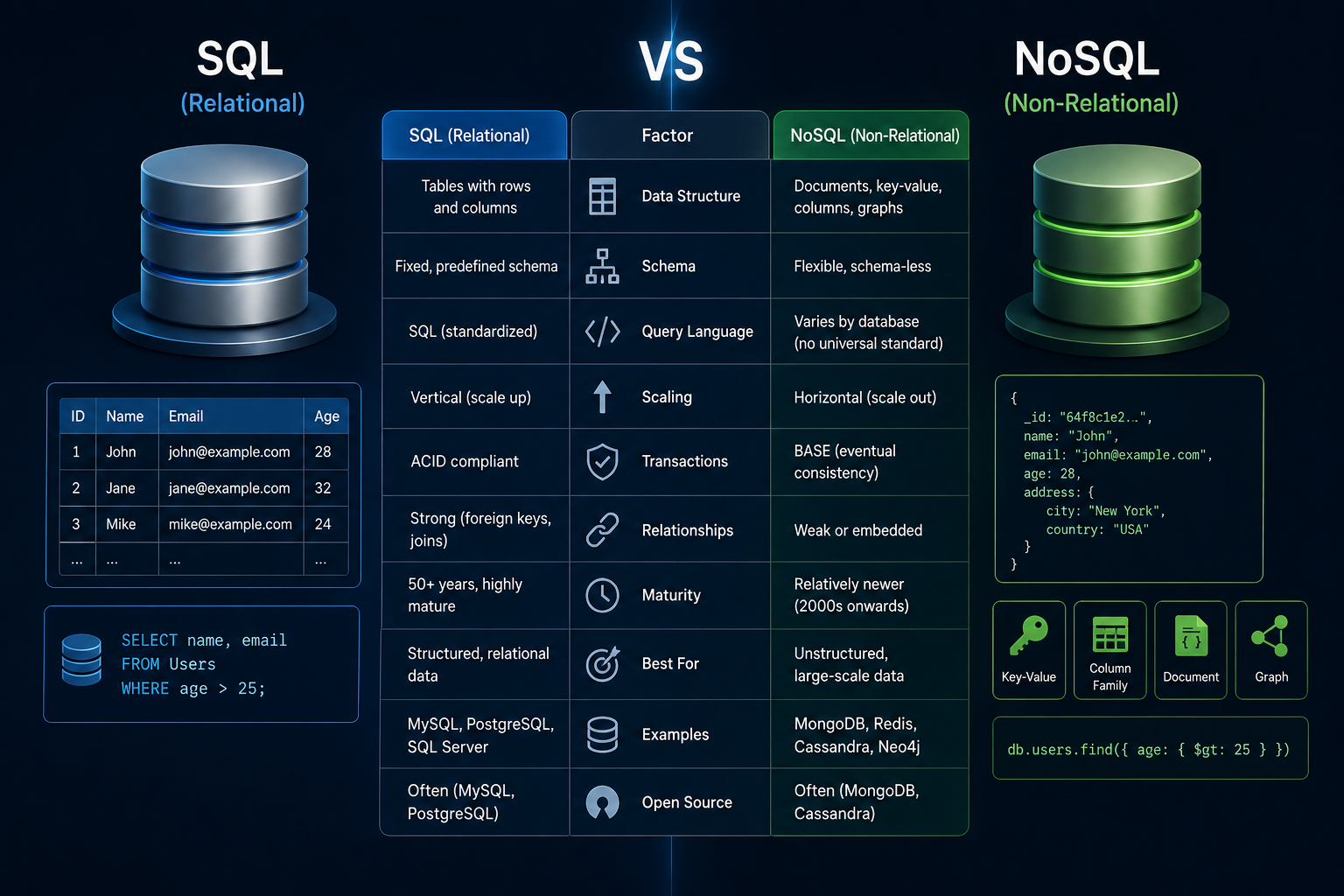
Here is a comprehensive side-by-side comparison of the two database paradigms:
| Factor | SQL (Relational) | NoSQL (Non-Relational) |
|---|---|---|
| Data Structure | Tables with rows and columns | Documents, key-value, columns, graphs |
| Schema | Fixed, predefined schema | Flexible, schema-less |
| Query Language | SQL (standardized) | Varies by database (no universal standard) |
| Scaling | Vertical (scale up) | Horizontal (scale out) |
| Transactions | ACID compliant | BASE (eventual consistency) |
| Relationships | Strong (foreign keys, joins) | Weak or embedded |
| Maturity | 50+ years, highly mature | Relatively newer (2000s onwards) |
| Best For | Structured, relational data | Unstructured, large-scale data |
| Examples | MySQL, PostgreSQL, SQL Server | MongoDB, Redis, Cassandra, Neo4j |
| Open Source | Often (MySQL, PostgreSQL) | Often (MongoDB, Cassandra) |
Schema and Data Structure
SQL: Rigid but Reliable Schema
In SQL databases, the schema must be defined before any data can be inserted. You specify what columns a table will have, what data types each column accepts, and what constraints apply (such as NOT NULL or UNIQUE). This rigidity is actually a strength in many scenarios — it enforces data quality, prevents inconsistencies, and makes the database self-documenting.
However, changing the schema later can be costly. Adding or removing columns from a table with millions of rows requires migrations that can take time and careful planning, which can slow down development in fast-moving projects.
NoSQL: Flexible and Adaptive Schema
NoSQL databases allow you to store different fields in different documents within the same collection. For example, in MongoDB, one user document might have a phone number field while another does not. This flexibility makes NoSQL ideal for projects where the data model is likely to evolve over time, such as startups, prototypes, or applications with rapidly changing requirements.
The tradeoff is that this flexibility puts the burden of data consistency on the application layer rather than the database itself. Developers must be more disciplined to avoid storing malformed or inconsistent data.
Scalability: Vertical vs Horizontal
SQL: Vertical Scaling
SQL databases traditionally scale vertically, meaning you improve performance by adding more resources to a single server, such as more CPU, RAM, or faster storage. This approach works well up to a point but becomes expensive and has physical limits. Once you hit the ceiling of a single machine, scaling a relational database further becomes complex and often requires techniques like read replicas, sharding, or clustering, which add significant architectural complexity.
NoSQL: Horizontal Scaling
NoSQL databases are designed from the ground up for horizontal scaling, also known as scaling out. This means you can distribute data across many servers (a cluster), and adding more capacity is as simple as adding more machines to the cluster. This is why NoSQL databases are the backbone of many large-scale web services that handle millions of concurrent users. Amazon’s DynamoDB, for instance, scales automatically to handle virtually any amount of traffic.
For most small to medium-sized applications, scaling is not an immediate concern. But for applications expecting rapid growth or unpredictable traffic spikes, NoSQL’s horizontal scaling model offers a significant advantage.
ACID vs BASE Properties
ACID (SQL)
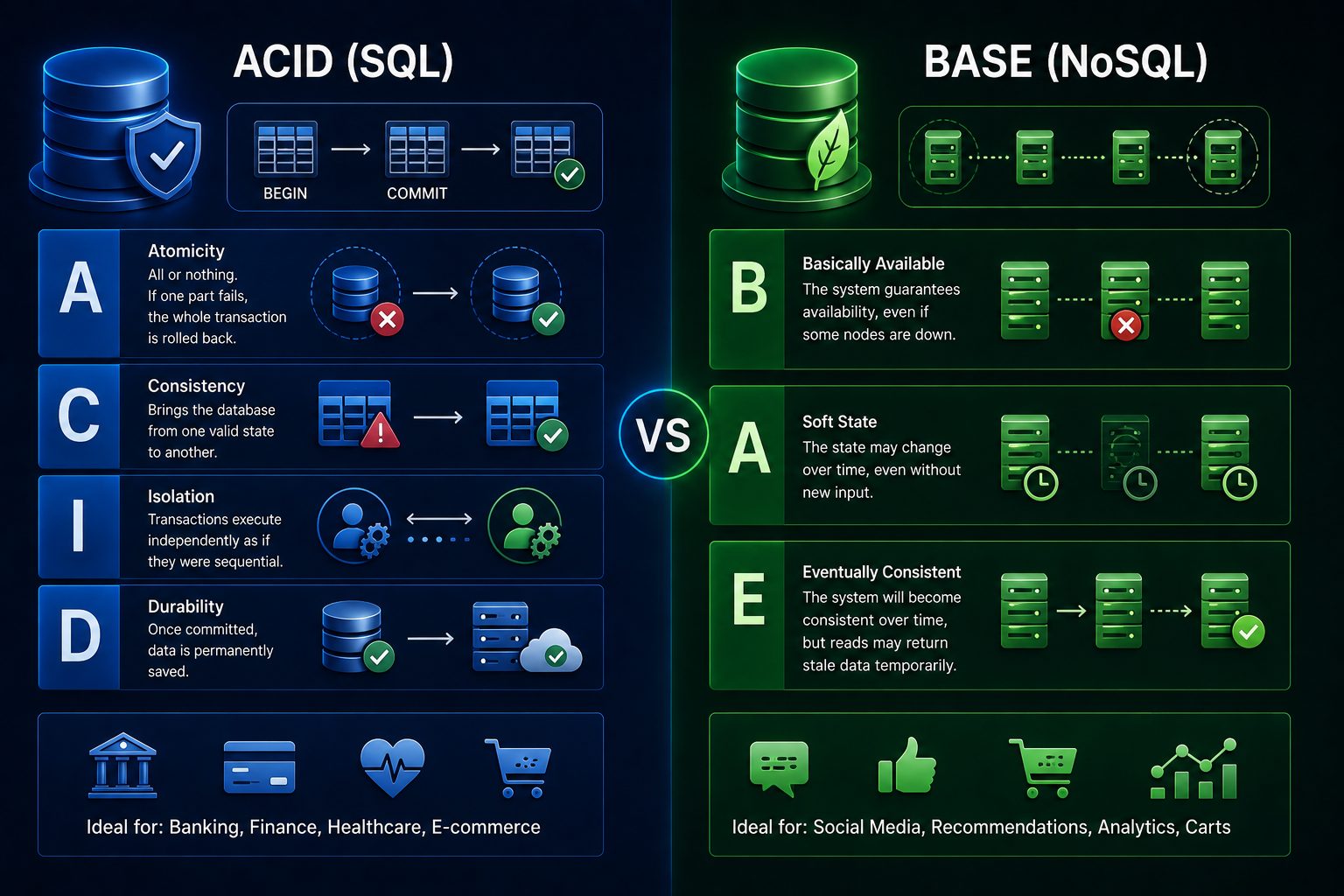
ACID is the gold standard for database transaction reliability. Here is what each property means:
- Atomicity — A transaction is all-or-nothing. If any part fails, the entire transaction is rolled back.
- Consistency — A transaction brings the database from one valid state to another. No partial or corrupt states are allowed.
- Isolation — Concurrent transactions execute independently, as if they were sequential.
- Durability — Once a transaction is committed, it is permanently saved, even in the event of a system crash.
ACID compliance is critical for applications where data accuracy is non-negotiable, such as banking systems, financial platforms, healthcare records, and e-commerce order processing.
BASE (NoSQL)
NoSQL databases typically follow the BASE model, which trades strict consistency for availability and performance:
- Basically Available — The system guarantees availability, even if some nodes are down.
- Soft State — The state of the system may change over time, even without new input, due to eventual consistency.
- Eventually Consistent — The system will become consistent over time, but reads may temporarily return stale data.
BASE is acceptable for applications where temporary inconsistency is tolerable, such as social media feeds, product recommendations, analytics dashboards, or shopping cart sessions. The tradeoff is faster performance and better availability at the cost of momentary data inconsistency.
Performance
SQL Performance
SQL databases excel at complex queries involving multiple tables, joins, aggregations, and filtering. Their query optimizer has decades of refinement, making them extremely efficient for structured data retrieval. For read-heavy applications with well-defined query patterns, a properly indexed SQL database can be extraordinarily performant.
However, performance can degrade under very high write loads or when dealing with extremely large datasets spread across distributed systems without careful optimization.
NoSQL Performance
NoSQL databases are optimized for high-speed reads and writes at scale. Because data is often stored in a denormalized format (all related data together in one document or record), retrievals require fewer operations and no expensive joins. Key-value stores like Redis can handle millions of read/write operations per second because data is stored entirely in memory.
The tradeoff is that complex queries across multiple collections or data types can be awkward and inefficient in NoSQL databases, often requiring additional application logic that a SQL join would handle natively.
Popular SQL vs NoSQL Databases Examples
| Database | Type | Category | Best Known For |
|---|---|---|---|
| MySQL | SQL | Relational | Web apps, WordPress, e-commerce |
| PostgreSQL | SQL | Relational | Advanced features, JSON support |
| MS SQL Server | SQL | Relational | Enterprise Windows applications |
| MongoDB | NoSQL | Document | Flexible schemas, content platforms |
| Redis | NoSQL | Key-Value | Caching, real-time leaderboards |
| Apache Cassandra | NoSQL | Column-Family | Time-series, IoT, high write loads |
| Neo4j | NoSQL | Graph | Social networks, fraud detection |
| Amazon DynamoDB | NoSQL | Key-Value / Document | Serverless, auto-scaling AWS apps |
MySQL vs MongoDB: The Classic Comparison
MySQL and MongoDB are the most commonly compared databases in the SQL vs NoSQL database debate. MySQL stores data in structured tables and uses SQL for querying. It is ideal for applications with well-defined, stable data models, such as a traditional e-commerce platform or a blogging system. MongoDB stores data as BSON (Binary JSON) documents and uses its own query language. It is ideal for applications with flexible, rapidly evolving data, such as a content management system, a user profile store, or a real-time analytics platform.
Use Cases: When to Use SQL vs NoSQL Databases
When to Use SQL
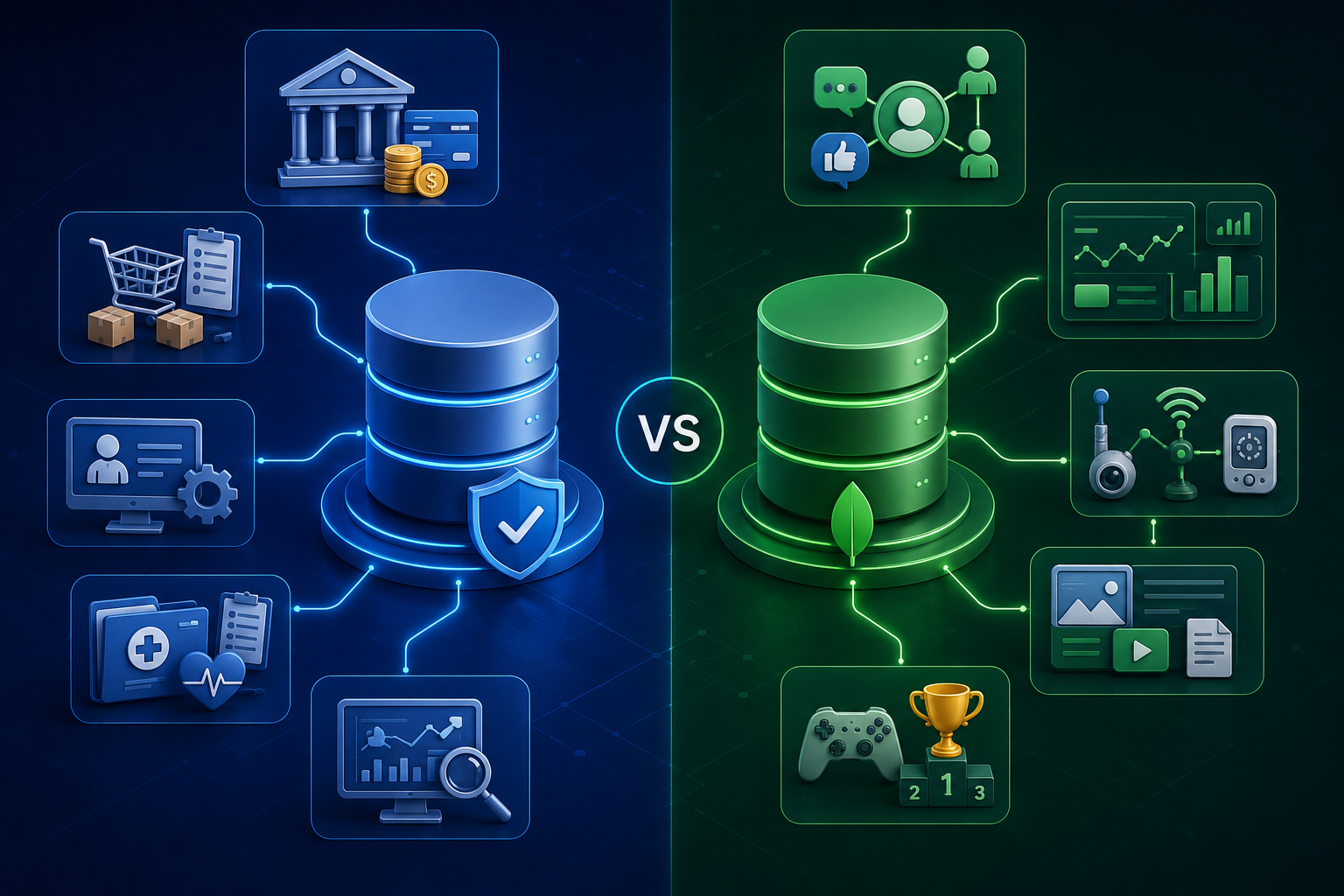
- Financial applications — Banking, accounting, and payment systems where ACID compliance and data integrity are critical
- E-commerce platforms — Managing orders, inventory, and customer records with complex relational data
- ERP and CRM systems — Enterprise applications with structured, interrelated data and complex reporting needs
- Healthcare systems — Patient records, billing, and medical data requiring strict regulatory compliance
- Applications with complex queries — When you need powerful JOIN operations, aggregations, and reporting
When to Use NoSQL
- Social media platforms — Handling user-generated content, activity feeds, and social graphs at massive scale
- Real-time analytics — Processing and querying large streams of event data with low latency
- IoT applications — Ingesting high-velocity sensor data from millions of devices
- Content management systems — Storing articles, media metadata, and product catalogs with varying attributes
- Gaming applications — Managing leaderboards, player sessions, and game state with high read/write throughput
- Recommendation engines — Storing and traversing complex relationship graphs between users and products
Read More: Learn The Difference Between MongoDB And MySQL
Pros and Cons
| # | SQL Pros | SQL Cons |
|---|---|---|
| 1 | Mature, well-documented ecosystem | Less flexible for unstructured data |
| 2 | ACID compliance ensures data integrity | Vertical scaling has physical limits |
| 3 | Powerful and standardized query language | Schema changes require migrations |
| 4 | Strong community and enterprise support | Can struggle with very high write loads |
| 5 | Excellent for complex relational queries | Can be overkill for simple data needs |
| # | NoSQL Pros | NoSQL Cons |
|---|---|---|
| 1 | Flexible, schema-less data model | Lack of standardized query language |
| 2 | Horizontal scaling for massive workloads | Eventual consistency can cause stale reads |
| 3 | High performance for simple read/writes | Less mature tooling and ecosystem |
| 4 | Ideal for unstructured and big data | Complex queries can require app-layer logic |
| 5 | Wide variety of models (document, graph, etc.) | ACID transactions limited or complex |
Which Should You Choose?
The SQL vs NoSQL databases debate does not have a universal winner. The right choice depends entirely on your specific use case, team expertise, and application requirements. Here is a simple decision framework:
Choose SQL If:
- Your data is structured and relationships between entities are important
- Data integrity and ACID transactions are non-negotiable (finance, healthcare)
- Your team is already familiar with SQL and relational concepts
- You need complex reporting, analytics, or multi-table queries
- Your application has a stable, well-defined data model that is unlikely to change frequently
Choose NoSQL If:
- You are dealing with large volumes of unstructured or semi-structured data
- Your application needs to scale horizontally to handle millions of users
- Your data model is evolving rapidly and flexibility is a priority
- You need very high write throughput or real-time performance
- You are building for use cases like social media, IoT, gaming, or content delivery
Can You Use Both? (Polyglot Persistence)
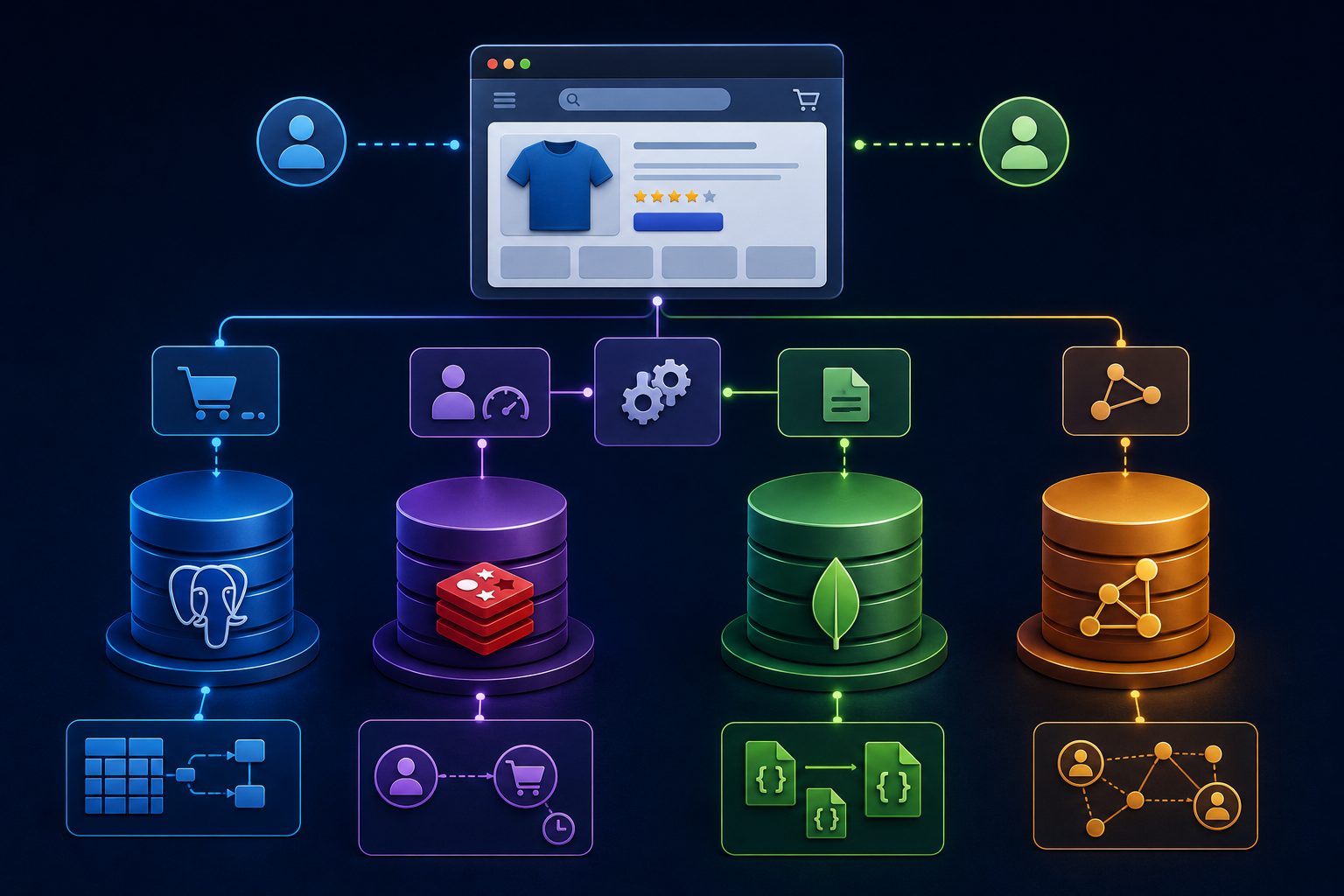
Absolutely, and many modern applications do exactly that. This approach is called polyglot persistence, where different parts of an application use different types of databases based on what each part needs. For example, an e-commerce platform might use PostgreSQL for order and payment data (requiring ACID compliance), Redis for session management and caching (requiring speed), MongoDB for product catalogs (requiring flexible schemas), and Neo4j for product recommendations (requiring graph traversal).
Polyglot persistence gives you the best of all worlds, but also adds architectural complexity. It works best for larger teams with the resources to manage multiple database systems and the expertise to integrate them seamlessly.
Conclusion
SQL and NoSQL databases each represent a powerful approach to storing and managing data, and both have earned their place in the modern development toolkit. SQL databases shine in structured, relational, and transaction-heavy environments where data consistency and complex querying are paramount. NoSQL databases excel in flexible, distributed, high-volume scenarios where scalability and adaptability matter most.
As a developer or architect in 2026, understanding both paradigms is no longer optional — it is a core competency. The era of using a single database type for every problem is behind us. By matching your database choice to your actual requirements rather than following trends, you will build faster, more reliable, and more scalable applications.
Start by analyzing your data model. If it is relational, start with SQL. If it is flexible or massive in scale, explore NoSQL. And if your application is complex enough, do not be afraid to combine both through polyglot persistence.
Quick Reference Summary
| Category | SQL | NoSQL |
|---|---|---|
| Data Model | Tables (rows & columns) | Documents, key-value, columns, graph |
| Schema | Fixed, predefined | Flexible, schema-less |
| Scaling | Vertical | Horizontal |
| Consistency | ACID (strong) | BASE (eventual) |
| Query Language | SQL (standardized) | Varies per database |
| Best For | Structured, relational data | Unstructured, big data, high scale |
| Top Examples | MySQL, PostgreSQL, SQL Server | MongoDB, Redis, Cassandra, Neo4j |
| Use When | Integrity & relations matter | Scale & flexibility matter |
Read More: How to Optimize MySQL Queries for Better Performance