
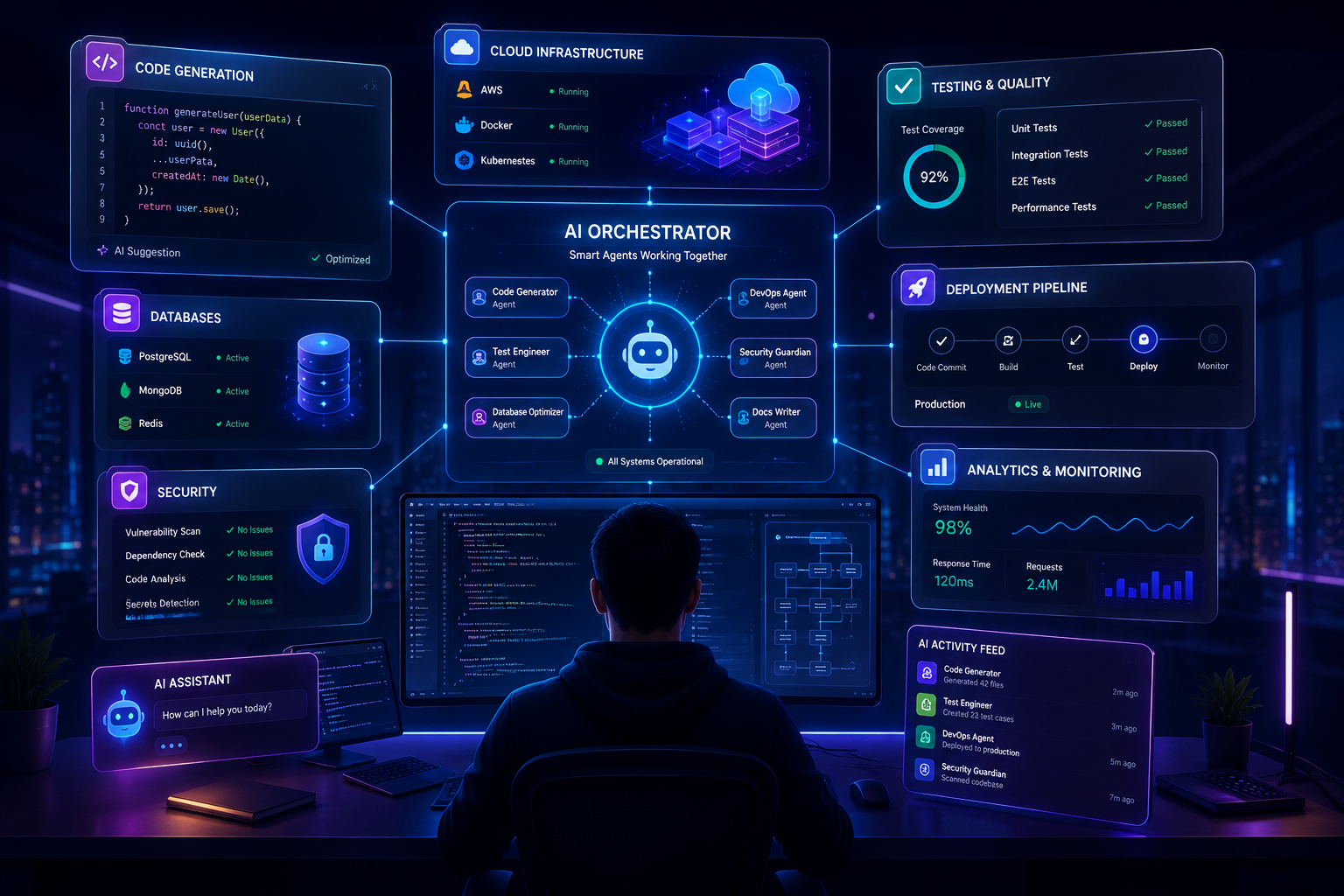
For decades, software development followed a familiar pattern.
A developer understood a problem, opened an editor, wrote hundreds or thousands of lines of code, tested everything manually, fixed bugs, and repeated the cycle.
But software engineering is entering one of its biggest transitions.
The future of development is no longer just about how well you can write code.
It is about how well you can design intelligent workflows where humans and AI systems collaborate.
Welcome to the era of AI-orchestrated development.
From Code Writers to System Architects
AI coding tools have changed what happens inside a developer’s workflow.
Modern AI assistants can now:
- Generate application components
- Suggest architecture improvements
- Explain unfamiliar codebases
- Create documentation
- Write automated tests
- Find bugs
- Assist with deployment workflows
Tools like GitHub Copilot, Claude Code, OpenAI Codex, and Cursor are changing the relationship between developers and code editors.
But this creates an important question:
If AI can generate code, what becomes the developer’s real value?
The answer is simple:
Engineering thinking.
AI can create code, but developers still need to understand:
- What should be built
- How systems should communicate
- How data should flow
- How applications should scale
- How security risks should be handled
- How different technologies work together
The developer’s role is evolving from someone who only writes instructions for computers to someone who manages intelligent systems.
Why Coding Alone Is No Longer Enough


Many developers are experimenting with AI tools, but most are still using them like advanced autocomplete.
They ask AI to:
“Create this function.”
“Fix this error.”
“Explain this code.”
While useful, this only scratches the surface.
The real transformation begins when developers use AI throughout the entire software lifecycle.
Modern AI-powered development includes:
1. AI-Assisted Planning
Before writing code, AI can help developers:
- Break down project requirements
- Compare technology choices
- Create development roadmaps
- Identify possible technical challenges
A strong developer does not blindly accept these suggestions but evaluates them using engineering knowledge.
2. Intelligent Application Development
AI coding assistants are becoming collaborative partners.
A developer can describe a feature, generate a first version, review the output, improve the architecture, and continue building faster.
But understanding fundamentals remains critical.
A generated API still needs proper:
- Authentication
- Database structure
- Error handling
- Performance optimization
- Security practices
AI increases speed.
Knowledge ensures quality.
3. AI Agents and Automated Workflows
One of the biggest changes happening today is the rise of AI agents.
Unlike simple chat-based AI assistants, agents can perform multi-step tasks.
For example:
A developer could create an AI workflow that:
- Reads a product requirement
- Generates initial code
- Creates test cases
- Checks errors
- Updates documentation
- Helps prepare deployment
Frameworks like LangChain and agent-based systems are introducing a new development style where developers build intelligent processes instead of handling every repetitive task manually.
4. Cloud and DevOps Automation
Building software does not stop after writing code.
Real-world applications need:
- Deployment pipelines
- Infrastructure management
- Monitoring
- Security
- Scaling
Modern teams combine AI with tools like:
- Docker
- Kubernetes
- Cloud platforms
- CI/CD pipelines
- Infrastructure automation
The developers who understand both AI and system operations will have a major advantage.
Read more- DevSecOps Explained: Maturity Models, CI/CD Security, Use Cases & Implementation Guide
The New Developer Skill Stack
The AI-first developer is not someone who only knows a programming language.
The modern developer understands multiple layers:
Foundation Layer
Programming concepts
Data structures
Software architecture
APIs
Databases
Development Layer
Frontend development
Backend systems
Mobile applications
Testing practices
Infrastructure Layer
Cloud computing
DevOps
Containers
Automation
Intelligence Layer
Large Language Models
AI agents
RAG systems
Prompt engineering
AI-powered workflows
The future belongs to developers who can connect these layers together.
AI Will Not Replace Developers — But It Will Change Expectations
Every major technology shift changes what companies expect.
Calculators did not remove mathematicians.
Design tools did not remove designers.
Cloud platforms did not remove engineers.
Instead, these technologies changed what professionals could achieve.
AI is doing the same for software development.
Developers who understand how to collaborate with AI will be able to:
- Build faster
- Experiment more
- Automate repetitive tasks
- Focus on architecture and creativity
The question is changing from:
“How many lines of code can you write?”
to:
“How effectively can you turn ideas into working systems?”
Preparing for the AI-First Development Era
The biggest challenge today is not access to tools.
Most AI tools are already available.
The challenge is learning how everything connects.
Knowing one programming language is helpful.
But understanding how AI, cloud, databases, security, DevOps, and application development work together creates a completely different level of capability.
This is why modern learning needs to move beyond traditional coding lessons and focus on complete system building.
One initiative exploring this direction is All In One Coding 6.0, a new AI-first learning ecosystem built around modern development workflows.
The program brings together technologies like Claude Code, OpenAI Codex, GitHub Copilot, Cursor, LangChain, Docker, AWS, AI agents, full-stack development, cybersecurity, cloud computing, and more than 100 modern tools.
The idea is not simply to teach people how to code.
It focuses on helping developers understand how to build, automate, and scale software in an AI-powered world.
Because the next generation of developers will not be defined by who writes the most code.
They will be defined by who can build the smartest systems.