
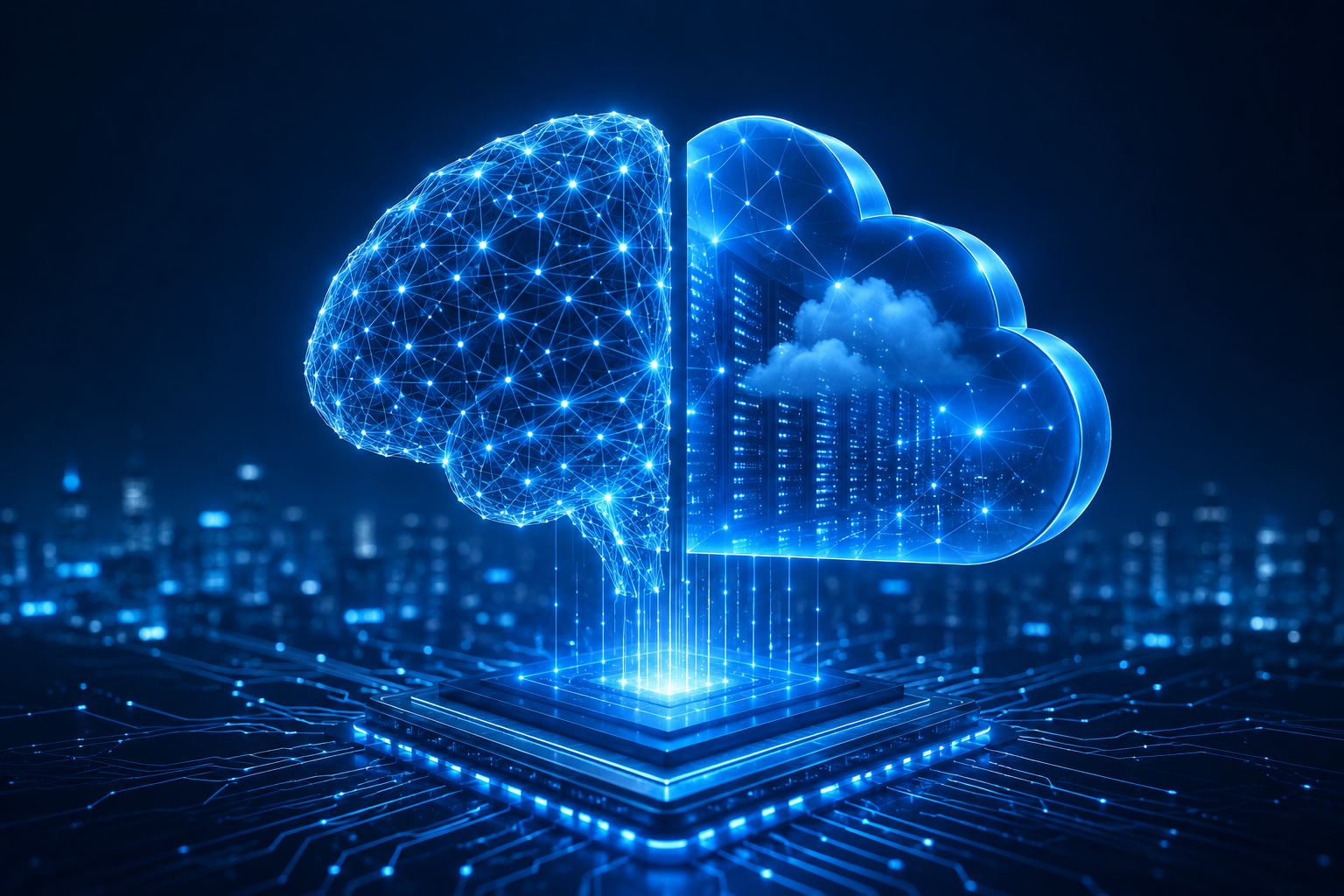
Technology is entering a new phase, and the professionals who understand AI and Cloud together are the ones shaping what comes next. For years, AI and Cloud were treated as two separate subjects taught in two separate courses. Today, that separation no longer reflects how real applications are built. AI and Cloud have merged into a single, connected layer of modern software development, and understanding this shift is no longer optional for anyone who wants to stay relevant in technology. Programs like the Cloud AI Masterclass are emerging precisely to help professionals close this gap in one structured learning journey.
The Shift Toward AI and Cloud
Cloud computing once meant servers, storage, and scalable infrastructure. Now, AI and Cloud platforms are evolving into complete ecosystems that bring together foundation models, AI services, intelligent assistants, agents and enterprise data tools. Microsoft Azure and Amazon Web Services are leading this transformation, turning their platforms into environments where AI and Cloud technologies work side by side to power intelligent applications. Developers can also explore these open-source AI tools for developers to strengthen their AI development workflows.
This is why developers, cloud engineers, and IT professionals are increasingly expected to understand both sides of the equation. Knowing only AI, or only Cloud, is no longer enough. The real opportunity lies in the intersection of AI and Cloud, where models, data, APIs, and infrastructure come together to create something far more powerful than either could achieve alone.


Why the AI and Cloud Skill Gap Exists
Most learning resources still teach AI and Cloud as isolated topics. One course covers a specific AI model. Another covers Azure. A third covers AWS. A fourth covers retrieval-augmented generation. Learners end up collecting scattered pieces of AI and Cloud knowledge without ever seeing how those pieces connect inside a real, working application.
This is the AI and Cloud skill gap that many technology professionals are quietly struggling with. A developer might understand how to call an AI model, but not how to deploy it inside a cloud-based architecture. A cloud engineer might manage infrastructure fluently, but never have touched an AI service. Bridging that gap is exactly where the real value of combined AI and Cloud learning comes from. Understanding how leading AI assistants compare can also help professionals make more informed decisions when choosing the right tools for their workflows, as explored in this Claude AI vs ChatGPT comparison.
The Growing Demand for AI and Cloud Talent
The numbers behind this shift are hard to ignore. Industry research shows that jobs requiring AI skills are growing significantly faster than the overall job market, and professionals with AI capabilities are commanding notably higher wages. At the same time, global cloud spending continues to climb toward record levels, with generative AI identified as one of the primary drivers behind that growth.
Put simply, AI and Cloud are no longer separate investment categories for businesses. They are becoming one connected budget line, one connected skill set, and one connected career path. Professionals who can speak fluently about AI and Cloud together are positioned very differently in the job market compared to those who specialize narrowly in just one side.
What Real AI and Cloud Applications Actually Require
Building a genuine AI and Cloud application involves far more than sending a prompt to a chatbot. It requires understanding how a foundation model connects to enterprise data, how retrieval systems ground responses in accurate information, how AI agents use tools and APIs to complete tasks, and how all of this gets deployed and monitored inside a cloud environment.
This is where AI and Cloud concepts like embeddings, vector search, hybrid search, RAG architecture, agent workflows, and AI-assisted development become essential. None of these ideas exist in isolation. They work together, layer by layer, to form what many now call the AI and Cloud stack — the foundation behind chatbots, business assistants, knowledge systems and customer support tools built by modern enterprises.
Who Should Be Learning AI and Cloud Right Now
You don’t need the title “AI Engineer” to benefit from developing AI and Cloud skills. Software developers can use AI and Cloud knowledge to build smarter applications. Cloud engineers can use it to modernize existing infrastructure. Data professionals can apply AI and Cloud concepts to build retrieval and knowledge systems. Even product managers and project leads benefit from understanding AI and Cloud well enough to coordinate technical initiatives confidently.AI and Cloud skills are also transforming learning environments, as AI in education enables smarter, more personalized, and scalable digital learning experiences.
The common thread isn’t a specific job title — it’s curiosity about where AI and Cloud technology is heading, and a willingness to build practical, transferable skills rather than chasing every new tool that appears.
How to Start Building AI and Cloud Skills
The most effective way to learn AI and Cloud isn’t by jumping between disconnected tutorials. It’s by following a structured path that moves from foundational AI models, through cloud platforms like Azure and AWS, into retrieval systems, AI agents, and finally AI-assisted development practices. This kind of progression mirrors exactly how real AI and Cloud applications are architected in the industry today. As AI-assisted development becomes more common, learning tools such as Claude Code can also help developers build, test, and refine applications more efficiently.
For learners who want a guided, hands-on way to close this gap, structured programs are now emerging that combine both ecosystems in one place — walking through Azure OpenAI, Microsoft Foundry, Amazon Bedrock, Bedrock Knowledge Bases, and Amazon Q Developer within a single connected AI and Cloud learning journey rather than scattered, single-platform courses. This kind of end-to-end approach is exactly what is currently being introduced through a new AI and Cloud-focused learning campaign built around practical projects and real enterprise use cases, for professionals who want structured exposure to both major AI and Cloud ecosystems at once.
Final Thoughts
AI and Cloud are no longer parallel trends — they are converging into a single technology layer that is reshaping how software gets built, deployed and scaled. Developers, engineers, and technology professionals who invest time in understanding AI and Cloud together, rather than treating them as separate disciplines, will be far better positioned for the next generation of enterprise technology. The transition from Cloud Computing to AI and Cloud is already underway, and those ready to start can look to a structured path like the Cloud AI Masterclass to build these skills the right way. The professionals who prepare for it now will be the ones building what comes next.