
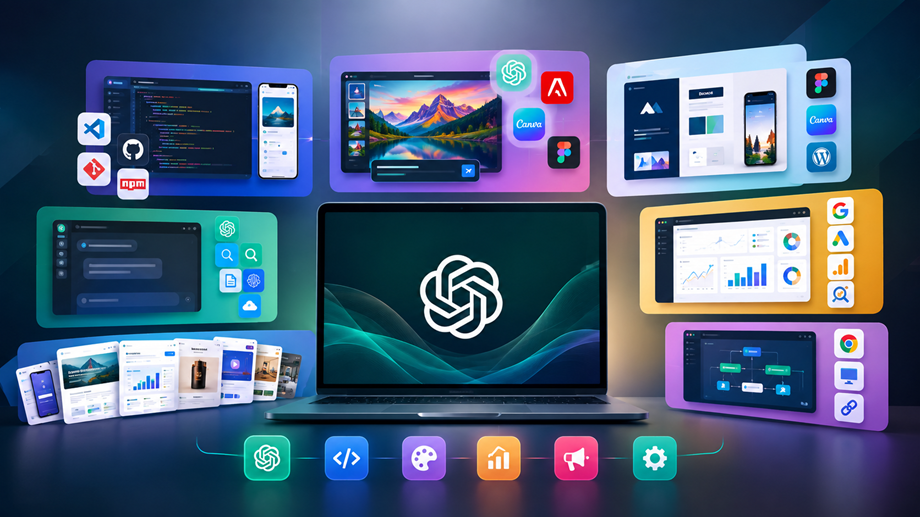
AI is changing how people work, learn, create, code, research, and grow businesses. But while millions of people have started using ChatGPT, simply knowing how to ask a question is no longer enough. The real advantage comes from developing ChatGPT skills that help you research better, solve complex problems, create faster, build software, design digital experiences, and automate repetitive work.
That is why learning how to use ChatGPT effectively is becoming an increasingly practical skill for students, professionals, developers, designers, marketers, entrepreneurs, and business owners.
The technology is moving quickly, too. ChatGPT has expanded beyond simple conversations into a broader ecosystem involving advanced reasoning, research, files, coding, image generation, projects, connected tools, and increasingly agentic workflows. OpenAI says ChatGPT is already being used by workers across industries and job functions, with people applying it to everything from debugging code to brainstorming campaigns.
For anyone who wants to stay competitive in an AI-powered workplace, the question is no longer simply “Should I use AI?”
It is:
“Do I know how to use AI effectively?”
And more importantly:
“Do I know what I can actually build with it?”
That is the idea behind All-in-One ChatGPT Mastery — a practical learning program designed to help people move from simply using ChatGPT to applying it across work, coding, design, business, and marketing.
Why ChatGPT Skills Are Becoming So Important
Artificial intelligence is changing the skills people need at work. A recent International Labour Organization report highlights growing demand for AI literacy, digital skills, adaptability, and higher-order cognitive skills as AI adoption reshapes workplaces.
The OECD has similarly identified a lack of skills as a major barrier to AI adoption and found that workers who receive AI training are more likely to report positive outcomes from using AI.
This distinction matters.
Having access to an AI tool doesn’t automatically make someone good at using it. Two people can have access to exactly the same ChatGPT account and get dramatically different results.
One person might use ChatGPT to rewrite an email.
Another might use it to:
- Research a market
- Analyze a large dataset
- Develop a business strategy
- Build a website
- Debug an application
- Create a marketing campaign
- Generate visual concepts
- Analyze documents
- Create a presentation
- Develop an SEO strategy
- Automate repetitive workflows
- Build an AI-powered application
The difference isn’t necessarily access.
It’s skill.
Learning ChatGPT Is About More Than Prompting
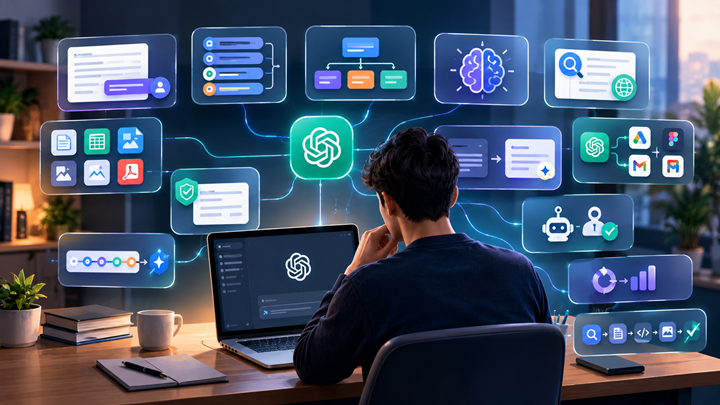

When people talk about learning ChatGPT, the conversation often focuses on prompts. Prompting is useful, but modern AI workflows go much further.
Effective ChatGPT use involves understanding:
- How to provide useful context
- How to structure complex instructions
- How to break large problems into smaller tasks
- When to use reasoning
- When to conduct research
- How to work with files and data
- How to evaluate AI-generated information
- How to iterate on an output
- How to use AI tools together
- How to supervise AI on complex tasks
- How to turn one successful interaction into a repeatable workflow
This is why ChatGPT skills are becoming more valuable than simply memorizing a collection of prompts.
The goal isn’t to remember hundreds of commands. The goal is to understand how to think and work with AI.
ChatGPT Can Become a Productivity Tool for Everyday Work
One of the simplest reasons to learn ChatGPT is productivity.
Professionals spend significant amounts of time on tasks such as writing, summarizing, researching, organizing information, preparing documents, analyzing data, planning projects, creating presentations, and communicating with customers or colleagues.
ChatGPT can assist with many of these activities.
For example, a professional could use AI to:
- Research Faster: Instead of starting every research task from scratch, AI can help organize questions, identify themes, summarize information, compare alternatives, and structure findings.
- Write and Improve Content: ChatGPT can help draft emails, reports, proposals, documentation, social posts, articles, presentations, and other business communication.
- Analyze Information: Files and structured data can be transformed into summaries, comparisons, insights, questions, and action plans.
- Plan Projects: A vague idea can be turned into objectives, milestones, tasks, dependencies, risks, and execution plans.
- Build Repeatable Workflows: Instead of solving the same problem manually every week, AI can help create reusable processes and templates.
The biggest productivity gains therefore don’t necessarily come from asking ChatGPT more questions.
They come from integrating ChatGPT into the way you already work.
AI Skills Can Give Professionals a New Productivity Advantage


The workplace is increasingly moving toward human-AI collaboration.
OpenAI’s research on ChatGPT usage at work shows adoption across industries and job functions, while its 2026 research on Codex describes AI being used for research, data analysis, reports, spreadsheets, presentations, workflow automation, and other knowledge-work tasks beyond traditional software development.
This points toward an important shift. The future worker may not simply be someone who knows how to perform a task.
They may be someone who knows how to:
Define the task → use AI to accelerate it → review the result → improve it → automate parts of it → deliver the final outcome.
That is a much broader skill set. And it applies far beyond technology companies.
Why Developers Need to Learn AI Coding
Software development is one of the clearest examples of how AI is changing professional workflows. Modern AI coding tools can help developers understand codebases, implement features, debug problems, refactor code, write tests, review changes, and work through longer engineering tasks.
OpenAI describes Codex as an agentic coding system capable of handling tasks such as feature development, complex refactoring, migrations, testing, and code review.
But learning AI coding isn’t about asking an AI to “build everything for me.” Developers still need to understand architecture, requirements, security, testing, debugging, deployment, and software quality.
The advantage comes from combining developer judgment with AI execution. That can allow developers to move from spending most of their time writing repetitive code toward spending more time on architecture, problem-solving, product decisions, and reviewing AI-generated work.
For aspiring developers, this creates another reason to learn ChatGPT and AI coding workflows early.
AI Coding Is Also Expanding Beyond Traditional Developers
One of the most interesting developments is that AI coding tools are no longer relevant only to professional programmers.
OpenAI reports that knowledge workers increasingly use Codex for tasks such as data analysis, research, creating reports and spreadsheets, building lightweight tools, and automating workflows.
This means that understanding basic AI coding and automation can become useful even for people whose job title doesn’t include “developer.”
A marketer might build an internal reporting tool.
A researcher might automate data processing.
A founder might prototype an application.
A business analyst might create a custom dashboard.
A designer might build an interactive prototype.
The barrier between “technical” and “non-technical” work is becoming increasingly flexible.
Why AI Design Skills Matter
AI isn’t only changing software development.
It is also changing visual creation and design.
Today, AI-powered creative workflows can support everything from image generation and editing to visual ideation, branding, product concepts, social media assets, presentations, interface concepts, prototypes, and marketing materials.
For designers, AI can become another creative partner. For non-designers, it can reduce the barrier to creating professional-looking visual concepts.
Someone with a business idea can explore branding.
A marketer can generate creative directions.
A founder can visualize a product.
A content creator can develop thumbnails and campaign assets.
A product team can explore interface concepts before moving into detailed design.
Learning AI design tools therefore isn’t about replacing creativity.
It is about expanding what one person can explore and produce.


ChatGPT Skills Are Becoming Valuable for Business and Marketing
Business and marketing may be among the areas where AI can have the broadest practical impact.
Consider how many activities are involved in launching a product or growing a business:
- Market research
- Customer research
- Competitor analysis
- Positioning
- Content strategy
- SEO
- Keyword research
- Email marketing
- Sales outreach
- Lead generation
- Campaign planning
- Social media
- Customer support
- Reporting
- Analytics
AI can assist with many of these workflows.
For example, a marketer can use ChatGPT to turn customer research into audience personas, convert those insights into content ideas, develop campaign messaging, create SEO briefs, generate outreach variations, and analyze campaign performance.
But again, the skill isn’t simply knowing which prompt to type. The real skill is understanding how to connect AI capabilities to a business objective. That is what separates casual AI use from practical AI adoption.
AI Skills Can Help Entrepreneurs Build More With Smaller Teams
For startups and small businesses, this shift can be particularly significant. A small team may not have the resources to hire specialists for every task.
AI can help extend the capabilities of a lean team.
A founder might use AI for research and strategy.
A developer can use AI coding tools to accelerate implementation.
A marketer can use AI for content and campaign development.
A designer can use generative tools to explore creative concepts.
An operations professional can use AI to document and automate workflows.
This doesn’t eliminate the need for expertise. Instead, it can allow individuals and small teams to combine multiple skill sets with AI assistance. That is one reason learning AI as a practical skill can be particularly valuable for entrepreneurs.
Why Learning an AI Ecosystem Is Better Than Learning One Tool
AI tools are changing rapidly.
Features get added.
Models improve.
Interfaces change.
New tools appear.
Some capabilities become integrated directly into existing platforms.
Because of this, learning one specific feature isn’t necessarily enough.
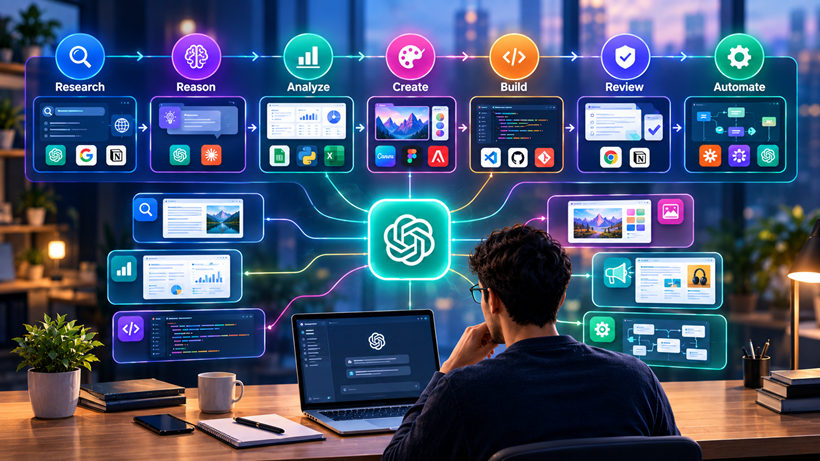
A stronger approach is to understand the broader AI workflow.
For example: Research → Reason → Analyze → Create → Build → Review → Automate
ChatGPT can participate in multiple stages of that process.
You can use research capabilities to gather information. Reasoning capabilities can help analyze complex problems. Files and data can provide context. Coding tools can turn ideas into software. Image and creative tools can turn concepts into visuals. Business workflows can turn those outputs into campaigns, products, and customer experiences.
The more these capabilities work together, the more powerful the workflow becomes.
What Should You Learn to Become an AI Power User?
If you’re wondering how to learn ChatGPT effectively, it helps to think beyond individual features.
A practical AI learning path should include several layers.
1. Learn the Fundamentals
Start with effective instructions, context, prompting, personalization, conversations, files, and everyday workflows.
You should understand how to get consistently useful results instead of relying on trial and error.
2. Learn Advanced AI Capabilities
Next, explore reasoning, multimodal workflows, research, complex task planning, and AI-assisted problem-solving.
The objective is to understand not only what AI can answer, but what kinds of problems it can help solve.
3. Learn AI Coding
Even if you’re not a professional developer, understanding AI-assisted coding can open new possibilities.
Developers can accelerate software development.
Non-developers can prototype ideas.
Entrepreneurs can experiment with products.
Professionals can build small internal tools.
4. Learn AI Design
Explore image generation, editing, visual ideation, branding, UI/UX, prototypes, presentations, marketing assets, and creative workflows.
5. Learn AI for Business and Marketing
Understand how AI can support research, SEO, content, sales, lead generation, customer communication, campaign planning, and business workflows.
6. Build Real Projects
This may be the most important step.
Don’t stop after watching tutorials.
Build something.
Create a personal AI workspace.
Build a small application.
Design a brand.
Create a marketing system.
Develop an SEO workflow.
Build a lead-generation process.
Create an AI assistant.
Projects transform theoretical knowledge into practical AI skills.
Why Project-Based AI Learning Matters


There is a major difference between watching someone demonstrate an AI tool and actually using it yourself. A tutorial might show you how to create a website.
A project forces you to decide:
- What should the website do?
- What information does AI need?
- Which tools should you use?
- How should the workflow be structured?
- What happens when something fails?
- How do you evaluate the result?
- How can the process be improved?
This is where real learning happens. Projects also create something you can demonstrate.
Instead of saying:
“I know ChatGPT.”
You can say:
“I built this application.”
“I created this workflow.”
“I designed this product.”
“I built this SEO system.”
“I created this AI-powered business assistant.”
That is a much stronger demonstration of AI capability.
Who Should Learn ChatGPT Skills?
The answer is increasingly simple:
Almost anyone who works with information, ideas, technology, communication, or creative work can benefit.
Students
Learn how to research, study, organize information, understand difficult concepts, and build projects.
Professionals
Use AI to improve productivity, writing, analysis, research, planning, and everyday workflows.
Developers
Use AI coding tools to accelerate development, debugging, testing, refactoring, and software delivery.
Designers
Use AI for creative exploration, visual generation, branding, UI/UX, prototypes, and production assets.
Marketers
Use AI for research, SEO, content, campaigns, sales, lead generation, and customer communication.
Entrepreneurs
Use AI to research markets, develop ideas, prototype products, create content, analyze information, and build business systems.
Business Owners
Use AI to improve operations, communication, customer support, marketing, documentation, and decision-making.
The important thing is not your current job title.
It is your willingness to learn how AI can become part of your workflow.
The Goal Isn’t to Let AI Do Everything
There is an important distinction between using AI and delegating your judgment to AI.
AI can generate ideas. You still need to evaluate them.
AI can write code. You still need to test it.
AI can conduct research. You still need to verify important information.
AI can create designs. You still need to understand your audience and brand.
AI can develop a strategy. You still need to decide whether that strategy makes business sense.
The most valuable AI users are therefore unlikely to be people who simply let AI make every decision.
They will be people who know when to use AI, how to direct it, how to evaluate its output, and how to turn its capabilities into useful outcomes.
The Future of Work Will Reward AI Fluency
The workplace is moving toward a model where human expertise and AI capabilities increasingly work together. Recent research from the ILO highlights AI literacy and adaptability as increasingly important workplace capabilities.
OpenAI’s research also shows AI agents moving beyond short chatbot interactions toward longer, more complex tasks involving research, tool use, automation, and execution. That suggests an important shift in what it means to be productive.
Instead of simply completing tasks manually, workers may increasingly be expected to:
Identify opportunities → design workflows → direct AI → review results → improve processes → deliver outcomes.
People who develop these skills early may have a meaningful advantage as AI becomes more deeply integrated into everyday work.
Start Learning ChatGPT as a Skill, Not Just a Tool
ChatGPT can be used casually.
You can ask it questions. You can generate a quick email.
You can summarize an article. You can brainstorm ideas.
But those are only the starting points. The bigger opportunity is learning how to use AI deliberately.
Learn how to research. Learn how to reason.
Learn how to work with information. Learn how to code with AI.
Learn how to design with AI. Learn how to build repeatable workflows.
Learn how to apply AI to business and marketing.
And most importantly, build things yourself.
The people who benefit most from AI may not necessarily be the people who use it the most. They may be the people who understand how to turn AI capabilities into real outcomes.
Take the Next Step Toward Becoming an AI Power User
The AI landscape will continue to change.
New models will arrive. New capabilities will appear. New coding and creative tools will emerge.
Workflows that seem advanced today may become standard tomorrow.
That makes one-time knowledge less valuable — and the ability to continuously learn and adapt more important.
If you want a structured way to develop these skills across ChatGPT fundamentals, advanced AI, AI coding, design, business, and marketing, explore All-in-One ChatGPT Mastery.
The program is designed around practical learning rather than simply collecting prompts or memorizing features. It combines structured lessons with real-world projects covering AI-powered productivity, advanced ChatGPT workflows, Codex-based software development, visual design, SEO, sales, lead generation, campaigns, and business automation.
The goal is simple: Don’t just learn what ChatGPT can do. Learn how to use it to create, build, solve, and accomplish more.
Because the future of AI won’t belong only to the people who have access to powerful models. It will increasingly belong to the people who know what to do with them.
Learn the skills. Build the projects. Develop the workflows.
Explore All-in-One ChatGPT Mastery and start your journey from ChatGPT user to AI power user.