

AI-powered development is no longer a buzzword — it is the new baseline. If you have been writing code for any length of time, you have probably already felt the shift: AI tools creeping into your IDE, colleagues raving about GitHub Copilot, or job postings asking for prompt engineering alongside Python and React.
The truth? The developers who thrive over the next decade will not simply be those who code the fastest. They will be the ones who know how to combine solid engineering fundamentals with the right AI development workflow — people who can design systems, direct AI agents, and ship production-ready products faster than any solo developer could five years ago.
This article breaks down what AI-powered development really means, which skills matter most, and why the shift is an opportunity — not a threat — for anyone willing to adapt. And if you are ready to go all in, the All-in-One Coding 6.0 Kickstarter campaign was built precisely for this moment.
What Is AI-Powered Development?
At its core, AI-powered development means using artificial intelligence throughout the entire software development lifecycle — not just as a code autocomplete feature, but as an active layer across planning, building, testing, deploying, and maintaining applications.
Modern AI development workflows integrate tools across every stage:
- Architecture and planning — AI helps brainstorm system design and identify technical trade-offs early
- Code generation — tools like Claude Code, GitHub Copilot, and Cursor accelerate feature development
- Debugging and code review — AI spots logic errors, performance issues, and security vulnerabilities
- Testing — AI generates unit tests, edge cases, and regression suites
- Documentation — AI drafts and maintains technical docs in real time
- Deployment and monitoring — AI-assisted DevOps pipelines catch anomalies before users do
The result is not a replacement for developers. It is a significant multiplier for engineers who understand when and how to direct these tools.
Why Traditional Coding Workflows Are Evolving
For decades, a typical developer workflow looked roughly the same: read documentation, write code manually, debug line by line, write tests, repeat. It worked — but it was slow, and a huge portion of that time was spent on repetitive execution rather than creative problem-solving.
The shift is not from developer to non-developer. It is from developer who types every character to developer who architects, directs, and ships.
AI-assisted coding is compressing the execution layer. Tasks that once took a full afternoon — writing a CRUD API, scaffolding a new component, generating boilerplate configurations — now take minutes. That freed time goes back into design, decision-making, and building things that matter.
This does not make fundamentals optional. If anything, strong engineering foundations matter more now, because you need to evaluate, debug, and improve the code AI produces — not just copy it blindly.
The Most Important AI Coding Tools in 2026
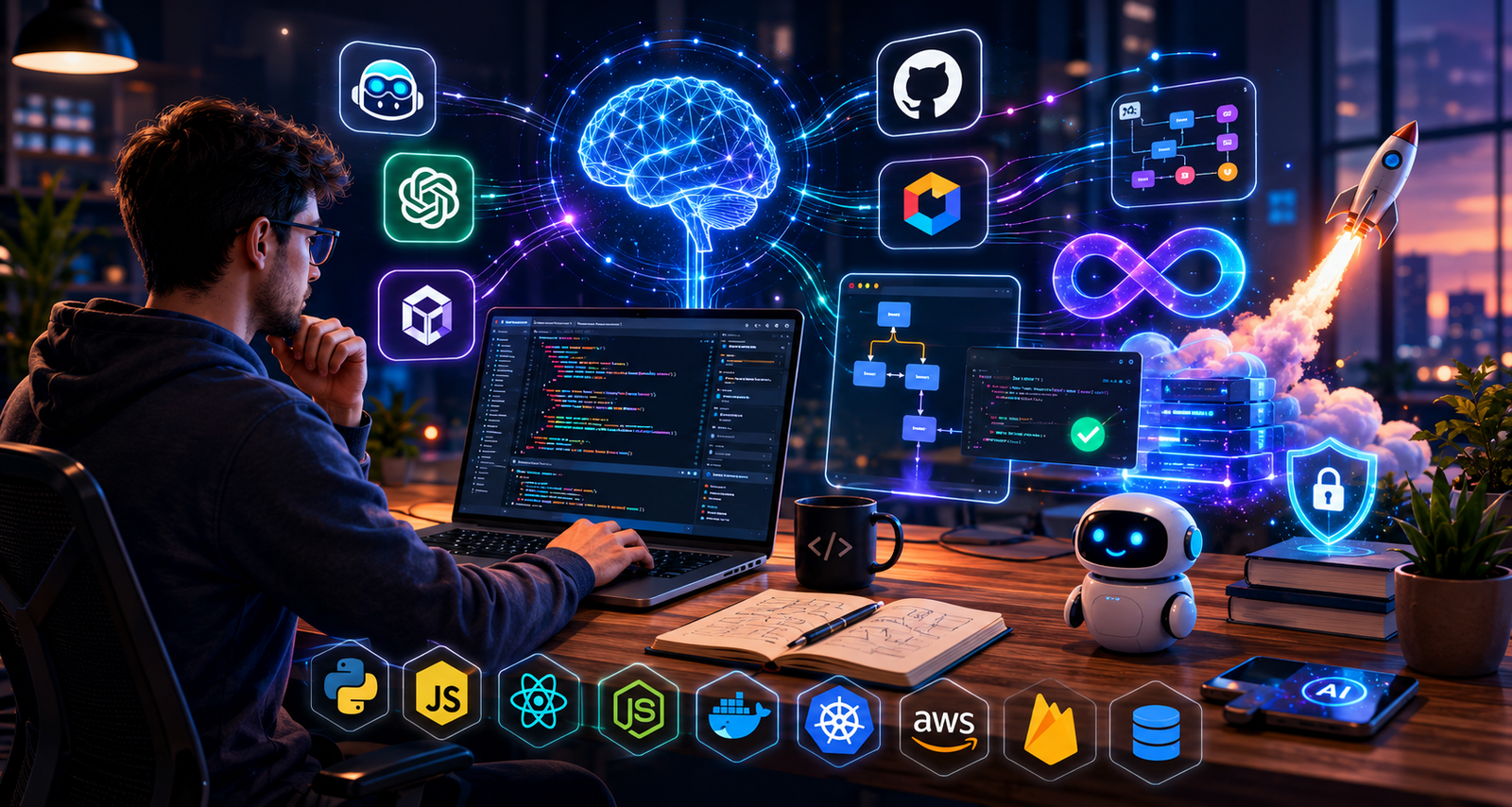

The ecosystem of AI programming tools has matured rapidly. Here are the categories every developer should understand:
1. AI Coding Assistants
These tools live inside your editor and suggest, complete, explain, and refactor code as you work. The leading options include GitHub Copilot, Cursor, Claude Code, and OpenAI Codex. They do not replace your judgment — but they dramatically reduce the time between thinking and implementing.
2. Generative AI Application Development
Beyond assisting developers, AI is spawning entirely new categories of products: chatbots, content automation platforms, intelligent search tools, and AI-driven business workflows. Building these applications requires familiarity with Large Language Models (LLMs), APIs, prompt engineering, vector databases, embeddings, and Retrieval-Augmented Generation (RAG). These are fast becoming standard engineering skills, not specialist knowledge.
3. AI Agents and Autonomous Workflows
AI agents represent the frontier of AI software development. Unlike simple assistants that respond to a single prompt, agents can plan multi-step tasks, use tools, browse the web, write and execute code, and hand off to other agents. Frameworks like LangChain, CrewAI, and AutoGen are making it increasingly practical to build autonomous workflows that handle tasks end-to-end. For developers, this opens a completely new design space.
AI-Powered Development vs. Traditional Learning: A Comparison
Choosing how to build your skills in an AI-first world is as important as the skills themselves. Here is how the options stack up:
| Feature | Traditional Bootcamp | Generic Online Course | All In One Coding 6.0 |
|---|---|---|---|
| Curriculum Depth | Narrow stack focus | Single topic focus | Full-stack + AI + Cloud + DevOps + Security |
| AI Integration | Minimal or none | Usually none | Core part of entire curriculum |
| AI Agents & GenAI | Rarely covered | Rarely covered | Dedicated modules with hands-on projects |
| Project-Based | Varies | Often theory-heavy | Real-world projects throughout |
| Lifetime Access | No | Sometimes | Yes — including future updates |
| Price | ₹50,000 – ₹2,00,000+ | ₹2,000 – ₹10,000 per topic | Early backer pricing on Kickstarter |
| Pace | Fixed schedule | Self-paced | Self-paced with structured milestones |
| Support | In-person only | Forum / email | Community + mentorship support |
The comparison above highlights a structural gap. Most existing programs were designed for a pre-AI world. All In One Coding 6.0 was engineered from the ground up for the era of AI-assisted development.
Skills Every Developer Needs for the AI Era
The skills that made developers valuable a decade ago are still relevant — but they need to be complemented by a new layer of AI engineering knowledge. Here is what the modern developer stack looks like:
Software Engineering Fundamentals
Data structures, algorithms, APIs, databases, system design, and security principles remain the backbone. AI-generated code is only useful if you can read, evaluate, and improve it — and that requires solid fundamentals.
Full-Stack Development
Understanding both frontend and backend systems, how they communicate, and how data flows through an application is still a core competency. Full-stack developers who add AI integration skills are extremely well-positioned for the current market.
AI Engineering Skills
This is the new layer: learning to work with LLMs, build with APIs, understand prompt design, implement RAG systems, and deploy AI agents. These are not optional extras — they are becoming table-stakes in many engineering roles.
Cloud, DevOps, and CI/CD
Building an application is only half the job. Knowing how to deploy it, scale it, monitor it, and update it reliably — using platforms like AWS, Azure, or Google Cloud and tools like Docker, Kubernetes, and GitHub Actions — is essential in AI-first development where iteration speed matters.
Cybersecurity Awareness
AI systems introduce new attack surfaces: prompt injection, data privacy risks, insecure API integrations. Developers who understand security principles can build safer systems and stand out in a market increasingly focused on responsible AI.
Read More: AI Coding in 2026: How Developers Are Building 10x Faster With AI-Powered Workflows
Career Opportunities Opening Up in AI-Powered Development
The demand for developers with AI skills is not a future trend — it is already showing up in hiring data across the industry. Some of the fastest-growing roles include:
- AI Application Developer — building products powered by LLMs and intelligent systems
- Full-Stack Developer with AI integration skills — the modern generalist role
- AI Automation Engineer — creating workflows and agents that replace manual processes
- DevOps and Cloud Engineer — automating infrastructure and scaling AI-powered systems
- Cybersecurity Analyst — securing applications and AI systems against emerging threats
What links all of these roles is a combination of traditional engineering knowledge and the ability to direct, integrate, and build with AI tools. Developers who have both are commanding higher salaries and more opportunities than those who have only one.
How to Start Building AI-Powered Development Skills
Whether you are a complete beginner or a working developer looking to upskill, the path into AI-assisted development is more accessible than ever:
- Build strong fundamentals first — logic, problem-solving, and core programming concepts underpin everything else.
- Use AI tools as learning partners — ask them to explain code, show alternatives, and catch your mistakes.
- Build real projects — portfolios beat certificates. Create web apps, automation tools, and AI-powered features.
- Expand vertically — move beyond your comfort zone into databases, cloud deployment, DevOps, and security.
- Integrate AI at every layer — experiment with AI agents, LLM APIs, and automation workflows in your own projects.
The developers who adopt this mindset early will have a measurable advantage — not because AI is a magic shortcut, but because learning to work with it effectively takes time and deliberate practice.
Frequently Asked Questions About AI-Powered Development
Q1. What exactly is AI-powered development?
AI-powered development is the practice of integrating artificial intelligence tools and systems across the full software development lifecycle — from initial planning and code generation to testing, deployment, and maintenance. It is less about any single tool and more about a new way of working.
Q2. Will AI replace software developers?
No. AI handles repetitive execution tasks well, but software engineering involves complex problem-solving, architecture decisions, security judgments, and understanding real-world user needs. AI raises the ceiling of what developers can build — it does not remove the need for engineering expertise.
Q3. Which AI coding tools should developers learn first?
Start with the tools already integrated into popular editors: GitHub Copilot or Cursor for day-to-day coding, and Claude Code or ChatGPT for architecture discussions and debugging. As you grow, explore LangChain and CrewAI for building AI agents.
Q4. Can beginners learn AI-powered development?
Yes — and in some ways it is easier to start now than it was five years ago. AI tools help beginners understand concepts, debug errors, and build projects faster. That said, spending time on programming fundamentals early will make everything else more effective.
Q5. What makes All In One Coding 6.0 different from other programs?
All In One Coding 6.0 was designed around the AI-first development paradigm rather than retrofitting AI into an older curriculum. It covers full-stack development, generative AI application development, AI agents, cloud computing, DevOps, cybersecurity, and mobile development in a single integrated program — with real-world projects throughout.
Q6. What is the Kickstarter campaign for All-in-One Coding 6.0?
The All-in-One Coding 6.0 Kickstarter campaign is Equinix’s way of bringing early backers into the program at exclusive pricing before the full launch. It offers lifetime access to a comprehensive AI-first learning ecosystem for developers, students, and professionals at an early backer rate not available elsewhere.
Conclusion: The Shift Has Already Started — Are You Building with It?
AI-powered development is not a future state. It is the current state of the industry for teams moving fastest, shipping most, and solving the hardest problems. The developers who will define the next decade are not those who resist AI tools — or those who depend on them blindly. They are the ones who combine strong engineering fundamentals with the ability to direct, integrate, and build intelligently with AI.
That combination is exactly what All in One Coding 6.0 is designed to develop. It is a complete AI-first learning ecosystem covering full-stack development, generative AI, AI agents, cloud, DevOps, cybersecurity, and more — built for developers who want to be genuinely prepared for what comes next.
The question is no longer whether AI will change how software is built. It already has. The question is whether you will be building it.
If you are ready to make that transition, our Kickstarter campaign is the place to start — with early backer pricing and lifetime access to a program built from the ground up for the AI era.