
Introduction
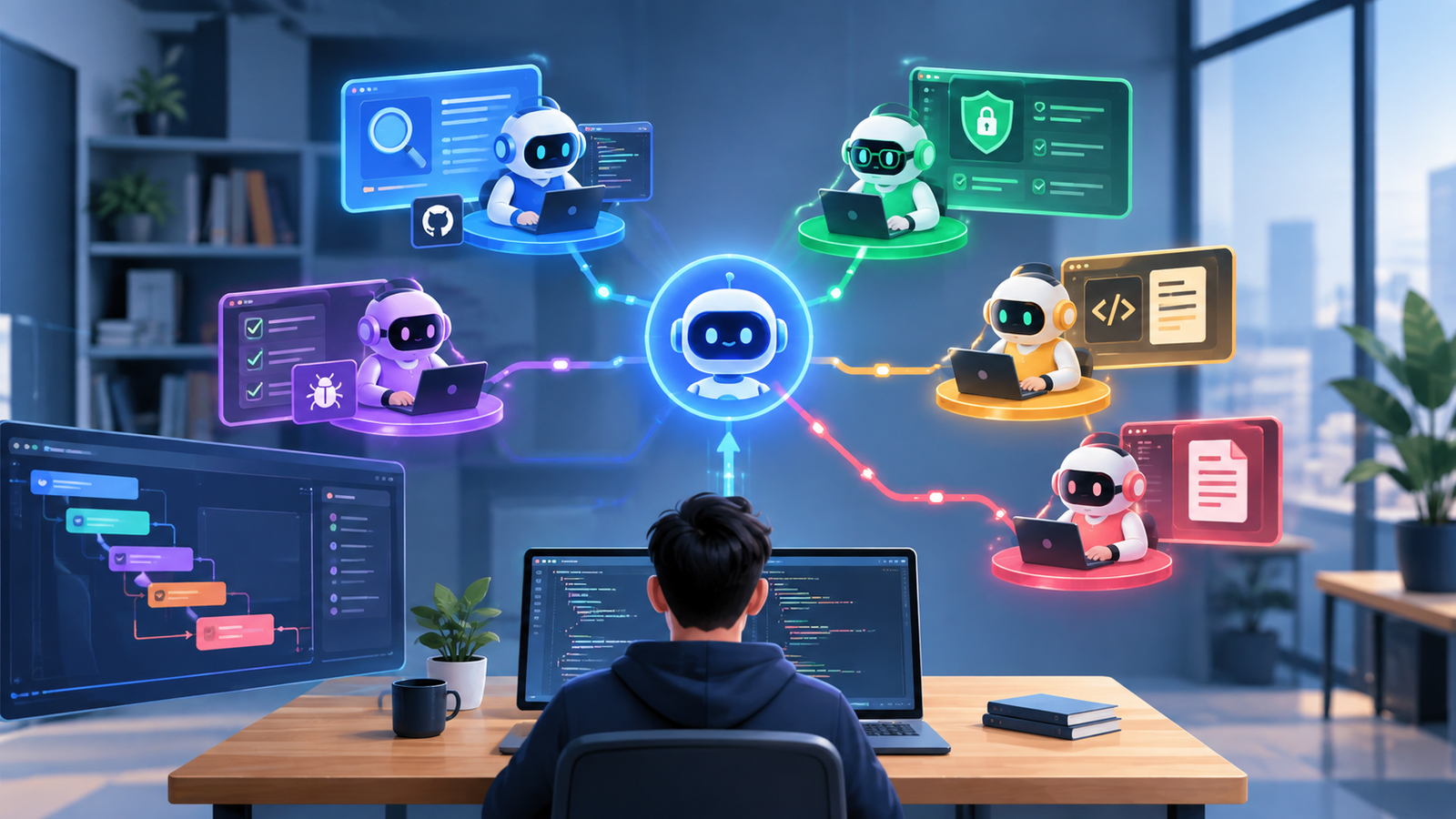
Software development is changing rapidly as AI moves beyond simple code suggestions and chat-based assistance. Parallel AI agents allow developers to divide complex tasks among multiple specialized agents and execute suitable tasks at the same time. Instead of asking one AI system to research, code, test, debug, and document an entire project, developers can create a coordinated team of AI agents with clearly defined responsibilities.
This approach is becoming particularly relevant as developers experiment with multi-agent systems, autonomous coding tools, and increasingly sophisticated agentic workflows. One agent might inspect a repository while another prepares tests and another reviews security requirements.
However, running multiple AI agents is not as simple as launching several agents simultaneously. Without clear task boundaries, shared context, permissions, and coordination, agents can duplicate work, make conflicting changes, or waste resources.
The objective is therefore not to use as many agents as possible. It is to determine which tasks can run independently and create an orchestration system that keeps those agents working toward the same goal.
This guide explains parallel AI agents, how they work, where developers can use them, the problems they can create, and the best practices for building reliable parallel workflows.
What Are Parallel AI Agents?
Parallel AI agents are multiple AI agents that perform separate tasks concurrently as part of a larger workflow.
A traditional single-agent process may look like this:
Plan → Research → Code → Test → Review → Document
Each stage waits for the previous stage to finish.
A parallel workflow can instead identify tasks that do not depend on one another:
Research Agent ──┐
Testing Agent ───┼──> Coordinator → Final Result
Security Agent ──┘
The important distinction is that parallel execution does not mean every task happens at the same time. Some tasks have dependencies and must remain sequential.
For example, a testing agent cannot meaningfully test a feature before the feature exists. However, a security research agent and documentation research agent may be able to work while the implementation is being prepared.
Parallel AI Agents Definition
A simple parallel AI agents definition is:
Multiple AI agents working concurrently on independent or partially independent tasks that contribute to a shared objective.
These agents may use different prompts, tools, models, permissions, or areas of expertise.
The concept is closely connected to multi-agent systems. In a multi-agent architecture, individual agents can specialize in different responsibilities and communicate through an orchestration layer, shared state, messages, files, or other mechanisms.
CodeCondo’s guide on multi-agent systems and AI agent teams provides additional context on how specialized agents can collaborate on complex tasks.
What Is Parallel AI?
When people ask what parallel AI is, they are generally asking how artificial intelligence can divide computational or reasoning work into multiple concurrent processes.
In an agentic environment, the idea is practical rather than purely theoretical. A larger objective is decomposed into smaller tasks, and different AI agents handle suitable portions of that work.
For example, an application modernization project could assign:
- One agent to analyze the existing architecture
- One agent to inspect dependencies
- One agent to identify security risks
- One agent to prepare test requirements
- One agent to investigate documentation requirements
The outputs can then be combined by an orchestrator or reviewed by a developer.
Why Developers Are Using Parallel AI Agents
The growth of parallel AI agents is closely connected to the increasing complexity of AI-assisted software development.
Modern development tasks rarely involve writing code alone. A feature may require requirements analysis, architecture research, implementation, testing, debugging, security review, documentation, and deployment preparation.
A single AI agent can potentially perform several of these tasks, but giving every responsibility to one agent creates a long chain of context and decisions.
Parallelization offers another model: divide the work according to expertise and dependencies.
Faster Independent Work
The most obvious advantage is concurrency.
Suppose a development task requires three independent investigations. A sequential system performs:
Research A → Research B → Research C
A parallel system can perform:
Research A + Research B + Research C
and then combine the results.
This can reduce waiting time when the tasks are genuinely independent.
However, parallelization should not be treated as an automatic speed improvement. Coordination, communication, model calls, and result validation all introduce overhead.
Specialized AI Agents
Specialization is another major benefit.
Instead of asking one general-purpose agent to perform every task, developers can create agents such as:
- Research agent
- Coding agent
- Testing agent
- Security agent
- Documentation agent
- Review agent
Each agent receives instructions appropriate to its role.
This approach makes responsibilities easier to understand and can simplify debugging when something goes wrong.
Agentic Workflows
Agentic workflows combine AI reasoning with tools, context, decision-making, and multiple steps.
An agent may inspect information, decide what action to take, call a tool, evaluate the result, and continue until its assigned objective is completed.
When several such agents are combined, the workflow becomes more powerful but also more complicated.
The challenge is determining which decisions belong to individual agents and which should be handled by the central coordinator.
For developers who want to understand how individual agents are constructed, Eduonix’s practical guide to building AI agents in 2026 covers agent architecture, tools, memory, workflows, and implementation concepts.
How Parallel AI Agents Work
A reliable parallel AI agents workflow normally begins with a single objective and then decomposes that objective into smaller tasks.
1. Define the Main Objective
First, define exactly what the system needs to accomplish.
For example:
Add a new authentication feature to an existing web application and validate the implementation.
This objective is still too broad for a group of agents.
The coordinator must determine what individual tasks are required.
2. Break the Objective Into Tasks
The system might divide the objective into:
| Task | Agent |
| Inspect authentication architecture | Analysis agent |
| Review security requirements | Security agent |
| Prepare implementation | Coding agent |
| Create test cases | Testing agent |
| Review completed changes | Review agent |
The next step is to determine which tasks are independent.
The analysis, security research, and test planning may be able to begin independently. Implementation may depend on some of their findings.
3. Assign Specialized Agents
Each agent should receive a clear role and task.
An agent definition should ideally specify:
- Objective
- Context
- Available tools
- Allowed actions
- Expected output
- Limitations
- Completion criteria
The more clearly these boundaries are defined, the easier it becomes to coordinate multiple agents.
4. Execute Independent Tasks
Once tasks are assigned, suitable agents can operate concurrently.
A simple structure could look like:
The coordinator does not necessarily perform the actual work. Its role is to manage task allocation, dependencies, outputs, and final synthesis.


5. Combine and Validate Results
Parallel execution is only useful when results can be reliably combined.
The system may need to:
- Compare outputs
- Detect contradictions
- Resolve conflicts
- Run tests
- Validate assumptions
- Request additional work
- Escalate uncertain results
This final stage is particularly important because several agents can produce technically reasonable outputs that do not work well together.
OpenAI’s official Agents SDK documentation describes agents that can use tools, work with other agents, maintain context, and grow into more advanced orchestration patterns.
Parallel AI Agents for Coding and Software Development
Software development is a natural environment for experimenting with parallel AI coding agents because a software project contains many specialized activities.
Developers can divide a feature into research, implementation, testing, security, and review rather than expecting one AI system to perform everything.
Codebase Analysis
An analysis agent can inspect the repository before any code is changed.
It can identify:
- Relevant files
- Existing architecture
- Dependencies
- Coding conventions
- Related functions
- Potential integration points
The agent can then return a structured report to the coordinator.
Parallel Coding Tasks
A large project may contain genuinely independent modules.
For example, if a new application requires separate frontend and backend changes, the work may sometimes be divided between two agents.
However, this requires careful boundaries. If both agents need to modify the same shared files, parallel execution can create conflicts.
Testing
A testing agent can independently examine requirements and existing implementation patterns to prepare unit or integration tests.
This can happen alongside certain research or documentation tasks.
Once implementation is complete, the testing agent can execute the tests and report failures.
Security Review
A security-focused agent can inspect the implementation for common problems without being responsible for changing the code.
Keeping the security role separate can provide another perspective on the implementation.
Code Review
A review agent can examine the final changes and check:
- Maintainability
- Error handling
- Security
- Test coverage
- Coding conventions
- Unnecessary complexity
CodeCondo’s AI coding agents guide explains the broader distinction between AI agents and predefined AI workflows and how autonomous agents are being used in software development.
Example: Parallel AI Agents for Coding
Imagine a developer wants to introduce a payment feature.
The workflow could use:
Agent 1 — Architecture: identifies where payment functionality belongs.
Agent 2 — Security: researches security requirements and potential risks.
Agent 3 — Testing: prepares test scenarios based on the requirements.
Agent 4 — Coding: implements the approved feature.
Agent 5 — Review: evaluates the completed changes.
The coding agent does not necessarily need to wait for every task. Some research and test planning can occur in parallel.
This is where parallel AI agents for coding can provide value.
How AI Agent Orchestration Prevents Chaos
Multiple autonomous agents can quickly become difficult to manage. This is why AI agent orchestration is one of the most important parts of a multi-agent architecture.
Orchestration determines who does what, when tasks start, what information agents receive, and how their outputs are combined.
Give Every Agent a Clear Role
Avoid instructions such as:
Improve the entire application.
A better instruction might be:
Review the authentication module for security issues. Do not modify files. Return findings with the affected file, issue, severity, and recommended remediation.
Clear roles reduce duplicate work.
Manage Dependencies
Not every task belongs in parallel.
For example:
Requirements → Implementation → Testing
contains strong dependencies.
But:
Security Research + Documentation Research + Test Planning
may be performed concurrently.
Developers should therefore create a dependency graph before launching multiple agents.
Control Shared State
Shared state is one of the biggest challenges in parallel systems.
Two agents modifying the same file can produce conflicting results.
Possible controls include:
- Separate branches
- Isolated workspaces
- File ownership
- Read-only permissions
- Explicit merge stages
- Version control
- Checkpoints
The objective is to ensure that agents do not unknowingly overwrite one another.
Standardize Agent Outputs
Agents should return predictable information.
For example:
Agent: Security Reviewer
Status: Complete
Findings:
- Issue
- Severity
- Affected file
- Recommended action
Confidence: High
Structured output makes it easier for an orchestrator to process results automatically.
Eduonix’s article on how AI agents coordinate work in software systems discusses task decomposition, communication, dependencies, and coordination across complex software environments.
Common Problems With Parallel AI Agents
The biggest mistake developers can make is assuming that more agents automatically produce better results.
Conflicting Changes
Two agents may edit the same function differently.
Agent A may refactor a function while Agent B changes its input handling.
When both outputs are combined, one change may overwrite the other.
Solution: establish ownership rules and controlled merge points.
Duplicate Work
Without a task registry, multiple agents may independently investigate the same problem.
This wastes model calls and increases costs.
Solution: maintain a shared task list that records assigned, active, completed, and failed tasks.
Context Fragmentation
Each agent has its own context.
An agent may discover an important architectural detail that another agent does not know about.
Solution: use structured shared state, artifacts, summaries, or explicit handoffs rather than assuming agents automatically understand each other’s work.
Endless Loops
An autonomous agent may repeatedly attempt the same failed action.
For example:
Test fails → Modify code → Test fails → Modify code → Test fails
Solution: establish retry limits, checkpoints, and escalation rules.
Increasing Costs
More agents mean more model calls.
Anthropic’s engineering documentation on its multi-agent research system notes that multi-agent architectures can consume substantially more tokens than ordinary chat interactions, making task value and parallelizability important considerations.
Developers should therefore measure:
- Token consumption
- Number of agent calls
- Execution time
- Success rate
- Retry rate
- Human intervention
Security and Permission Risks
An autonomous agent with broad permissions can potentially make unwanted changes.
Every agent should receive only the access required for its assigned task.
A research agent may need web access but no repository write access.
A testing agent may need to execute tests but should not necessarily have deployment permissions.
Best Practices for Building a Parallel AI Agents Workflow
A successful parallel AI agents workflow begins with careful task design.
Start With Independent Tasks
Look for tasks that can be performed without waiting for another agent.
Good candidates include:
- Independent research
- Repository analysis
- Security investigation
- Documentation research
- Test planning
Do not force dependent tasks into parallel execution simply to increase the agent count.
Keep Agents Specialized
Each agent should have a focused responsibility.
A security agent should not also be responsible for documentation unless there is a clear reason to combine those roles.
Specialization makes outputs easier to evaluate.
Limit Concurrency
Start with a small number of agents.
Two or three well-coordinated agents can be more useful than ten agents producing overlapping results.
Increase concurrency only after measuring whether additional agents improve the workflow.
Use Human Checkpoints
Human oversight remains useful for high-impact actions.
Require review before:
- Merging important code
- Deploying to production
- Changing infrastructure
- Accessing sensitive data
- Making irreversible changes
The objective is not to remove developers from the workflow. It is to let them spend more time on decisions that require engineering judgment.
Monitor Agent Activity
A production system should make it possible to determine:
- Which agent performed an action
- Which tools it used
- What information it received
- What files it changed
- How long it ran
- Whether it failed
- Why it failed
Observability makes complex agentic systems easier to debug.
Evaluate the Entire Workflow
Testing individual agents is not enough.
A multi-agent system should also be evaluated as a complete process.
Useful measurements include:
| Metric | Purpose |
| Completion time | Measures workflow speed |
| Success rate | Measures reliability |
| Token usage | Measures model consumption |
| Retry rate | Identifies instability |
| Conflict rate | Measures coordination problems |
| Human intervention | Measures autonomy |
| Final quality | Measures usefulness |
Parallel AI Agents Examples
The best way to understand parallel AI agents examples is to look at tasks where independent workstreams naturally exist.
Software Development
A development team can assign:
- Architecture analysis
- Security analysis
- Test planning
- Coding
- Documentation
to different agents.
The coordinator then manages dependencies and combines the results.
Research
Research is another strong use case.
One agent can investigate technical documentation, another can research market information, and another can examine competing approaches.
Anthropic has publicly described a multi-agent research system in which a lead agent delegates research tasks to specialized subagents working in parallel. Its engineering team also describes the importance of clear task boundaries, observability, guardrails, and evaluation when operating such systems.
The example demonstrates an important principle: parallel agents work particularly well when the problem contains multiple independent directions.
Business Workflows
A business workflow could use agents for:
- Market research
- Competitor analysis
- Data processing
- Report preparation
- Quality review
The agents can produce specialized outputs while a central system coordinates the final report.
The Future of Parallel AI Agents
The parallel AI agents programming trend is likely to continue as developers become more comfortable with agentic software architectures.
Modern agent platforms are increasingly providing tools for orchestration, handoffs, state management, observability, and controlled execution.
OpenAI’s current agent documentation describes systems in which agents can work with tools and other agents while maintaining context across multiple steps. Its platform documentation also includes guidance for orchestration and multi-agent workflows.
More Specialized Autonomous Agents
Future systems may contain specialized agents for:
- Coding
- Testing
- Security
- Infrastructure
- Documentation
- Product analysis
- Research
Rather than replacing every software process with one autonomous system, organizations may build coordinated collections of specialized agents.
AI Agent Marketplaces
An AI agent marketplace could make specialized agents available as reusable components.
Developers could select an agent based on its capabilities, connect it to an orchestration system, define permissions, and place it into a larger workflow.
The important challenge will be compatibility, security, reliability, and evaluation.
Better AI Agent Orchestration
As systems become more complex, orchestration will become increasingly important.
Future orchestration systems may improve:
- Task allocation
- Agent communication
- Context management
- Error recovery
- Cost optimization
- Monitoring
- Human approvals
The goal will not simply be to run more agents. It will be to coordinate them more intelligently.
Parallel AI Agents for Beginners
For beginners, the best starting point is simple.
Do not begin with ten autonomous agents.
Start with two:
Agent 1: Research
Agent 2: Review
Then introduce a third agent when there is a clear reason.
This makes it easier to understand how context, communication, permissions, and dependencies affect the system.
FAQs About Parallel AI Agents
What are parallel AI agents?
Parallel AI agents are multiple AI agents that work concurrently on independent or partially independent tasks that contribute to a larger objective. A coordinator can combine and validate their results.
How do parallel AI agents work?
They work by breaking a larger objective into smaller tasks, assigning those tasks to specialized agents, running independent tasks concurrently, collecting the results, and validating the combined output.
What are parallel AI agents used for?
They can be used for software development, research, testing, security analysis, documentation, business analysis, and other tasks where a larger objective can be divided into independent workstreams.
Are parallel AI agents useful for coding?
Yes. Parallel AI agents for coding can divide development responsibilities among agents for repository analysis, implementation, testing, security review, and documentation. However, shared files and dependencies must be carefully controlled.
What is AI agent orchestration?
AI agent orchestration is the process of coordinating multiple agents, including assigning tasks, managing dependencies, controlling context and permissions, collecting outputs, handling failures, and determining when the overall workflow is complete.
Conclusion
Parallel AI agents offer developers a practical way to divide complex work among specialized AI systems.
Instead of relying on one agent to handle every stage of a project, developers can create a coordinated workflow where different agents research, code, test, review, and analyze different parts of the problem.
The main advantage comes from parallelizing work that is genuinely independent. The main challenge comes from coordinating that work.
Without clear roles, agents can duplicate tasks. Without dependency management, they can work in the wrong order. Without shared context, they can miss important information. Without permissions and checkpoints, they can make unwanted changes.
The solution is thoughtful AI agent orchestration.
Developers should begin with a small number of specialized agents, clearly define their responsibilities, identify which tasks can run concurrently, isolate shared resources, standardize outputs, and monitor the complete workflow.
As autonomous agents become more capable, these coordination skills will become increasingly important. The future of AI-assisted development is unlikely to depend solely on one powerful model. Instead, developers may increasingly work with coordinated teams of specialized AI agents.
The real opportunity is therefore not simply running more agents.
It is learning how to make multiple agents work together without chaos.