Introduction
Multi-Agent Systems are transforming how developers solve complex problems in 2026. Instead of depending on one AI model to handle every step, teams of specialized AI agents now collaborate, share information, and complete tasks together. This approach is powered by advances in artificial intelligence, machine learning, and distributed system design. Developers in the United States and Europe are increasingly adopting Multi-Agent Systems to improve reliability, scalability, and performance on real-world workloads.
In this guide, we explain what Multi-Agent Systems are, how they differ from single-agent setups, the core technologies behind them, and practical ways developers are building them today.
What Are Multi-Agent Systems in AI?
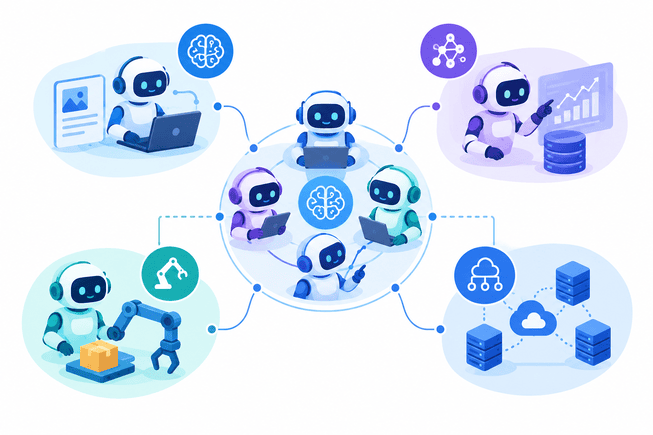
Multi-Agent Systems in AI are collections of autonomous agents that work together toward shared or complementary goals. Each agent has its own role, tools, memory, and decision-making ability. Rather than forcing one large model to manage every part of a task, Multi-Agent Systems divide the work so agents can specialize.
One agent may plan the approach, another may gather information, a third may write code or generate content, and a fourth may verify results. Communication happens through structured messages, shared memory, or an orchestration layer. This design builds on long-standing research in artificial intelligence and distributed systems. Modern implementations usually rely on large language models as the reasoning core for each agent, which gives the overall system greater flexibility and better handling of long-horizon tasks.
Multi-Agent Systems vs Single-Agent Systems
A single-agent system uses one AI model to complete an entire task from beginning to end. It is simpler to build and works well for straightforward requests. However, it often struggles with complex, multi-step problems that require different skills or parallel exploration.
Multi-Agent Systems address this limitation by assigning specialized roles. Research from Anthropic has shown that coordinated agent teams can significantly outperform single agents on certain research and problem-solving benchmarks. According to Anthropic’s findings on multi-agent research systems, a lead agent working with specialized sub-agents achieved strong gains on tasks that required broad exploration. You can read more about their approach in the Anthropic multi-agent research system report.
The main trade-off is added complexity. Developers must manage communication between agents, prevent conflicting actions, and control costs. When designed carefully, Multi-Agent Systems deliver higher accuracy and better scalability than single-agent approaches for many real-world problems.
Core Technologies Behind Multi-Agent Systems
Artificial Intelligence and Machine Learning Foundations
Artificial intelligence and machine learning form the foundation of every modern Multi-Agent System. Large language models supply the reasoning capability, while machine learning techniques help agents improve through experience or feedback. The combination of artificial intelligence and machine learning allows agents to understand natural language instructions, call tools, and adapt to new situations. Without these core technologies, Multi-Agent Systems would remain limited to rigid rule-based designs.
AI Reinforcement Learning in Multi-Agent Environments
AI reinforcement learning becomes especially useful when agents must learn effective behaviors through interaction. In multi-agent settings, agents receive rewards or penalties based on both individual actions and overall team success. This approach, often called multi-agent reinforcement learning, helps agents discover collaboration strategies that would be difficult to program by hand.
Developers apply AI reinforcement learning in simulations, games, and robotics scenarios. Understanding what AI reinforcement learning and how an AI reinforcement learning agent operates is becoming an important skill for teams building advanced Multi-Agent Systems. The technique is particularly valuable when explicit rules cannot cover every possible situation the agents will face.
Distributed System Principles for Agent Coordination
Multi-Agent Systems are inherently a form of distributed system. Agents frequently run on different processes or machines and must communicate reliably. Concepts from distributed systems principles and paradigms such as message passing, consensus, fault tolerance, and eventual consistency apply directly.
Developers often compare distributed systems vs microservices when designing agent architectures. Many Multi-Agent Systems adopt patterns similar to microservices, where each agent acts as a lightweight service with clear interfaces. Knowledge of types of distributed systems and real examples of distributed systems helps engineers avoid common coordination failures and design more resilient agent teams.
Designing Multi-Agent Systems
Multi-Agent Systems with AutoGen
AutoGen remains one of the most widely used open-source frameworks for building Multi-Agent Systems with AutoGen. It allows developers to define agents with different roles and lets them converse to solve tasks. Teams use AutoGen for coding assistants, research workflows, and automated testing pipelines. The framework handles much of the conversation management and tool calling, which reduces the amount of custom orchestration code required. Many developers begin with AutoGen when they want to prototype multi-agent collaboration quickly.
Popular Frameworks and Architecture Patterns
Besides AutoGen, frameworks such as LangGraph, CrewAI, and the OpenAI Agents SDK have matured significantly by 2026. Common architecture patterns include hierarchical designs (one supervisor agent directing others), sequential pipelines, and fully decentralized peer-to-peer setups.
Choosing the right pattern depends on the problem. Hierarchical designs work well for controlled enterprise workflows. Peer-to-peer approaches suit open-ended research or creative tasks. Successful designing multi-agent systems requires matching the architecture to the coordination needs of the specific use case rather than forcing one pattern onto every project.
Real-World Use Cases of Multi-Agent Systems
Robotics and Autonomous Systems
Robotics and autonomous systems have used Multi-Agent Systems for years. Swarms of drones, warehouse robots, and multi-robot teams rely on agent coordination to avoid collisions and complete shared missions. In 2026, the combination of classical robotics control with modern language-model agents is creating more flexible autonomous systems. Agents can interpret high-level human instructions and translate them into low-level robot actions while coordinating with teammates in real time.
Enterprise and Developer Workflows
In software teams, Multi-Agent Systems now handle code generation, review, testing, and documentation in parallel. One agent writes code, another checks for security issues, and a third generates tests. Companies are also deploying agent teams for customer support, research synthesis, and internal process automation. These systems reduce repetitive work and free human developers for higher-level decisions.
For practical guidance on building individual agents, see this step-by-step guide to creating your first AI agent with Python on Eduonix. Additional insights on different agent types are available in Types of AI Agents Explained with Simple Examples on CodeCondo.
Benefits and Challenges of Multi-Agent Systems
The main benefits of Multi-Agent Systems include better handling of complex tasks, improved specialization, higher reliability through redundancy, and the ability to scale by adding more agents. Parallel work can also reduce overall completion time for certain classes of problems. Gartner has highlighted Multiagent Systems as one of the top strategic technology trends, noting their potential to transform processes by dividing work among specialized agents.
Challenges remain significant. Communication overhead can increase token costs. Agents may disagree or enter repetitive loops. Debugging interactions across multiple agents is harder than debugging a single model. Security and permission management become more complicated when agents can call tools and share data. Developers must carefully design guardrails, monitoring, and fallback mechanisms. Without these controls, Multi-Agent Systems can become unpredictable or expensive to operate.
Best Practices for Building Multi-Agent Systems in 2026
Start with a clear division of roles. Give each agent a focused responsibility and a limited set of tools. Prefer structured communication over free-form chat whenever possible. Implement strong observability so you can see what each agent is doing and why it made a particular decision.
Control costs by limiting the number of parallel agents and setting token budgets. Add human-in-the-loop checkpoints for high-stakes decisions. Test coordination failures early in the development process. Many teams begin with simple hierarchical designs before moving to more complex patterns.
Learning from production experience is essential. Complementary reading includes Memory-Driven Agents on Eduonix and AI Coding Agents: How Autonomous Code Generation Will Shape 2026 on CodeCondo. For deeper insight into coordination challenges, the Anthropic research on patterns and problems in multiagent systems provides valuable real-world observations.
Conclusion
Multi-Agent Systems represent one of the most practical advances in artificial intelligence for developers in 2026. By combining specialized agents with solid distributed system principles, teams can tackle problems that were previously too complex for single models. Success depends on thoughtful design, clear roles, reliable communication, and continuous monitoring. Developers who master these skills will be well positioned as Multi-Agent Systems move from experimental projects into everyday production tools.
Frequently Asked Questions
What are Multi-Agent Systems in simple terms?
They are teams of specialized AI agents that collaborate to solve problems no single agent could handle efficiently alone.
Do I need reinforcement learning to build Multi-Agent Systems?
Not always. Many current systems rely primarily on large language models and careful prompt design. AI reinforcement learning becomes useful when agents must learn complex behaviors through trial and error.
Are Multi-Agent Systems ready for production use?
Yes, for carefully scoped use cases. Many organizations already run them in research, coding assistance, and internal automation workflows. Full autonomy in open environments still requires strong human oversight.
Which framework should beginners start with?
AutoGen and CrewAI are popular starting points because of their relatively gentle learning curves and active communities.