
Introduction
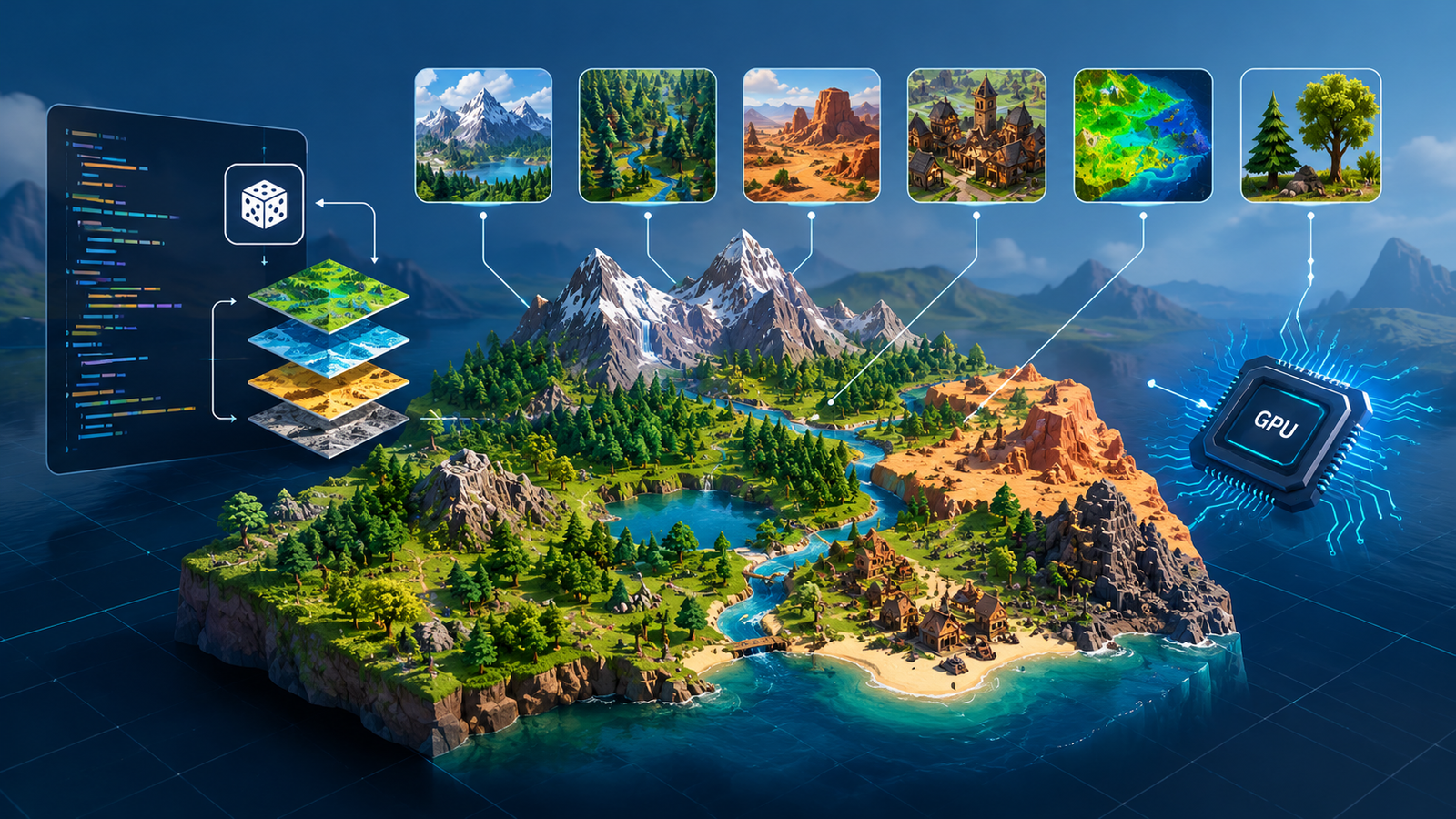
Procedural Content Generation is transforming how game developers create environments, levels, terrain, and interactive experiences. Instead of designing every element manually, developers use algorithms, mathematical functions, and predefined rules to generate content automatically. This approach can reduce repetitive work, increase variety, and make games more replayable.
For independent developers and large studios, procedural content generation in games offers a practical way to build expansive environments using reusable assets and intelligent generation systems. When combined with GPU compute, these systems can also process suitable calculations in parallel, helping developers handle terrain data, environmental simulations, and other computationally intensive tasks.
However, successful generation requires more than randomness. Developers need effective algorithm design, carefully defined constraints, performance optimization, and tools that fit their projects.
This guide explores seven procedural generation techniques, explains how GPU compute supports them, and examines the tools, frameworks, and best practices developers can use to create dynamic game worlds.
What Is Procedural Content Generation?
Procedural Content Generation (PCG) is the process of creating digital content through algorithms, rules, mathematical functions, or trained models rather than manually creating every individual element.
In game development, procedural content generation can create:
- Terrain, mountains, rivers, and landscapes.
- Dungeons, maps, and playable levels.
- Vegetation, buildings, rocks, and environmental details.
- Items, quests, and variations in gameplay encounters.
- Textures, patterns, and certain animation-related data.
Developers establish the rules and constraints, while the generation system produces content that follows them.
For example, a survival game might use world generation algorithms to distribute forests, lakes, caves, and resource locations across a large map. Different players could encounter different layouts while the system maintains rules that prevent important resources from appearing in inaccessible locations.
Choosing the right engine is an important step when implementing procedural content generation. Developers should compare available features, performance, platform support, and workflow flexibility before selecting a tool. Read Eduonix’s guide to the top five game development engines to understand the differences between popular engines and choose an environment that fits your project requirements.
Types of Procedural Generation
There are several types of procedural generation, each suited to different development requirements.
Rule-based generation: Developers define conditions that determine how content is created. This approach works well for structured environments, buildings, and item placement.
Noise-based generation: Mathematical noise functions create natural-looking variation for terrain, textures, clouds, and environmental features.
Simulation-based generation: A system models processes such as erosion, ecological growth, or resource distribution to produce believable results.
Learning-based generation: Machine learning models learn patterns from existing content and use those patterns to generate new variations.
These approaches can also be combined. For example, a terrain generator might use noise for elevation, rules for biome placement, and a simulation to approximate erosion.
Procedural Generation vs. Handcrafted Content
| Factor | Procedural generation | Handcrafted content |
| Production | Algorithms create variations | Designers create individual elements |
| Variety | Potentially extensive | Depends on available assets |
| Creative control | Depends on rules and constraints | Direct artistic control |
| Replayability | Can produce different layouts | Often uses fixed layouts |
| Best application | Large worlds and repeatable systems | Story-critical or carefully designed areas |
Neither approach is universally better. Many projects benefit from combining handcrafted landmarks with procedurally generated environments to balance variety and artistic direction.
How Procedural Content Generation Works
Procedural content generation transforms inputs and rules into usable content. Although implementations vary, most systems follow a similar workflow.
Rules, Seeds, and Algorithm Design
First, developers define what the generator should create. The target might be a terrain map, dungeon, forest, or collection of objects.
Next, the algorithm determines how the output will be structured. A random seed controls the sequence of generated values. When the same seed is used with the same algorithm and compatible settings, the system can reproduce the same result. This makes debugging, testing, and sharing generated levels easier.
Good algorithm design also establishes constraints. A dungeon generator, for example, should create connected rooms, maintain valid pathways, and avoid placing exits inside blocked areas.
From Random Values to Meaningful Worlds
Random values alone do not guarantee enjoyable gameplay. A useful generator transforms those values into content that follows design principles.
A typical workflow includes:
- Define the map dimensions and generation rules.
- Create an initial distribution of terrain or room data.
- Apply procedural generation techniques to introduce variation.
- Validate the output against gameplay requirements.
- Build or update the necessary game objects.
- Test the result for performance, accessibility, and playability.
These stages make procedural content generation easier to maintain because developers can identify which part of the process produces an undesirable result.
For example, if a generated level contains unreachable rooms, the problem may lie in the layout algorithm or connectivity checks rather than the rendering system.
A procedural content generation framework can organize these stages into reusable components. Developers can then modify generation rules without rebuilding the entire system.
7 Procedural Generation Techniques for Game Development
Different procedural generation techniques solve different design problems. The following seven methods provide a practical starting point for developers.


1. Random and Seeded Generation
Random generation introduces variation into object placement, room layouts, loot distribution, and environmental details. Seeded randomness makes the results reproducible.
This approach is useful for roguelikes, randomized missions, and games where each session should offer a different experience.
The main challenge is controlling quality. Developers should establish limits for object density, resource placement, difficulty, and other gameplay factors.
2. Noise-Based Terrain Generation
Noise functions create smooth, continuous variation that works well for landscapes. Developers can combine noise at different scales to produce broad hills, smaller terrain features, and irregular surface details.
Procedural world generation techniques often use noise to create elevation maps before assigning water, vegetation, and biomes.
Noise alone does not understand geography. Additional rules are needed to create believable coastlines, connected rivers, and traversable terrain.
3. Rule-Based and Grammar-Based Generation
Rule-based systems create content by applying explicit conditions. Grammar-based approaches use production rules to expand a structured representation into more complex content.
For example, a building generator might begin with a building type, select a floor plan, place rooms, and add doors and windows according to structural rules.
These methods are useful when content must follow recognizable patterns rather than look completely random.
4. Procedural Map and Level Generation
Procedural map generation techniques create playable layouts for dungeons, tactical maps, platformers, and exploration games.
Common methods include room-and-corridor generation, cellular automata, graph-based layouts, and constraint-based placement.
A good generator checks connectivity, difficulty progression, available space, and player movement. These checks help ensure that generated content remains playable instead of merely looking interesting.
5. Simulation-Based Generation
Simulation-based systems use modeled processes to create more complex results. Examples include simulated erosion for terrain, ecological rules for vegetation, and resource models for settlements.
These systems can produce convincing variation, but their computational cost depends on simulation complexity and the amount of data being processed.
Developers can generate expensive results offline and load them at runtime, or simplify the simulation when immediate updates are required.
6. Machine Learning and Reinforcement Learning
Procedural content generation via machine learning (PCGML) uses learned patterns to produce or evaluate content. A model might learn characteristics of existing levels and generate new layouts with similar structural properties.
Procedural content generation via reinforcement learning takes a different approach. An agent learns through feedback and rewards. In experimental systems, it may help search for layouts that satisfy objectives or provide a desired level of challenge.
These methods require careful evaluation. Training data, reward design, computational costs, and unpredictable outputs can affect results. They should not be assumed to outperform conventional algorithms in every project.
7. Generative AI-Assisted Content Creation
Procedural content generation via generative artificial intelligence can help developers explore concepts, propose variations, and create draft content from prompts or examples.
AI-assisted systems might suggest quest structures, generate text descriptions, or help create variations that designers refine before release.
A practical workflow combines generation with validation. Developers should check technical compatibility, content quality, originality requirements, and consistency with the game’s design.
For many projects, conventional rules remain responsible for critical gameplay constraints while AI supports selected creative tasks.
GPU Compute and Parallel Processing
GPU compute allows developers to run suitable calculations across many GPU processing units in parallel. This can be valuable when procedural content generation requires large numbers of similar operations.
A CPU often manages gameplay logic, orchestration, and tasks with complex dependencies. A GPU can be effective for operations such as updating terrain samples, calculating particle behavior, or processing large grids of environmental data.
How Compute Shaders Accelerate Procedural Generation
Compute shaders are programs that run on the GPU outside the traditional graphics-rendering pipeline. They are useful for general-purpose calculations that can be divided into parallel work.
For example, a terrain generator could calculate elevation values for thousands of grid points. If each point can be processed largely independently, a GPU compute shader may calculate those values in parallel.
Unity provides compute shader support for this type of work. Developers can explore the official Unity ComputeShader documentation to understand its API. Microsoft’s compute shader overview also explains how compute shaders support parallel processing in Direct3D.
A Practical GPU Compute Shader Example
The following Python example demonstrates a simple procedural terrain generation algorithm that calculates height values for each point in a two-dimensional grid using mathematical functions. It illustrates the basic logic behind terrain generation by creating height variations across the grid.
import math

# Define grid width and scale
Width = 8
Scale = 0.5

# Create an empty height array
Heights = [0.0] * (Width * Width)

# Generate height values
for y in range(Width):
for x in range(Width):

# Calculate the array index
index = y * Width + x

# Calculate scaled position
position_x = x * Scale
position_y = y * Scale

# Calculate terrain height
height = math.sin(position_x) * math.cos(position_y)

# Store the height value
Heights[index] = height

# Display the generated terrain heights
print("Generated Terrain Heights:\n")

for y in range(Width):
for x in range(Width):
index = y * Width + x
print(f"{Heights[index]:.2f}", end=" ")
print()
The kernel assigns work to individual grid coordinates and stores a calculated value in a buffer. A Unity C# script must create and bind the buffer, set Width and Scale, dispatch enough thread groups, and read or use the resulting data. The output could then feed a mesh-generation process or another stage of the procedural pipeline.
This example produces a simple mathematical pattern, not production-quality terrain noise. Real projects must also validate buffer dimensions, manage GPU resources, handle platform support, and ensure that thread-group counts cover the intended grid.
GPU compute is not automatically faster for every task. Moving data between the CPU and GPU, synchronizing results, and allocating resources can introduce overhead. Benchmark the complete workflow before deciding which operations belong on the GPU.
Procedural Generation in Indie Games and Unity
Procedural generation in indie games can help small teams create larger-feeling experiences without manually designing every environment. It is particularly useful for roguelikes, survival games, simulation games, and exploration-focused titles.
However, generation should support the game’s design rather than replace it.
Building Replayable Environments
Indie developers can use procedural content generation to vary maps, encounters, collectibles, and environmental layouts between playthroughs. A fixed set of reusable assets can produce many combinations when paired with effective generation rules.
For example, a survival game might generate different forest layouts while preserving safe starting areas, resource balance, and access to essential locations. Designers can manually build important landmarks and let algorithms create the surrounding environment.
Developers should also establish quality checks. Generated areas need reasonable navigation paths, balanced resource distribution, and appropriate difficulty. Testing multiple seeds can reveal problems that a single successful test might miss.
For more background on the tools available to smaller studios, read Eduonix’s guide to the rise of indie game developers.
Procedural Content Generation for Unity Game Development
Unity provides a flexible environment for implementing procedural content generation through C# scripts, procedural meshes, terrain systems, and compute shaders.
A practical development workflow can include:
- Generating layout data using C# algorithms.
- Converting generated coordinates into game objects or mesh geometry.
- Applying noise functions to terrain and environmental features.
- Using compute shaders for suitable parallel calculations.
- Loading and unloading world sections as players explore.
- Testing generated content across supported hardware.
A hybrid approach often works best. The CPU can manage world rules and gameplay decisions, while the GPU handles computationally intensive tasks that benefit from parallel execution.
Unity developers should verify compute shader support on their target platforms and provide an alternative for devices that do not support the required functionality.
For additional programming practice, CodeCondo’s guide to C++ projects for building development skills offers ideas for hands-on development exercises.
Procedural Content Generation Tools and Frameworks
The right procedural content generation tools depend on the type of content, engine, team experience, and performance requirements.
Engines, Libraries, and Development Tools
Unity: Unity supports scripted generation, procedural meshes, terrain workflows, and GPU compute through compute shaders. It can suit developers who want to integrate generation directly into a game project.
Unreal Engine: Unreal Engine provides procedural workflows for building environments and managing complex scenes. Its Procedural Content Generation framework is designed to help developers create rule-driven environments.
Godot: Godot can support custom generation systems through GDScript, C#, procedural mesh APIs, and shaders. It is worth considering for developers who prefer an open-source engine and want control over their generation architecture.
Custom algorithms and libraries: A custom framework may be appropriate when a project needs specialized map generation, deterministic simulation, or integration with an existing content pipeline.
Developers experimenting with AI can also use machine learning libraries, but they should consider training costs, model size, inference speed, and the need to validate generated content.
Choosing the Right Framework
Use these criteria when evaluating procedural content generation tools:
| Requirement | What to evaluate |
| Content type | Terrain, levels, assets, or simulations |
| Performance | CPU, GPU, memory, and generation time |
| Control | Rules, constraints, and reproducible results |
| Integration | Compatibility with the chosen engine |
| Portability | Support for target platforms |
| Maintenance | Debugging, documentation, and team skills |
A framework is useful only when it solves the project’s actual problems. Before adopting one, build a small prototype that generates representative content and measure its performance.
Challenges, Optimization, and Best Practices
Even well-designed procedural content generation systems can produce poor results if their rules, performance, or testing strategy are inadequate.
Performance, Memory, and GPU Synchronization
Generating a large world can consume substantial processing time and memory. GPU compute can help with parallelizable calculations, but poorly managed data transfers or synchronization can reduce its benefits.
Consider these practices:
- Generate only the content needed for the current gameplay area.
- Use chunking to divide large worlds into manageable sections.
- Cache reusable results when appropriate.
- Avoid unnecessary CPU-to-GPU and GPU-to-CPU transfers.
- Profile generation time, frame rate, and memory consumption.
- Use simpler algorithms when detailed simulation is unnecessary.
For large environments, asynchronous generation can help prevent visible interruptions. However, the implementation should ensure that generated data is ready before the game attempts to use it.
Maintaining Quality and Player Experience
Procedural content generation should produce meaningful variation, not merely a large quantity of content.
Use constraints to protect important gameplay requirements. Validate navigation, object placement, encounter difficulty, and resource availability before generated content reaches the player.
A reliable testing process should include:
- Repeating generation with known seeds.
- Testing many different seeds and parameter combinations.
- Checking edge cases and invalid outputs.
- Measuring performance on lower-powered target devices.
- Reviewing the generated results through actual gameplay.
Keep important story locations or carefully designed encounters handcrafted when precise control matters. This hybrid approach allows procedural systems to provide variety while preserving the intended experience.
CodeCondo’s article on future gaming technology and procedural narratives provides additional context on how generated locations, environments, and gameplay variations can contribute to more dynamic experiences.
Frequently Asked Questions
How Does Procedural Generation Work?
Procedural generation uses algorithms, rules, random values, or learned models to create content automatically. Developers define constraints and inputs, then validate the generated output to ensure that it meets technical and gameplay requirements.
Is Procedural Generation Suitable for Indie Games?
Yes. Procedural generation in indie games can help small teams create varied environments, maps, and encounters from reusable assets. The best results come from combining automated generation with deliberate design rules and quality testing.
Can GPUs Generate Game Worlds in Real Time?
GPUs can accelerate suitable parts of world generation, particularly calculations that can run in parallel. However, full world generation also involves data management, gameplay rules, and asset creation, which may require CPU processing. Real-time performance depends on the algorithm, hardware, and implementation.
How Does Machine Learning Improve Procedural Content Generation?
Machine learning can identify patterns in existing content and use them to generate new variations or evaluate candidate designs. Reinforcement learning can help explore solutions to defined objectives. Both approaches require suitable data, evaluation methods, and quality controls.
What Tools Are Useful for Procedural Content Generation?
Unity, Unreal Engine, Godot, custom algorithms, and specialized generation libraries can all be useful. The best choice depends on the game engine, type of content, target hardware, performance requirements, and the team’s experience.
Conclusion
Procedural Content Generation gives game developers a flexible way to create varied environments, levels, assets, and interactive experiences. From seeded randomness and noise-based terrain to rule-based systems, simulation, machine learning, and generative AI, different techniques offer solutions for different design challenges.
GPU compute adds another capability by accelerating suitable calculations through parallel processing. When developers combine efficient algorithms with compute shaders, they can build more responsive generation pipelines for terrain, environmental data, and other computationally intensive tasks.
The most effective approach is not necessarily the most complex one. Start with a small generator, define clear constraints, test multiple outputs, and measure performance before expanding the system. Choose procedural content generation tools that fit your engine and target platforms, and retain handcrafted design wherever it improves gameplay.
Ultimately, procedural content generation works best when technology and design reinforce one another. By combining thoughtful algorithm design, GPU optimization, and consistent quality checks, developers can build engaging game worlds that offer variety without sacrificing playability.