Artificial intelligence is entering a new era. While AI chatbots and virtual assistants introduced millions of people to conversational AI, the next wave of innovation is focused on autonomous AI agents that can reason, plan, use tools, and execute complex tasks with minimal human input. This shift toward Agentic AI is transforming how software is built, how businesses automate operations, and how developers solve real-world problems.
At the same time, organizations are increasingly adopting open-source artificial intelligence solutions. Instead of relying solely on proprietary AI platforms, developers want greater transparency, flexibility, and control over their AI systems. Open-source frameworks make it possible to customize AI workflows, integrate different large language models (LLMs), and deploy solutions on local infrastructure when privacy or compliance is a priority.
Among the emerging projects in this space, the OpenClaw AI Agent has gained attention as a powerful framework for building intelligent, task-oriented AI applications. Rather than functioning as a traditional chatbot, OpenClaw enables developers to create autonomous agents that can plan workflows, interact with external tools, access APIs, and collaborate with other AI agents to complete sophisticated tasks.
Whether you’re a software engineer exploring AI programming tools, a startup founder looking to automate repetitive processes, or a student interested in learning about the future of AI agents, OpenClaw offers an exciting opportunity to experiment with next-generation AI automation.
In this article, we’ll explore what the OpenClaw AI Agent is, why it is attracting the developer community, its key features, practical applications, and how it is helping shape the future of open-source AI.
What Is OpenClaw?
The OpenClaw AI Agent is an open-source AI agent framework designed to help developers build intelligent systems capable of reasoning, planning, and executing multi-step tasks. Unlike traditional AI assistants that mainly generate text responses, OpenClaw enables AI agents to interact with external tools, manage workflows, and automate real-world processes.
Built around the principles of openness and flexibility, OpenClaw allows developers to inspect the source code, customize agent behavior, integrate multiple large language models, and extend functionality through plugins or APIs. This makes it suitable for everything from personal AI projects to enterprise-grade automation.
Why Was OpenClaw Created?
As AI models became more capable, developers began encountering limitations with traditional AI assistants. Most commercial platforms excel at answering questions or generating content but offer limited control over how the AI operates behind the scenes.
Some common challenges include:
- Limited customization options
- Vendor lock-in with proprietary ecosystems
- Restricted access to internal workflows
- Difficulty integrating custom tools
- Privacy concerns when using cloud-only AI services
The OpenClaw AI Agent addresses these issues by giving developers complete control over the framework. Instead of being confined to predefined capabilities, users can build AI agents that are tailored to their specific workflows and business requirements.
What Makes OpenClaw Different?
Several features distinguish OpenClaw from conventional AI applications.
Open-Source Philosophy
Unlike many commercial AI platforms, OpenClaw follows an open-source development model. Developers can examine the code, contribute improvements, and customize the framework without licensing restrictions. This collaborative approach accelerates innovation while encouraging transparency.
Built for Autonomous AI Agents
OpenClaw is designed to create AI agents that do more than answer questions. These agents can break complex problems into smaller tasks, interact with software tools, retrieve information, and make informed decisions based on available data.
Flexible and Modular Architecture
The framework supports a modular design, making it easier to connect APIs, databases, external applications, and different language models. Developers can build highly customized AI systems without starting from scratch.
Community-Driven Development
Because OpenClaw is open source, its capabilities continue to expand through community contributions. Developers worldwide help improve documentation, introduce new integrations, fix bugs, and share innovative use cases, creating a rapidly evolving ecosystem.
Why OpenClaw Is Gaining Attention
The rise of Agentic AI has created demand for platforms that provide flexibility, scalability, and transparency. The OpenClaw AI Agent aligns well with these needs, making it an increasingly popular choice among developers and organizations.
1. Open-Source Accessibility
One of OpenClaw’s greatest advantages is its accessibility. Anyone can explore the source code, modify the framework, and adapt it to unique project requirements without depending entirely on commercial vendors.
This openness encourages experimentation and lowers the barrier to innovation.
2. Community-Driven Innovation
Open-source projects often evolve faster because thousands of developers contribute improvements. As more contributors join the OpenClaw ecosystem, the framework benefits from better documentation, additional integrations, performance optimizations, and expanded functionality.
3. Cost-Effective Alternative
Many AI automation platforms charge recurring subscription fees or usage-based pricing. By supporting self-hosted deployments and customizable infrastructure, OpenClaw offers organizations greater flexibility and can help reduce long-term operational costs, depending on deployment requirements.
4. Developer Flexibility
Every AI project has unique requirements. OpenClaw enables developers to customize nearly every component of an AI system, including:
- Language models
- Memory systems
- External APIs
- Workflow logic
- Automation pipelines
- Decision-making strategies
This level of flexibility makes it valuable for startups, research teams, and enterprise development.
5. Enterprise Adoption
Businesses are increasingly seeking AI platforms that offer greater privacy, security, and governance. Since OpenClaw can be deployed on private infrastructure and integrated with existing business systems, it appeals to organizations exploring secure AI automation solutions.
6. Expanding AI Developer Ecosystem
As the demand for open-source AI continues to grow, OpenClaw benefits from a rapidly expanding ecosystem of developers, plugins, tutorials, and community resources. This collaborative environment makes it easier for newcomers to learn while enabling experienced developers to build increasingly sophisticated AI solutions.
Key Features of OpenClaw
The OpenClaw AI Agent combines several advanced capabilities that support modern AI application development.
| Feature | Benefit |
| Open-source framework | Full transparency and free customization |
| AI agent framework | Build autonomous AI agents capable of multi-step reasoning |
| Multi-agent support | Coordinate multiple AI agents for complex workflows |
| Tool integrations | Connect APIs, databases, and third-party applications |
| Local deployment | Greater privacy, security, and infrastructure control |
| Extensible architecture | Add custom modules, plugins, and integrations |
| LLM compatibility | Work with multiple large language models |
| AI workflow automation | Reduce repetitive tasks and improve productivity |
Open-Source Framework
Developers have complete access to the framework, making it possible to customize workflows, experiment with new ideas, and continuously improve AI applications without being restricted by proprietary software.
AI Agent Framework
Instead of generating one-off responses, OpenClaw enables AI agents to analyze objectives, plan actions, execute tasks, and deliver meaningful results with minimal human intervention.
Multi-Agent Support
Some complex workflows require multiple specialized AI agents working together. OpenClaw supports collaborative, multi-agent systems where different agents handle planning, coding, research, or analysis before combining their outputs into a unified solution.
Tool Integrations
Modern AI applications often need access to external systems. OpenClaw allows seamless integration with APIs, databases, search tools, development environments, productivity software, and custom business applications.
Local Deployment
Organizations handling sensitive information can deploy OpenClaw on private infrastructure, improving data privacy and reducing dependence on cloud-only AI services.
Extensible Architecture
Its modular design enables developers to expand functionality through custom plugins, integrations, and workflow components as project requirements evolve.
LLM Compatibility
OpenClaw supports multiple large language models, allowing developers to choose the model that best fits their performance, deployment, or cost requirements.
AI Workflow Automation
By combining reasoning, memory, planning, and tool usage, the OpenClaw AI Agent helps automate repetitive workflows, improve productivity, and support the development of intelligent AI-powered applications.
How OpenClaw Works
The OpenClaw AI Agent is designed to go beyond answering questions. Instead of simply generating text, it follows a structured workflow that enables it to understand objectives, plan actions, use external tools, and complete complex tasks autonomously. This workflow is one of the reasons OpenClaw is considered part of the growing Agentic AI movement.
While implementations may vary depending on the project, the overall process generally follows these stages:
1. User Prompt
Every interaction begins with a prompt or objective provided by the user. This could be a simple coding request or a larger task, such as creating an application, researching a topic, or automating a business workflow.
Rather than responding immediately, the OpenClaw AI Agent first analyzes the request to understand the desired outcome and identify the resources needed to accomplish it.
2. Planning
After understanding the request, the AI agent develops an execution plan. Large tasks are broken into smaller, manageable steps that can be completed systematically.
For example, if the objective is to build a web application, the agent may:
- Analyze project requirements
- Create the application structure
- Generate source code
- Review and debug the code
- Suggest performance improvements
- Prepare documentation
This planning capability enables OpenClaw to solve multi-step problems more effectively than traditional chatbots.
3. Agent Reasoning
Planning is followed by reasoning. During this stage, the AI evaluates available information, determines what additional data may be required, and decides the most effective approach for completing the task.
The reasoning process may involve:
- Evaluating different solutions
- Identifying missing information
- Prioritizing tasks
- Adjusting plans based on new inputs
- Optimizing workflow execution
This ability to reason before acting helps improve both accuracy and efficiency.
4. Tool Selection
Modern AI agents become significantly more powerful when they can interact with external tools instead of relying only on language generation.
Depending on the task, the OpenClaw AI Agent can work with:
- APIs
- Databases
- Search engines
- Development environments
- File systems
- Productivity applications
- Custom enterprise software
Choosing the right tool allows the agent to retrieve information, process data, or perform actions that would otherwise require manual effort.
5. API Interaction
Many business workflows depend on external services. OpenClaw supports API integration, allowing AI agents to exchange information with third-party platforms.
Typical API-based tasks include:
- Retrieving customer records
- Sending emails
- Creating reports
- Accessing cloud services
- Managing project management tools
- Updating databases
This capability makes OpenClaw a practical solution for workflow automation and enterprise AI applications.
6. Memory Usage
Unlike traditional chatbots that often lose context between interactions, OpenClaw can use memory to retain important information throughout an ongoing workflow.
Memory allows the AI agent to:
- Remember previous decisions
- Track completed tasks
- Maintain project context
- Improve long-running conversations
- Deliver more consistent responses
Persistent memory is especially useful for software development projects and business automation tasks that require multiple stages.
7. Response Generation
Once the task has been completed, the OpenClaw AI Agent generates its final output.
Depending on the workflow, the output may include:
- Source code
- Technical documentation
- Research summaries
- Business reports
- Marketing content
- Recommendations
- Completed automation results
The final response reflects not only language generation but also planning, reasoning, and external tool execution.
8. Continuous Improvement
Since OpenClaw is an open-source framework, developers can continuously improve its performance by refining prompts, adding plugins, optimizing workflows, and contributing new features.
Community-driven development ensures that the framework evolves alongside advances in AI models, automation techniques, and developer requirements.

Major Use Cases of OpenClaw AI Agent
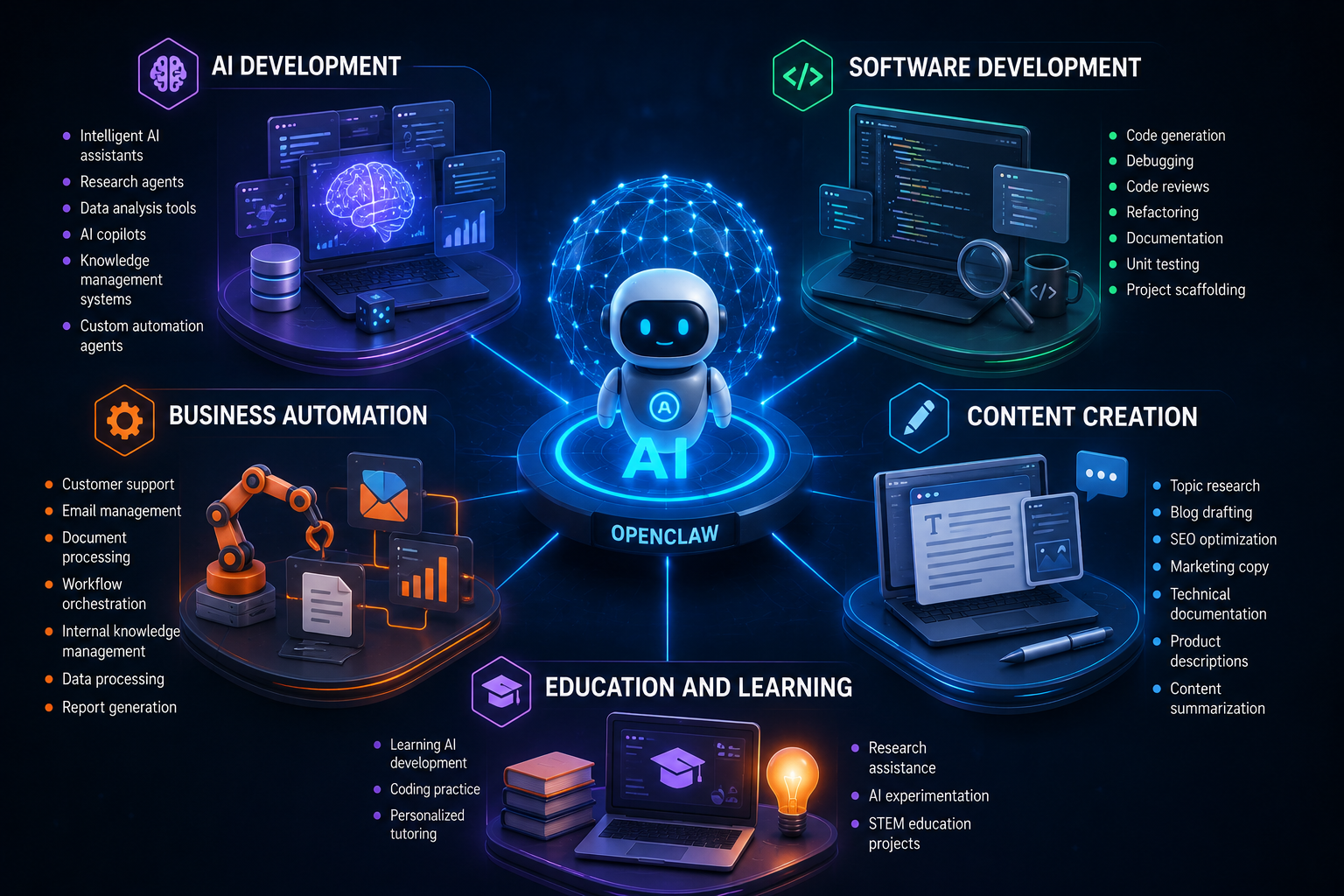
One of the biggest strengths of the OpenClaw AI Agent is its versatility. Its modular architecture makes it suitable for developers, startups, educators, and enterprises looking to automate tasks or build intelligent applications.
AI Development
Developers can use OpenClaw as the foundation for creating advanced AI applications capable of autonomous decision-making.
Popular development projects include:
- Intelligent AI assistants
- Research agents
- Data analysis tools
- AI copilots
- Knowledge management systems
- Custom automation agents
Its flexibility makes it ideal for experimenting with new AI architectures and workflows.
Software Development
Software engineering is one of the most promising applications of autonomous AI agents.
OpenClaw can assist developers with:
- Code generation
- Debugging
- Code reviews
- Refactoring
- Documentation
- Unit testing
- Project scaffolding
Rather than replacing developers, OpenClaw functions as an AI coding assistant that accelerates development while allowing engineers to focus on architecture, problem-solving, and innovation.
Business Automation
Organizations are increasingly adopting AI to streamline routine operations and improve productivity.
OpenClaw supports automation for:
- Customer support
- Email management
- Document processing
- Workflow orchestration
- Internal knowledge management
- Data processing
- Report generation
By integrating with existing business systems, organizations can reduce repetitive work while improving operational efficiency.
Content Creation
Content teams can also benefit from AI-powered workflows.
The OpenClaw AI Agent can assist with:
- Topic research
- Blog drafting
- SEO optimization
- Marketing copy
- Technical documentation
- Product descriptions
- Content summarization
Human oversight remains essential to verify facts, maintain originality, and ensure the content aligns with the intended audience and brand voice.
Education and Learning
Students, educators, and researchers can use OpenClaw as a practical platform for learning about modern AI systems.
Educational use cases include:
- Learning AI development
- Coding practice
- Personalized tutoring
- Research assistance
- AI experimentation
- STEM education projects
Because the framework is open source, students can also explore its architecture and contribute to community-driven development.
OpenClaw AI Agent vs Traditional AI Assistants
Although both OpenClaw and traditional AI assistants use large language models, their goals and capabilities are quite different.
| Feature | OpenClaw AI Agent | Traditional AI Chatbots |
| Open Source | ✔ | Mostly No |
| Customization | High | Limited |
| Local Deployment | Yes | Rare |
| Multi-Agent Support | Yes | Limited |
| Workflow Automation | Advanced | Basic |
| API Integration | Extensive | Moderate |
| Privacy Control | Better (self-hosted options) | Depends on the provider |
| Community Support | Strong open-source community | Vendor-based |
Traditional AI chatbots are primarily designed for conversational interactions, content generation, and question answering. They generally operate within predefined environments and have limited access to external systems.
The OpenClaw AI Agent, on the other hand, is built for autonomy. It can plan workflows, collaborate with multiple agents, integrate with external tools, and automate end-to-end processes, making it far more suitable for developers and businesses building production-ready AI solutions.
OpenClaw AI Agent vs Other AI Agent Frameworks
The market for AI agent frameworks has expanded rapidly over the past few years. Each framework has its own strengths depending on project requirements.
| Framework | Strengths | Best For |
| OpenClaw AI Agent | Flexible architecture, open-source customization, workflow automation | Custom AI applications and enterprise automation |
| AutoGPT | Autonomous task execution | Experimental AI workflows |
| LangGraph | Stateful workflow management | Production AI applications |
| CrewAI | Multi-agent collaboration | Team-based AI systems |
| OpenAI Agents SDK | Tight integration with OpenAI services | Developers using the OpenAI ecosystem |
| Microsoft AutoGen | Enterprise-grade multi-agent conversations | Large-scale enterprise automation |
Ease of Use
Some frameworks are designed for beginners, while others prioritize flexibility and scalability. OpenClaw is best suited for developers who have a basic understanding of APIs, Python, and AI development concepts.
Flexibility
One of OpenClaw’s biggest advantages is its modular design. Developers can customize workflows, integrate external tools, replace language models, and extend functionality without major architectural changes.
Community Support
As an open-source project, OpenClaw benefits from community contributions that improve documentation, add integrations, optimize performance, and expand available learning resources.
Performance
The framework’s performance depends largely on the selected large language model, hardware configuration, and workflow complexity. Developers have the flexibility to optimize these components based on their project requirements.
Scalability
OpenClaw can be adapted for individual learning projects, startup applications, or enterprise-grade automation systems. Its modular architecture supports gradual expansion as organizational needs grow.
Learning Curve
Like many advanced AI programming tools, OpenClaw requires some familiarity with software development and AI concepts. Although beginners may need time to understand the framework, the knowledge gained provides a strong foundation for building sophisticated autonomous AI systems.
Benefits of OpenClaw AI Agent
As businesses and developers increasingly adopt autonomous AI systems, the OpenClaw AI Agent offers several advantages over traditional AI tools. Its open-source architecture, flexibility, and automation capabilities make it valuable for users across different industries.
Benefits for Developers
Developers are among the biggest beneficiaries of OpenClaw because it provides complete control over how AI agents are designed and deployed.
Some key advantages include:
- Full customization of AI workflows
- Freedom to choose different large language models (LLMs)
- Easy integration with APIs and third-party tools
- Faster prototyping and experimentation
- Support for multi-agent AI systems
- Community-driven improvements and open-source collaboration
Instead of working within the limitations of proprietary platforms, developers can build AI solutions tailored to their exact requirements.
Benefits for Businesses
Organizations are increasingly investing in AI workflow automation to improve efficiency and reduce operational costs.
The OpenClaw AI Agent can help businesses by:
- Automating repetitive business processes
- Improving customer support operations
- Reducing manual workloads
- Increasing productivity
- Supporting secure self-hosted deployments
- Integrating with existing enterprise software
For companies concerned about data privacy and compliance, the option to deploy OpenClaw on private infrastructure is another significant advantage.
Benefits for Students and AI Enthusiasts
OpenClaw also serves as an excellent educational platform.
Students can use it to:
- Learn how AI agents work
- Practice AI programming
- Explore open-source AI development
- Build portfolio projects
- Contribute to open-source communities
- Understand modern AI architectures
Hands-on experience with frameworks like OpenClaw helps learners develop practical skills that are increasingly valuable in today’s AI job market.
Challenges and Limitations
While the OpenClaw AI Agent offers many benefits, it is important to recognize that no AI framework is without limitations. Understanding these challenges helps developers make informed decisions before adopting the platform.
| Challenge | Description |
| Technical setup | Initial configuration requires programming knowledge |
| Documentation | Some features may have evolving documentation |
| Learning curve | Understanding AI agents takes time |
| Maintenance | Self-hosted deployments require ongoing management |
| Infrastructure | Advanced workloads may require powerful hardware |
| Security | Developers must implement proper security practices |
Technical Complexity
Unlike plug-and-play AI applications, OpenClaw is designed primarily for developers. Setting up environments, configuring integrations, and deploying agents may require experience with Python, APIs, and software development.
Documentation
As an evolving open-source project, documentation continues to improve. Some advanced features may require exploring community resources or source code for additional guidance.
Infrastructure Requirements
Running AI agents locally or managing multiple autonomous workflows may require sufficient computing resources, especially when using larger language models.
Responsible AI Usage
Because OpenClaw enables powerful automation, developers should implement appropriate safeguards to ensure AI systems operate securely, ethically, and within organizational policies.
Best Practices When Using OpenClaw
Following best practices helps maximize the performance, security, and reliability of the OpenClaw AI Agent.
For Developers
- Start with small automation projects before scaling to larger systems.
- Use version control to track workflow changes.
- Store API keys securely using environment variables or secret management tools.
- Thoroughly test AI agents before deploying them in production.
- Monitor agent behavior to detect unexpected outputs or failures.
- Keep dependencies and language models updated.
For Organizations
Businesses deploying OpenClaw should establish governance policies for responsible AI usage.
Recommended practices include:
- Define user roles and permissions.
- Monitor automated decision-making.
- Protect sensitive business data.
- Regularly audit AI workflows.
- Maintain security updates.
- Combine human oversight with AI automation for critical tasks.
Future of OpenClaw
The rapid evolution of Agentic AI suggests that platforms like the OpenClaw AI Agent will continue to grow in capability and adoption.
Several trends are likely to shape its future.
Smarter Autonomous AI Agents
Future AI agents are expected to demonstrate stronger reasoning, better planning, and improved decision-making across increasingly complex workflows.
Enterprise Adoption
As organizations seek flexible alternatives to proprietary AI platforms, open-source AI frameworks like OpenClaw may see broader adoption across industries such as healthcare, finance, education, and software development.
Improved Reasoning Models
Advancements in large language models will enable AI agents to better understand context, solve problems more accurately, and execute more sophisticated tasks.
Multi-Agent Collaboration
Future AI systems will increasingly rely on specialized agents working together to complete complex objectives. OpenClaw’s support for multi-agent AI systems positions it well for this trend.
Local AI Deployment
Growing concerns around privacy, regulatory compliance, and data ownership are encouraging organizations to deploy AI on their own infrastructure. OpenClaw’s open architecture makes local deployment an attractive option.
Expanding Open-Source Ecosystem
As the AI developer ecosystem continues to grow, OpenClaw is likely to benefit from new integrations, plugins, tutorials, and community contributions that further expand its capabilities.
Who Should Use OpenClaw?
The OpenClaw AI Agent is particularly well suited for users who need flexibility, customization, and advanced automation capabilities.
Best For
- Software developers
- AI researchers
- Machine learning engineers
- Startup founders
- Enterprise development teams
- Automation specialists
- Students learning AI development
- Open-source contributors
May Not Be Ideal For
OpenClaw may not be the best choice for everyone.
It may be less suitable for:
- Users looking for a simple plug-and-play chatbot
- Individuals with no programming experience
- Organizations that prefer fully managed SaaS AI platforms
- Small teams without technical resources to manage self-hosted infrastructure
For these users, commercial AI assistants may offer a simpler starting point.
Frequently Asked Questions (FAQ)
What is the OpenClaw AI Agent?
The OpenClaw AI Agent is an open-source AI agent framework that enables developers to build autonomous AI systems capable of reasoning, planning, using external tools, and automating complex workflows.
Is OpenClaw free to use?
Yes. OpenClaw is an open-source project, allowing developers to access, modify, and extend the framework according to its licensing terms.
Is OpenClaw open source?
Yes. One of OpenClaw’s biggest strengths is its open-source philosophy, which encourages community contributions, transparency, and customization.
How does OpenClaw compare to AutoGPT?
Both frameworks focus on autonomous AI agents. However, OpenClaw emphasizes flexibility, extensibility, and developer customization, while AutoGPT is primarily known for autonomous task execution.
Can OpenClaw run locally?
Yes. OpenClaw supports local deployment, making it suitable for organizations that prioritize data privacy, security, or regulatory compliance.
Which LLMs does OpenClaw support?
OpenClaw is designed to work with multiple large language models, giving developers the flexibility to choose models that best fit their project requirements.
Is OpenClaw suitable for beginners?
Developers with basic programming knowledge can start learning OpenClaw. However, complete beginners may need time to understand AI agents, APIs, and workflow automation concepts before using advanced features.
What are the best use cases for OpenClaw?
Common use cases include AI coding assistants, workflow automation, research agents, business process automation, content generation, software development, and educational AI projects.
Conclusion
The rise of autonomous AI agents is reshaping how developers build software and how organizations automate complex workflows. As demand for transparency, customization, and privacy grows, open-source AI frameworks are becoming an increasingly important part of the AI ecosystem.
The OpenClaw AI Agent represents this shift by providing developers with a flexible framework for creating intelligent, task-oriented AI systems. Its support for workflow automation, multi-agent collaboration, extensibility, and local deployment makes it a compelling option for developers, startups, and enterprises exploring the future of AI.
While OpenClaw does require technical knowledge and ongoing maintenance, its advantages in customization and control make it a strong choice for organizations that want more than a traditional AI chatbot.
Quick Summary
| Topic | Key Takeaway |
| OpenClaw AI Agent | Flexible open-source AI agent framework for autonomous workflows |
| Best Feature | Highly customizable autonomous AI agents |
| Ideal Users | Developers, businesses, students, and AI researchers |
| Biggest Benefit | AI workflow automation with greater control and transparency |
| Future Outlook | Positioned to play an important role in the future of Agentic AI and open-source AI innovation |
Final Recommendation
If you’re looking to explore the next generation of AI development, the OpenClaw AI Agent is worth considering. Its open-source architecture, growing developer ecosystem, and support for intelligent automation make it a valuable framework for building modern AI applications. As the field of Agentic AI continues to evolve, frameworks like OpenClaw are likely to play an increasingly significant role in shaping how developers build, customize, and deploy autonomous AI solutions.