

As a web developer, you have plenty of choices when it comes to building a website. There are several open-source content management systems available today, including WordPress, Joomla, Magento, Blogger, and Drupal.
The choice of CMS largely depends on the project requirements, scalability needs, and long-term vision of the website. While some platforms are designed for ease of use, others are built for performance, flexibility, and enterprise-level applications.
One such powerful CMS is Drupal.
If you’re looking for real-world proof, there are thousands of websites built with Drupal, including government portals, university platforms, media organizations, and global enterprise systems.
In this guide, we’ll explore some of the most popular Drupal websites, along with real examples of Drupal websites across different industries and use cases.
Drupal is widely preferred by governments, NGOs, and large enterprises because of its strong focus on scalability, security, and flexibility. Additionally, modern hosting providers now offer optimized Drupal hosting environments, making it even easier for businesses to deploy and scale Drupal-powered websites efficiently.
Why So Many Popular Websites Are Still Built with Drupal in 2026?
If you’ve been wondering whether Drupal is still relevant today, you’re not alone.
With newer website builders and CMS platforms entering the market, many developers question whether large organizations still rely on Drupal. The answer might surprise you.
Even in 2026, many enterprise websites, government portals, and high-traffic platforms are still built with Drupal.
But why?
1. Enterprise-Level Security and Compliance
Large organizations like governments, healthcare institutions, and financial systems require strict security standards. Drupal continues to be a preferred choice because of its strong security team, regular updates, and enterprise-grade protection.
That’s one of the biggest reasons why many government websites using Drupal continue to rely on it.
2. Built for Complex, Large-Scale Websites
Unlike simpler CMS platforms, Drupal is designed to handle:
- Massive traffic spikes
- Complex content structures
- Multiple user roles and workflows
This makes it ideal for websites built with Drupal that serve millions of users globally.
3. Multilingual and Global Reach
Drupal offers powerful multilingual capabilities out of the box. This is why international organizations and global enterprises prefer Drupal-based websites to manage content across regions.
4. Flexibility for Developers
For developers, Drupal is not just a CMS — it’s a framework.
This flexibility allows teams to build highly customized solutions, which is why many sites using Drupal are not just websites, but complex digital ecosystems.
The Reality in 2026
While smaller businesses may choose simpler platforms, Drupal continues to dominate in areas where:
- Security matters
- Scale matters
- Customization matters
That’s why many of the most popular Drupal websites you’ll see below are still thriving today.
Drupal Usage Statistics in 2026
Over the years, Drupal has established itself as one of the most powerful content management systems for enterprise and high-traffic websites.
According to industry data from platforms like W3Techs, Drupal powers a significant portion of websites where scalability, security, and flexibility are critical. While its overall market share is smaller compared to beginner-friendly CMS platforms, Drupal remains a dominant choice for governments, universities, and enterprise-grade applications.
This clearly shows that Drupal is not designed for “everyone” — but for platforms where performance and complexity truly matter.
If we take a look at the statistics report of W3Techs, Drupal is used by 3.5% of all the websites whose CMS are known. Approximately, it is 1.9% of all websites.
Now, let’s look at some recent numbers to understand the current position of Drupal:
Over 90,000 active websites are currently built with Drupal
Drupal holds around 2.5% market share in CMS platforms
It is heavily used in:
- Government sector
- Nonprofits
- Higher education
What’s important to understand here is not just the number of websites, but the type of websites using Drupal.
Most Drupal-powered websites belong to organizations that require:
– High security standards
– Complex content management systems
– Multi-region and multilingual capabilities
This is why Drupal continues to dominate in enterprise and government-level applications.
Countries like the United States, France, Germany, and the UK lead in Drupal adoption.
Interestingly, while small businesses are moving to simpler tools, large organizations continue to rely on Drupal for mission-critical websites.
Drupal Market Size
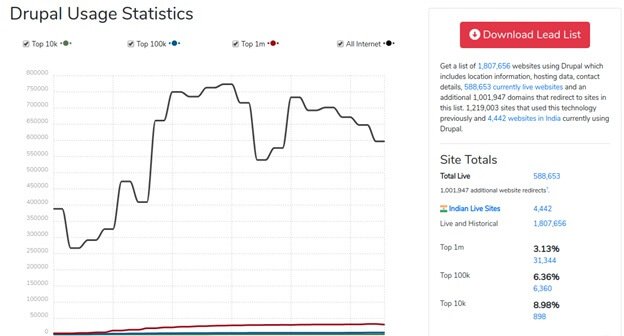

If we talk about the most popular CMS platform right now available, Drupal is the top name after WordPress and Joomla. According to the Drupal Usage Statistics report, the number of active websites tracked on Drupal is 588,653. While the number of sites in the top one million is 31,344.
Real Drupal Website Examples Across Different Industries
To better understand the power of Drupal, let’s look at real-world examples of Drupal websites across industries.
| Industry | Example Type | Why Drupal is Used |
|---|---|---|
| Government | National portals | Security, compliance, scalability |
| Education | Universities | Complex content & research data |
| Media & Publishing | News platforms | Content workflows, high traffic |
| Enterprise | Corporate websites | Integration & flexibility |
| Nonprofits | NGO platforms | Multilingual + accessibility |
Top Popular Websites Built with Drupal (2026 Examples)
Here are some of the most well-known websites built with Drupal, showcasing its scalability, flexibility, and enterprise-level capabilities.
1. Australian Government (australia.gov.au)
A large-scale government portal that provides information on services, policies, tourism, and public resources.
Why it uses Drupal:
– High security requirements
– Massive traffic handling
– Structured public data
2. Timex (timex.com)
Timex uses Drupal to manage its global brand presence and product-focused content.
Why it uses Drupal:
– Flexible content management
– Scalable architecture
– Global audience handling
3. Harvard University (harvard.edu)
One of the most prestigious universities in the world, Harvard uses Drupal for its complex academic and informational ecosystem.
Why it uses Drupal:
– Multi-department content management
– High traffic
– Structured educational data
4. Nokia (nokia.com)
Nokia uses Drupal across various digital properties to manage enterprise-level communication and product content.
Why it uses Drupal:
– Enterprise scalability
– Product and content integration
– Global reach
5. Stanford University (stanford.edu)
A major educational institution using Drupal for managing research, student resources, and institutional content.
Why it uses Drupal:
– Content-heavy architecture
– Academic workflows
– Multi-user access
6. The Emmy Awards (emmys.com)
A media-rich platform showcasing award content, interviews, and event coverage.
Why it uses Drupal:
– Media content handling
– High traffic during events
– Flexible publishing workflows
7. NASA (nasa.gov)
One of the most well-known Drupal-powered websites, handling massive global traffic and real-time updates.
Why it uses Drupal:
– Extreme scalability
– Advanced content structuring
– High security standards
8. European Commission (ec.europa.eu)
A massive government ecosystem serving multiple countries and languages.
Why it uses Drupal:
– Multilingual capabilities
– Regional content distribution
– Compliance and accessibility
9. UNICEF (unicef.org)
A global nonprofit platform delivering content across different countries and regions.
Why it uses Drupal:
– Multi-language support
– Scalable infrastructure
– Content accessibility
10. MIT (web.mit.edu)
MIT uses Drupal across multiple departments and educational platforms.
Why it uses Drupal:
– Academic scalability
– Structured content
– Multi-site management
11. BBC (bbc.co.uk – partial usage)
Some parts of BBC’s content infrastructure use Drupal for structured publishing.
Why it uses Drupal:
– Content workflows
– Large-scale publishing
– Media integration
12. Warner Bros (warnerbros.com)
A global entertainment brand managing media content and promotions.
Why it uses Drupal:
– Content flexibility
– Media-heavy architecture
– Brand scalability
13. Oxford University (ox.ac.uk)
Another top university leveraging Drupal for academic and research-based content.
Why it uses Drupal:
– Complex information architecture
– Multi-department usage
– High credibility content
14. Tesla (tesla.com – partial usage)
Certain sections of Tesla’s ecosystem use Drupal for structured content.
Why it uses Drupal:
– Content scalability
– Structured publishing
– Performance
15. The Economist (economist.com – partial usage)
A global media platform that has used Drupal for editorial workflows.
Why it uses Drupal:
– Content management at scale
– Publishing workflows
– Editorial flexibility
What Makes These Drupal Websites Stand Out?
If you look closely at these Drupal website examples, a few common patterns emerge:
- They handle massive traffic volumes
- They require complex content structures
- They operate across multiple regions and languages
- They prioritize security and compliance
This is exactly where Drupal excels compared to other CMS platforms.
Unlike beginner-focused website builders, Drupal is designed for organizations that need full control over their digital infrastructure.
Read More: 7 Websites for Finding Drupal Jobs
How to Identify if a Website is Built with Drupal?
If you’re curious about whether a website is built with Drupal, here are a few reliable methods:
- Check the page source for keywords like “Drupal.settings”
- Use tools like BuiltWith or Wappalyzer
- Look for typical Drupal URL patterns (e.g., /node/ or /sites/default/)
- Analyze HTTP headers and CMS footprints
These methods can help you identify more websites built with Drupal and understand how they are structured.
Frequently Asked Questions About Drupal Websites
What are some popular websites built with Drupal?
Many large organizations use Drupal, including government agencies, universities, and enterprise companies. These popular Drupal websites are known for their scalability and security.
Are there real examples of Drupal websites?
Yes, there are thousands of Drupal website examples, ranging from small business sites to large global platforms. Many enterprise-level systems rely on Drupal for performance and flexibility.
Why do companies still use Drupal?
Companies choose Drupal because it offers:
- Advanced security
- Custom development flexibility
- Scalability for high-traffic websites
This is why many websites built with Drupal are still active today.
Is Drupal still relevant in 2026?
Yes, Drupal remains highly relevant, especially for enterprise and government use cases. While smaller websites may prefer simpler CMS platforms, Drupal-powered websites continue to dominate complex digital ecosystems.
What types of websites use Drupal?
Drupal is used for:
- Government portals
- University websites
- Corporate platforms
- Media and publishing sites
These sites using Drupal often require advanced features and scalability.
Final Notes
As we’ve seen from these examples, Drupal continues to power some of the most complex and high-traffic websites in the world.
From government portals to global enterprises, Drupal proves its strength in scalability, security, and flexibility.
If your goal is to build a future-proof, enterprise-grade website, Drupal remains one of the strongest choices available in 2026.
Read More:
Best Free Wireframe Tools in 2026 (Free Mockup & UI Design Tools)
Best C/C++ IDEs for Linux (2026) – Ranked for Beginners, Pros, & Ubuntu Users
Developer Habits That Scale With Growing System Complexity in 2026
Single Page Applications (SPAs) & SEO Best Practices (Updated for 2026)