Introduction
AI agents are moving beyond simple prompt-and-response interactions. Modern agents can research information, manipulate files, use APIs, interact with software, analyze data, write code, and coordinate multi-step workflows. But an agent becomes considerably more useful when these abilities are packaged into AI agent skills that can be reused across tasks.
Instead of repeatedly explaining how an agent should complete a specialized task, developers can create reusable instructions, resources, workflows, and tools. This makes agent behavior more consistent and easier to maintain.
The idea is especially important as AI agents become part of software development, business automation, research, customer service, and enterprise workflows. Anthropic’s public skills repository, for example, describes skills as folders containing instructions, scripts, and resources that an agent can load dynamically when specialized expertise is required.
So, what exactly are AI agent skills, how do they differ from tools and plugins, and how can developers create a useful skills library?
Let’s explore.
What Are AI Agent Skills?
AI agent skills are reusable packages of knowledge, instructions, resources, and sometimes executable components that teach an AI agent how to perform a particular type of task.
A normal AI model may know how to generate text or reason about a problem. However, it does not automatically know your organization’s preferred workflow for producing a report, reviewing code, creating a presentation, or processing a specific type of document.
A skill provides that additional layer of specialized capability.
For example, a developer could create a:
- Financial reporting skill
- Code-review skill
- Research skill
- SEO analysis skill
- Data-analysis skill
- Customer-support skill
- Document-generation skill
A useful skill can include:
- Instructions — how the task should be performed.
- Context — domain-specific information the agent needs.
- Resources — templates, reference files, examples, or documentation.
- Scripts — code that helps complete repeatable operations.
- Validation rules — requirements that determine whether the output is acceptable.
This makes reusable AI agent skills different from simply writing a longer prompt.
A prompt may tell an agent what you want right now. A skill packages knowledge and procedures so an agent can repeatedly apply them when appropriate.
Anthropic’s implementation follows this model: skills are self-contained folders with a SKILL.md file containing instructions and metadata, while additional resources can be loaded when required.
AI agent skills become even more useful when they are combined with tools, memory, and workflows that allow agents to complete multi-step tasks. For a broader introduction to building these systems, see this guide to building AI agents in 2026
Why AI Agent Skills Matter
The biggest advantage is repeatability.
Imagine a company has five developers who regularly ask an AI agent to review pull requests. Without a shared skill, each developer may provide different instructions.
With a code-review skill, the organization can define:
- Coding standards
- Security checks
- Testing requirements
- Documentation expectations
- Review format
- Escalation rules
The agent can then apply the same process consistently.
That makes AI agent skills particularly useful for organizations building repeatable AI workflows.
AI Agent Skills vs. Tools vs. Plugins
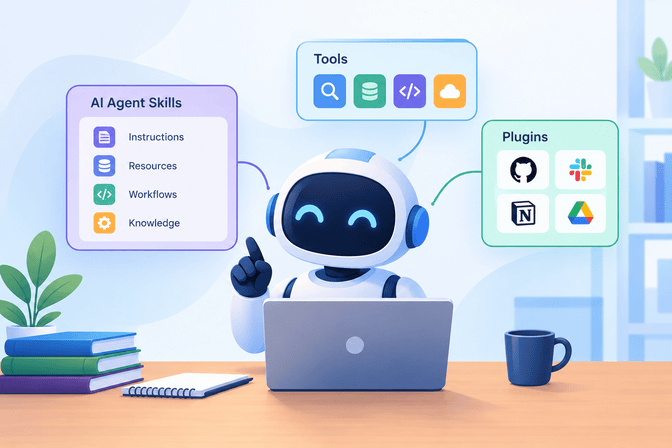
One of the easiest ways to misunderstand AI agents is to treat skills, tools, and plugins as interchangeable concepts.
They are related, but they solve different problems.
| Component | Main Purpose | Example |
| AI Agent Skill | Teaches an agent how to perform a specialized task | Code-review workflow |
| AI Agent Tool | Gives an agent the ability to perform an action | Search database |
| AI Agent Plugin | Packages integrations or capabilities for a platform | CRM integration |
| Model | Provides reasoning and generation | Large language model |
Think about an AI coding agent.
The tool might allow the agent to execute code.
The skill might explain how to review that code according to your team’s standards.
A plugin might connect the agent to GitHub, Jira, Slack, or another application.
The model provides the underlying reasoning.
This distinction is important when comparing AI agent skills vs tools.
A tool answers:
“What can the agent access or execute?”
A skill answers:
“How should the agent perform this specialized task?”
AI Agent Tools Examples
AI agent tools can include:
- Web search
- Database queries
- API requests
- Code execution
- File operations
- Browser automation
- Calendar access
- CRM operations
For example, an agent might have a web-search tool but require a research skill explaining how to find sources, evaluate evidence, organize findings, and produce a final report.
The tool provides the capability.
The skill provides the procedure.
This separation makes complex agent architectures easier to design and maintain. Modern agent systems commonly combine models, tools, memory, and orchestration into a larger workflow. If you want a deep dive read How to build an AI agent eduonix blog.
How AI Agent Skills Improve Agent Capabilities
The real value of AI agent capabilities comes from combining general intelligence with specialized procedures.
A general-purpose agent might be able to write an email. A sales skill can teach it how to write that email according to a company’s sales methodology.
A general agent might analyze a spreadsheet. A financial-analysis skill can teach it which metrics to calculate, how to validate numbers, and how to structure the final report.
This creates a more powerful system without requiring a completely new AI model for every task.
1. Specialization
Skills allow agents to become specialists.
Instead of one generic agent attempting everything, organizations can maintain specialized capabilities for:
- Software development
- Marketing
- Research
- Finance
- Legal operations
- Data analysis
- Customer service
As these systems become more sophisticated, developers also need to coordinate specialized agents, define responsibilities, and manage how different capabilities work together. Learn more about this emerging role in our guide to the AI orchestrator role.
2. Consistency
Reusable instructions reduce variations in how agents perform recurring tasks.
3. Faster Development
Developers can build a skill once and reuse it across multiple agent workflows.
4. Easier Maintenance
If the organization’s process changes, the skill can be updated rather than rewriting every individual prompt or workflow.
5. Better Collaboration
Teams can share common skills across compatible agents and development environments.
This is already becoming an important pattern in agent development. Anthropic’s public repository includes skills covering document creation, development, enterprise communication, and other specialized workflows.
Anthropic Skills and the Rise of Reusable AI Agent Skills
Anthropic Skills have helped bring greater attention to the idea of packaging specialized agent capabilities into reusable components.
Anthropic’s public skills repository describes skills as folders containing instructions, scripts, and resources that Claude can load dynamically to improve performance on specialized tasks.
The concept is broader than simply creating prompts.
A skill can provide a complete workflow.
For example, a document skill could contain:
- Formatting requirements
- Templates
- Supporting scripts
- Validation instructions
- Examples
- Specialized references
The agent doesn’t necessarily need every resource loaded into its context immediately. Instead, the relevant material can be accessed when the skill becomes useful.
This approach supports progressive disclosure: agents can discover relevant skills and load deeper instructions only when needed. Anthropic’s repository also points developers toward an Agent Skills specification intended to standardize this approach across compatible systems.
AI Agent Skills Claude Workflows
The concept is particularly useful for Claude-based workflows.
For example, a development team could create skills for:
- Code review
- Testing
- Documentation
- Data analysis
- Git workflows
- API development
The team can then reuse those skills instead of embedding every instruction into the main agent configuration.
Anthropic’s API documentation also describes skills being attached to agents and loaded for specialized work, including pre-built document-related skills and custom skills. This represents an important shift:
Agents are becoming extensible systems rather than isolated AI conversations.
7 Practical AI Agent Skills Examples
The easiest way to understand AI agent skills examples is to look at practical workflows.
1. Code Review Skill
A code-review skill could instruct an AI agent to:
- Inspect changed files
- Identify bugs
- Check security issues
- Review test coverage
- Look for performance problems
- Produce structured feedback
The skill could also include the team’s coding standards.
2. Research Skill
A research skill could define how an agent:
- Searches for reliable sources
- Compares information
- Records citations
- Separates facts from assumptions
- Produces structured findings
This is especially useful for research agents handling recurring topics.
3. SEO Content Skill
An SEO skill could teach an agent to:
- Analyze search intent
- Structure headings
- Map keywords
- Create metadata
- Review readability
- Identify internal-link opportunities
The same workflow can then be reused for hundreds of articles.
4. Data Analysis Skill
A data-analysis skill could define:
- Data-cleaning procedures
- Statistical checks
- Required visualizations
- Reporting formats
- Validation rules
5. Customer Support Skill
A support skill could teach an agent:
- How to classify requests
- Which knowledge base to use
- When to escalate
- How to structure responses
- Which actions require human approval
6. Document Creation Skill
The agent could follow company templates and formatting rules for:
- Reports
- Presentations
- Proposals
- Spreadsheets
- Business documents
7. Security Review Skill
A security skill could provide a repeatable checklist for:
- Authentication
- Authorization
- Secrets
- Dependencies
- Input validation
- Common vulnerabilities
These examples show why AI agent capabilities should not be viewed only as model capabilities. Much of an agent’s practical value comes from the reusable workflows surrounding the model.
How to Build an AI Agent Skills Library
Once an organization creates several skills, managing them individually becomes difficult.
That is where an AI agent skills library becomes useful.
A skills library is a structured collection of reusable capabilities that agents can discover and use when required.
A simple structure might look like:
skills/
├── research/
│ └── SKILL.md
├── code-review/
│ └── SKILL.md
├── seo-content/
│ └── SKILL.md
├── data-analysis/
│ └── SKILL.md
└── customer-support/
└── SKILL.md
Each skill should have a clear purpose and description.
What Should a Skill Contain?
A practical skill can include:
- Name
- Description
- Instructions
- Examples
- Supporting resources
- Scripts
- Validation requirements
- Version information
Keep the core instructions concise.
Anthropic’s guidance emphasizes that context is a limited resource and recommends keeping skills concise, well-structured, and tested with real usage.
AI Agent Skills GitHub Repositories
GitHub is becoming an important place for discovering and sharing agent skills.
Anthropic’s public skills repository provides examples for development, document creation, enterprise workflows, and other use cases.
Other ecosystems are also adopting the standardized skill format. Hugging Face, for example, describes skills for its ecosystem and notes compatibility with several agentic development environments.
This creates the foundation for a broader AI agent skills marketplace ecosystem where developers can discover, share, adapt, and maintain specialized capabilities.
However, developers should review third-party skills carefully before installing them, particularly when a skill can execute code or access sensitive systems.
AI Agent Skills Best Practices for Production
Creating a skill is easy.
Creating a reliable skill is harder.
The following AI agent skills best practices can help teams build safer and more maintainable systems.
Keep Skills Focused
A skill should solve a recognizable problem.
Avoid creating one enormous skill that attempts to cover unrelated workflows.
A focused skill is easier to test, understand, update, and reuse.
Write Clear Instructions
Use explicit requirements rather than vague guidance.
Instead of:
“Review the code carefully.”
Define what “carefully” means:
- Check authentication
- Check input validation
- Run tests
- Identify breaking changes
- Report severity
Include Examples
Examples help agents understand the expected output format and workflow.
Define Failure Conditions
Tell the agent what to do when:
- Required information is missing
- A tool fails
- Data conflicts
- A task exceeds permissions
- Human approval is required
Add Human Approval Where Necessary
Skills should not automatically grant an agent unlimited authority.
Sensitive operations such as deleting data, publishing content, moving money, or changing production infrastructure should have appropriate controls.
Version Your Skills
Treat skills like software.
Track:
- Changes
- Owners
- Versions
- Dependencies
- Testing results
Measure Real Performance
Test skills against realistic tasks.
Track:
- Success rate
- Error rate
- Cost
- Latency
- Human corrections
- Escalations
Anthropic’s guidance similarly emphasizes testing skills with real usage rather than assuming that a skill will work correctly simply because its instructions look reasonable.
As these systems become more sophisticated, developers also need to coordinate specialized agents, define responsibilities, and manage how different capabilities work together. Learn more about this emerging role in our guide to the AI orchestrator role.
FAQ
What are AI agent skills?
AI agent skills are reusable packages of instructions, knowledge, resources, and sometimes executable components that help AI agents perform specialized tasks consistently.
What is the difference between AI agent skills and tools?
An AI agent tool generally gives an agent the ability to perform an action, such as querying a database or calling an API. A skill explains how to use capabilities to complete a specialized workflow.
Are Anthropic Skills only for Claude?
Anthropic Skills originated around Claude’s agent ecosystem, but the broader Agent Skills concept is increasingly being implemented across other agentic environments. The exact format and compatibility depend on the platform. Anthropic’s public repository also references an Agent Skills specification.
Where can I find AI agent skills?
Developers can find examples in public repositories such as GitHub, official platform ecosystems, and emerging skills libraries or marketplaces. Always inspect a skill’s instructions, dependencies, permissions, and code before using it in a production environment.
Can I create my own AI agent skills?
Yes. A custom skill can package your organization’s instructions, workflows, templates, examples, and supporting resources. This is one of the main advantages of the skills approach because teams can turn internal expertise into reusable agent capabilities.
Conclusion
The next generation of AI agents will not be defined only by increasingly powerful models. Their usefulness will also depend on how effectively developers package knowledge, workflows, tools, and specialized procedures into reusable capabilities.
That is why AI agent skills are becoming an important part of agent architecture.
Skills can make agents more specialized, consistent, reusable, and easier to maintain. They can complement AI agent tools, extend AI agent capabilities, and connect specialized workflows with external systems.
The emergence of Anthropic Skills, public GitHub repositories, standardized skill formats, and growing skills ecosystems suggests that reusable agent capabilities could become an important layer of the AI development stack.
For developers and organizations, the practical opportunity is clear: start with focused skills for repeatable tasks, test them against real workflows, control their permissions, and build a well-organized skills library over time.
The most effective AI agents may ultimately be less about asking a model to “do everything” and more about giving the model the right skill for the right job at the right time.