Introduction
AI agents for cloud engineering are transforming how teams provision, manage, and operate infrastructure. These systems can write Infrastructure-as-Code, detect drift, remediate incidents, and optimize costs. The real question is no longer whether agents can automate work. The question is how teams keep full control while still gaining the speed and consistency agents deliver.
This guide explains practical patterns that let cloud engineers automate infrastructure without surrendering governance. We cover leading platforms such as Amazon Q, Google Gemini for Cloud, and GitHub Copilot, plus frameworks like LangChain and CrewAI that help teams build safer custom agents.
What Are AI Agents for Cloud Engineering?
AI agents for cloud engineering are autonomous or semi-autonomous systems that reason over cloud state, use tools such as CLIs and APIs, and take actions to achieve infrastructure goals. Unlike simple scripts, they can plan multi-step workflows, adapt to changing conditions, and report results.
These agents read current inventory, generate or modify Terraform, Pulumi or CloudFormation code, preview the impact of changes, and open pull requests for human review. They can also investigate incidents, suggest remediations, and enforce policy. The best implementations treat the agent as a junior engineer that never merges without approval.
From Scripts to Intelligent Agents
Traditional automation relied on fixed runbooks and deterministic scripts. AI agents for cloud engineering and reasoning. An agent can interpret a natural-language goal, query live cloud state, decide which tools to call, and verify the outcome. This makes them far more flexible than static automation.
The shift is already visible in production. Teams report that agents now handle a growing share of routine infrastructure tasks while humans focus on architecture, risk decisions, and exception handling.
Why Control Matters More Than Speed
Speed without control creates outages, compliance failures, and unexpected costs. An agent that can create resources can also destroy them. An agent that can modify security groups can open dangerous holes.
Successful teams therefore design every agent workflow around explicit approval gates, least-privilege credentials, and full audit trails. Control is not the enemy of automation. It is the foundation that makes large-scale agent use safe.
The Core Challenge – Automation vs Governance
The central tension in AI agents for cloud engineering is the balance between autonomy and oversight. Full autonomy promises maximum speed. Full manual control preserves safety but loses productivity gains.
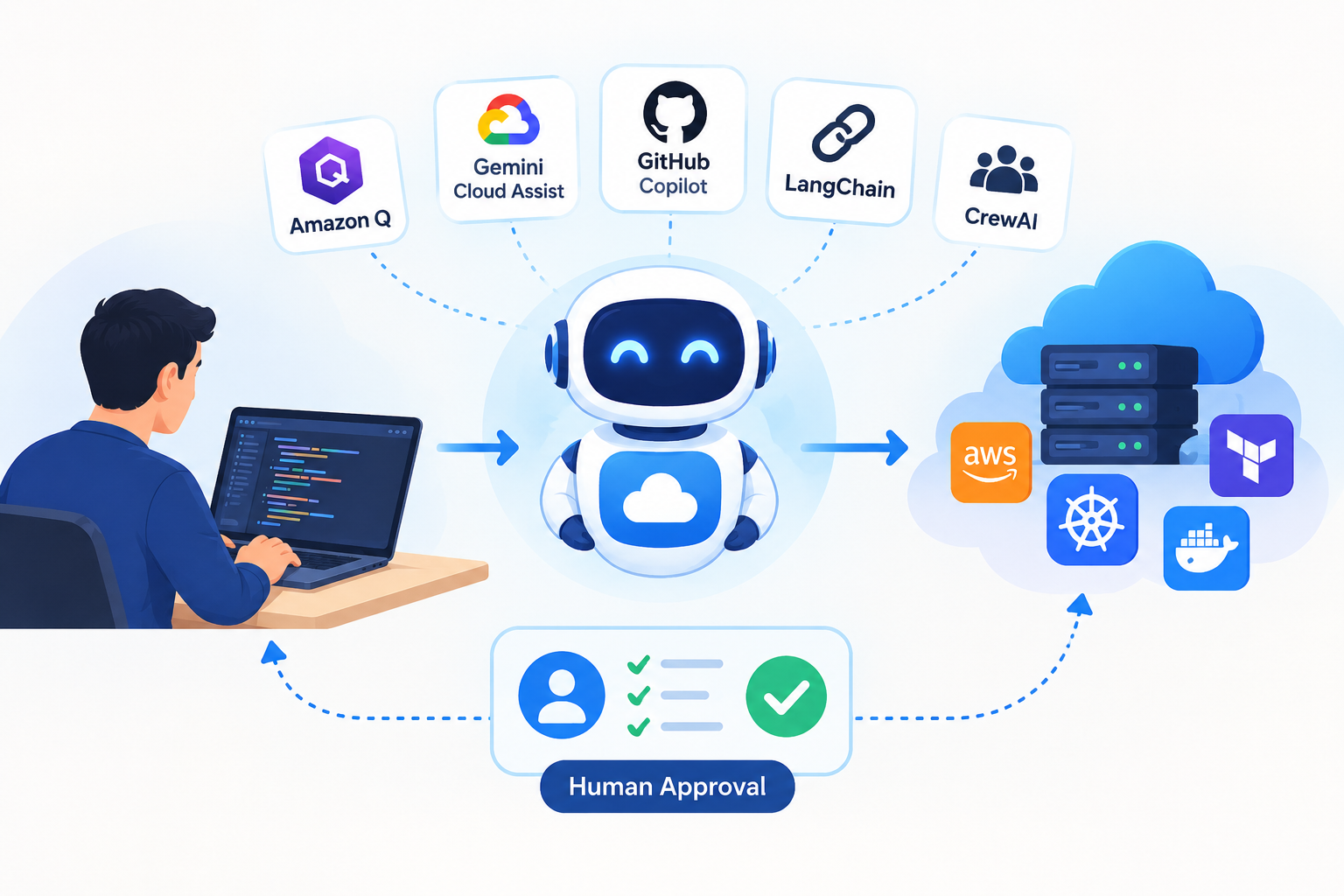
Most mature teams settle on a hybrid model: agents propose and prepare, humans approve and own the final decision. This model delivers the majority of the efficiency benefit while keeping accountability clear.
Risks of Fully Autonomous Infrastructure Agents
Fully autonomous agents can cause rapid, widespread damage if they misinterpret state or policy. A single incorrect application can delete critical resources or expose data. Cost anomalies can spiral when agents loop on provisioning.
Security teams also worry about credential leakage and prompt-injection attacks that trick an agent into privileged actions. These risks make unrestricted autonomy unacceptable for production infrastructure in most organizations.
Human-in-the-Loop as the Winning Model
The human-in-the-loop pattern has emerged as the practical standard. Agents generate plans, code, and even dry-run results. Engineers review the plan and the predicted impact before any production change is applied.
This approach preserves the speed of automation while ensuring every change has a named human owner. It also creates a natural feedback loop that improves future agent performance.
Leading AI Agents for Cloud Engineering
Several platforms now offer strong capabilities for cloud infrastructure work. The most useful ones combine deep cloud knowledge with clear control surfaces.
Amazon Q for AWS Infrastructure
Amazon Q, especially through its DevOps and developer agent features, helps teams investigate issues, generate infrastructure code, and remediate problems inside the AWS ecosystem. It understands AWS services, IAM, and operational data.
Engineers can ask Amazon Q to diagnose a performance problem or draft a Cloud Formation change. The agent returns recommendations that still require human approval before execution. This design keeps control firmly with the team.
Google Gemini for Cloud (Gemini Cloud Assist)
Google Gemini for Cloud, often called Gemini Cloud Assist, provides investigation, optimization, and remediation capabilities across Google Cloud. It correlates telemetry, suggests cost and reliability improvements, and can assist with infrastructure changes under governed modes.
Teams value the ability to keep the agent in review-only or approval-required mode. This makes Gemini Cloud Assist a practical choice for organizations that want agent assistance without unrestricted production access.
GitHub Copilot for Infrastructure-as-Code
GitHub Copilot remains one of the most widely used tools for writing and reviewing Infrastructure-as-Code. Developers use it daily to generate Terraform, Pulumi, Bicep, and Kubernetes manifests.
When combined with agent modes and pull-request workflows, Copilot helps teams move from idea to reviewed infrastructure change quickly. The pull-request gate ensures that every generated change receives human scrutiny before it reaches production.
Building Custom Agents with LangChain and CrewAI
Not every team can or wants to rely solely on vendor agents. Frameworks such as LangChain and CrewAI let organizations build tailored agents that follow their exact policies and tool sets.
LangChain for Flexible Cloud Workflows
LangChain provides the building blocks for agents that call cloud CLIs, query state, and generate code. Teams use it to create specialized agents for provisioning, cost analysis, or compliance checks.
Because the framework is open and extensible, engineers can insert custom policy checks, approval steps, and logging at every stage. This makes LangChain a strong foundation for controlled automation.
CrewAI for Multi-Agent Cloud Teams
CrewAI shines when multiple specialized agents must collaborate. One agent can plan an infrastructure change, another generates the code, a third runs security and cost checks, and a fourth prepares the pull request.
Small platform teams use CrewAI to create internal “agent crews” that handle routine work while still routing every production action through human approval. The multi-agent pattern mirrors how real engineering teams divide labor.
For a practical overview of multi-agent collaboration patterns, see this guide to multi-agent systems.
Safe Patterns for Using AI Agents for Cloud Engineering
Safety is the difference between useful automation and expensive outages. The following patterns appear consistently among teams that successfully scale AI agents for cloud engineering.
Approval Gates and Policy-as-Code
Every change that affects production must pass through an explicit approval gate. Agents open draft pull requests or change requests. Humans review the plan, the predicted impact, and the policy evaluation before merging.
Policy-as-code tools evaluate the proposed change against organizational rules for naming, tagging, security, and cost. Agents that fail these checks never reach the approval stage.
Sandboxing, Least Privilege, and Audit Trails
Agents should run with the minimum credentials required for their task. Short-lived tokens, just-in-time access, and environment isolation reduce blast radius.
Complete audit trails record every tool call, every decision, and every human approval. When something goes wrong, teams can reconstruct exactly what the agent did and why.
Additional patterns for safe autonomous systems are discussed in this overview of autonomous coding approaches
Practical Workflows That Keep Engineers in Control
Theory only becomes valuable when it turns into repeatable daily workflows.
Issue-to-IaC Pull Request Pattern
An engineer opens a ticket describing a needed change. An agent reads the ticket, examines current state, generates Infrastructure-as-Code, runs a plan or dry-run, and opens a pull request with a clear summary.
The engineer reviews the PR, requests adjustments if needed, and merges only when satisfied. This pattern delivers most of the speed of full automation while keeping ownership with a human.
Incident Response with Human Oversight
During incidents, agents can rapidly gather logs, metrics, and recent changes, then propose a short list of likely causes and safe remediation steps. The on-call engineer chooses which steps to execute.
This approach dramatically shortens mean time to resolution without removing the human from the decision loop.
You can explore related automation ideas in this collection of AI workflows that save time
Getting Started with AI Agents for Cloud Engineering
Adoption works best when it is deliberate and measured.
Skills Cloud Engineers Need
Engineers must learn to write precise goals for agents, design effective approval workflows, and review agent-generated infrastructure critically. Understanding the underlying cloud services remains essential. Agents amplify existing expertise; they do not replace it.
Prompt engineering for long-horizon infrastructure tasks and the ability to debug agent failures are becoming core platform skills.
30-Day Adoption Roadmap
Week one focuses on read-only investigation agents that surface information but never change state.
Week two introduces code-generation agents that open draft pull requests only.
Week three adds policy evaluation and cost estimation to the agent pipeline.
Week four expands the set of approved workflows and measures the reduction in manual toil.
This gradual path builds confidence and surfaces process gaps before agents gain broader permissions.
Further reading on agentic patterns appears in this article about agentic software
Two useful external references are the official documentation for Amazon Q and the Google Cloud Gemini
Conclusion – Automation with Accountability
AI agents for cloud engineering can remove a large share of repetitive infrastructure work. The teams that succeed treat control as a first-class design requirement rather than an afterthought.
By combining capable platforms such as Amazon Q, Gemini Cloud Assist, and GitHub Copilot with frameworks like LangChain and CrewAI, and by enforcing approval gates, least privilege, and audit trails, organizations gain speed without sacrificing accountability.
The future of cloud engineering is not fully autonomous infrastructure. It is highly automated infrastructure that remains firmly under human governance. Teams that master this balance will deliver faster, safer, and more reliable systems.