Introduction
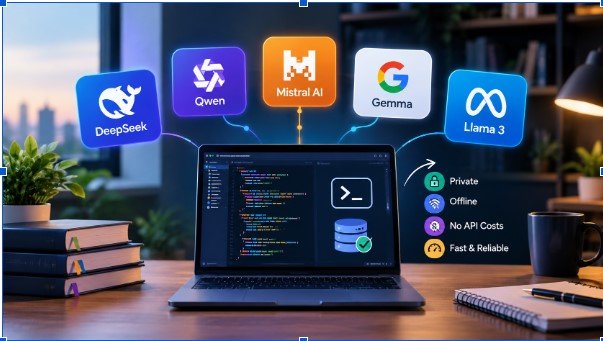
Choosing the right open-weight models for local coding agents has become one of the most important decisions a developer makes. As AI pair-programmers move from cloud subscriptions to machines developers actually own, open-weight models give teams a powerful, private, and often free alternative to closed APIs. This guide breaks down the best open-weight models for local coding agents — DeepSeek, Qwen, Mistral AI, Gemma, and Llama 3 — and shows you exactly how to set one up.
What Are Open-Weight Models for Local Coding Agents?
Open-weight models for local coding agents are AI models whose trained parameters are published for anyone to download, run, and fine-tune on their own hardware, instead of only being accessible through a paid cloud API.
What Makes a Model Open-Weight?
A model is open-weight when the provider releases the final trained parameters (the “weights”) publicly, usually on Hugging Face, even if the training data and code stay private. This differs from fully open-source models, which release everything, and from closed models like GPT-5.6, where only an API is offered.
Why Run Coding Agents Locally?
Developers run open-weight models for local coding agents to keep proprietary source code off third-party servers, avoid per-token billing, work offline, and get predictable latency. For regulated industries, this privacy angle alone often justifies the hardware investment. Eduonix’s breakdown of top open-source AI models to watch in 2026 covers this shift in more depth.
Open-Weight Models vs. Cloud Coding Models
Cloud models like Claude or GPT stay ahead on raw benchmark scores, but open-weight models for local coding agents have closed the gap dramatically in 2026, especially for everyday tasks like autocomplete, refactors, and test generation. See Eduonix’s AI coding assistants comparison for how local and cloud options stack up.
What Should You Look for in a Local Coding Model?
Not every open-weight release is agent-ready. A few criteria separate genuinely useful local coding models from ones that struggle outside a benchmark chart.
Coding and Reasoning Performance
Look at SWE-bench Verified, HumanEval, and LiveCodeBench scores, but weight real repository-level tasks more heavily than isolated function generation, since agentic coding depends on multi-step reasoning, not one-shot answers.
Model Size, VRAM, and Hardware Requirements
Parameter count directly drives VRAM needs. Mixture-of-Experts (MoE) architectures, used by DeepSeek, Qwen, and Gemma, activate only a fraction of total parameters per token, which keeps memory and speed far more manageable on consumer hardware.
Context Window and Agentic Coding
Agentic workflows read entire files, tool outputs, and multi-turn history, so a 128K–1M token context window matters more for coding agents than for simple chat use cases.
License and Commercial Use
Apache 2.0 and MIT licenses (Gemma, Devstral, DeepSeek) allow unrestricted commercial use. Some Qwen variants above 35B require a separate revenue-sharing agreement for very large deployments — always confirm before shipping a product.
DeepSeek for Local Coding Agents
DeepSeek remains one of the most talked-about names among open-weight models for local coding agents, thanks to aggressive pricing and strong benchmark performance.
DeepSeek Best Coding Model
DeepSeek-V4-Pro is widely considered the deepseek best coding model for local deployment: a 1.6T-parameter MoE model with 49B active parameters and a genuine 1M-token context window, released under an MIT license.
DeepSeek Latest Coding Model
The deepseek latest coding model lineup also includes V4-Flash, a lighter, faster sibling built for autocomplete-style tasks and high-volume agent loops at a fraction of V4-Pro’s compute cost.
Why Developers Use DeepSeek for Coding Agents
Beyond raw scores, DeepSeek leads published open-weight benchmarks on long-context repository bugs, which is exactly the kind of task local coding agents are asked to handle. Full model cards are on the official DeepSeek website.
Qwen for Local Coding Agents
Alibaba’s Qwen family is purpose-built for agentic and local development scenarios.
Qwen Coding Model Latest
The qwen coding model latest release, Qwen3-Coder-Next, is built on the Qwen3-Next-80B-A3B architecture with hybrid attention and MoE, trained specifically for coding agents and local use rather than pure parameter scaling.
Qwen Coding Model Best for Local Development
For the qwen coding model best suited to consumer hardware, Qwen3.6-27B is a favorite: it fits a single 24GB GPU or a 32GB Mac while still handling repository-level reasoning fluently.
Qwen for Coding and AI Agents
Qwen models ship under the Apache License for most sizes, with tool-calling and multi-file editing support baked in, making them a natural fit for terminal-based agents. Details live on the official Qwen site.
Mistral AI for Local Coding Agents
Europe’s leading open-weight lab, Mistral AI, focuses its lineup on efficient, self-hostable coding specialists.
Mistral AI Coding Model
The flagship mistral ai coding model is Devstral 2, a 123B dense transformer scoring 72.2% on SWE-bench Verified, purpose-built for autonomous code-agent workflows.
Mistral Latest Coding Model
The latest coding model for lighter setups is Devstral Small 2 (24B), which runs comfortably on a single RTX 4090 or a 32GB Mac under an Apache 2.0 license.
Mistral for Agentic Software Development
Mistral pairs its models with Mistral Vibe CLI, an open-source terminal agent, giving developers an out-of-the-box way to connect open weights to a working coding agent. See the official Mistral AI announcement.
Gemma for Local Coding Agents
Google’s Gemma line brings Gemini-derived research into a fully open, locally runnable package.
Best Gemma Coding Model
Most reviewers name Gemma 4 as the best gemma coding model for local agents, released April 2026 under Apache 2.0 in four sizes: E2B, E4B, 26B-A4B (MoE), and 31B dense.
Gemma for Code Generation and Development
Gemma 4 26B-A4B activates only ~4B parameters per token yet supports a 256K context window, making it one of the most efficient open-weight models for local coding agents on mid-range GPUs.
When a Smaller Local Model Makes Sense
If you only need autocomplete, commit messages, or quick explanations, Gemma 4 E4B or similar small variants avoid wasting VRAM on capacity you won’t use.
Is Llama 3 Good for Coding?
Llama 3 still shows up constantly in searches, so it’s worth a direct answer.
Llama 3 for Software Development
Yes — is llama 3 good for coding is a fair question, and the answer is “solid but no longer cutting-edge.” Llama 3 70B trained on 15 trillion tokens with 4x more code data than Llama 2, giving it dependable general-purpose coding ability.
Llama 3 for Local Coding Agents
For local coding agents, Llama 3 offers a mature ecosystem, wide framework support, and predictable behavior, though it trails newer specialist models like DeepSeek or Qwen on pure coding benchmarks.
When to Consider Llama for Local Development
Meta’s newer Llama 4 Scout, with a 10M-token context window, is worth considering if your workload needs whole-repository context; otherwise, Llama 3 remains a stable, well-documented starting point. See Meta’s official Llama page for current downloads.
DeepSeek vs Qwen vs Mistral vs Gemma vs Llama 3
Coding Performance Comparison
On published SWE-bench Verified scores, DeepSeek-V4-Pro and Qwen3-Coder-Next lead among fully open weights, with Mistral’s Devstral 2 close behind; Gemma 4 and Llama 3 trail slightly but remain strong all-rounders.
Hardware and Local Deployment Comparison
Gemma 4 and Qwen’s smaller variants are the easiest to run on consumer GPUs (12–24GB VRAM); DeepSeek-V4-Pro and Llama’s larger variants need workstation or multi-GPU setups.
Choosing a Model Based on Your Development Needs
Pick DeepSeek or Qwen for pure coding throughput, Mistral for agentic tool-calling reliability, Gemma for efficient multimodal local work, and Llama 3 for ecosystem maturity and general-purpose reasoning.
How to Set Up an Open-Weight Model for a Local Coding Agent
Choose the Right Model Size
Match the model to your available VRAM or unified memory first — an oversized model that swaps to disk will be slower than a well-chosen smaller one.
Choose a Local Inference Runtime
Ollama, LM Studio, and vLLM are the most common runtimes for serving open-weight models for local coding agents, handling quantization and API compatibility automatically.
Connect the Model to a Coding Agent
Point your coding agent (Cline, Aider, Continue, or a custom CLI) at your local runtime’s OpenAI-compatible endpoint.
Configure Project Context and Permissions
Scope the agent to your project directory, set file-write permissions carefully, and disable unrestricted shell access until you trust the workflow.
Test the Agent With a Small Coding Task
Start with a low-risk task — writing a unit test or fixing a lint error — before trusting the agent with larger refactors.
Open-Weight Models for Local Coding Agents: Hardware Requirements
Running Smaller Models on a Laptop
Models like Gemma 4 E4B or Qwen3 4B run on a 16GB RAM laptop for basic coding help. If you’re shopping for new hardware, Codecondo’s laptop buying guide for coding walks through processor, RAM, and storage trade-offs in detail.
Running Medium-Sized Models on a Developer Workstation
A 24–48GB GPU (RTX 4090, RTX 5090, or a 32–64GB Mac) comfortably runs Qwen3.6-27B, Gemma 4 31B, or Devstral Small 2.
Running Large Models Locally
DeepSeek-V4-Pro and Qwen3-Coder-Next’s larger variants need 80GB+ GPUs or multi-GPU servers — realistically enterprise or shared-team infrastructure rather than a single desk.
Best Practices for Using Local Coding Agents
Keep Human Review in the Development Loop
Treat every agent-generated change as a pull request, not a merge — local models still make confident mistakes.
Use Automated Tests and Validation
Pair your agent with an existing test suite so it can self-verify changes before you review them, reducing back-and-forth.
Protect Secrets and Sensitive Source Code
Even running locally, restrict the agent’s file access and never let it read .env files or credential stores by default.
Track Model and Configuration Changes
Log which model version, quantization, and prompt template produced each change — reproducibility matters once agents touch production code. Communities like the ones listed in Codecondo’s guide to programming communities are a good place to compare configuration notes with other developers.
Benefits and Limitations of Open-Weight Local Coding Agents
Benefits of Running Models Locally
No per-token costs, full data privacy, offline availability, and complete control over fine-tuning make open-weight models for local coding agents attractive for cost-sensitive and compliance-heavy teams.
Limitations to Consider
Upfront hardware costs, slower inference than cloud GPUs, and a persistent (if narrowing) capability gap versus frontier closed models are real trade-offs to weigh.
How to Choose the Right Open-Weight Model for Your Coding Agent
Choosing a Model for Laptop and Low-Memory Systems
Go with Gemma 4 E4B or Qwen3 4B–8B for responsive, low-resource coding help.
Choosing a Model for High-End Developer Workstations
Qwen3.6-27B, Devstral Small 2, or Gemma 4 31B suit a single high-end GPU or Apple Silicon Mac.
Choosing a Model for Privacy-Sensitive Development
Any Apache 2.0 or MIT-licensed model run fully offline satisfies most compliance requirements — DeepSeek-V4-Flash and Devstral are popular picks here.
Choosing a Model for Multi-Step Agentic Coding
DeepSeek-V4-Pro and Qwen3-Coder-Next lead for long, multi-file, multi-tool agent sessions thanks to their million-token context windows.
The Future of Open-Weight Models and Local Coding Agents
The Growth of Local AI Coding
IDE vendors bundling open models directly — as seen with Android Studio and Gemma 4 — signal that local-first coding assistance is becoming a mainstream default, not a niche choice.
The Evolution of AI Coding Agents
Expect continued gains in agentic training (not just parameter scaling), longer context windows, and tighter integration between open-weight models for local coding agents and terminal-native tools.
Frequently Asked Questions
What are the best open-weight models for local coding agents in 2026?
DeepSeek-V4, Qwen3-Coder-Next, Mistral’s Devstral 2, Gemma 4, and Llama 3 are consistently ranked among the top choices.
Are open-weight models for local coding agents free?
Yes — most are free to download and run under Apache 2.0 or MIT licenses, though very large commercial deployments of some Qwen models require a separate agreement.
Is Llama 3 good for coding?
Yes, Llama 3 handles general-purpose coding well, though newer specialist models like DeepSeek and Qwen now outperform it on coding-specific benchmarks.
What hardware do I need to run open-weight models for local coding agents?
Small models run on 16GB laptops; mid-size models need 24–48GB GPUs; the largest models require 80GB+ or multi-GPU workstations.
Conclusion: Choosing an Open-Weight Model for Local Coding Agents
There’s no single best answer the right open-weight model for local coding agents depends on your hardware, privacy needs, and workload. DeepSeek and Qwen lead on raw coding benchmarks, Mistral excels at agentic reliability, Gemma offers efficient local deployment, and Llama 3 remains a dependable, well-supported baseline. Start small, test on real tasks, and scale up as your hardware and confidence grow.