AI Automation Is Changing Software Development
Every few years, technology reaches a point where the way we work completely changes.
The internet changed how we access information.
Cloud computing changed how companies build and scale products.
Now, AI is changing how we create software.
Today, millions of people are experimenting with tools like ChatGPT, Claude, Google Gemini, and AI-powered coding assistants. Some use them to write faster. Some use them to automate repetitive tasks. Others are trying to understand one important question:
What does the future of coding look like when AI can generate code?
This question has become even more important as conversations around the impact of AI on jobs continue to grow.
Every week, AI news headlines talk about automation, new AI models, and how intelligent systems are transforming industries.
But the reality is more balanced.
AI is not simply replacing developers.
It is changing what being a developer actually means.
Before talking about tools or technologies, it is important to understand the bigger shift happening in the world of software.
Because the future is not just about writing more code.
It is about building smarter systems.
What Is Automation and Why Is AI Automation Different?
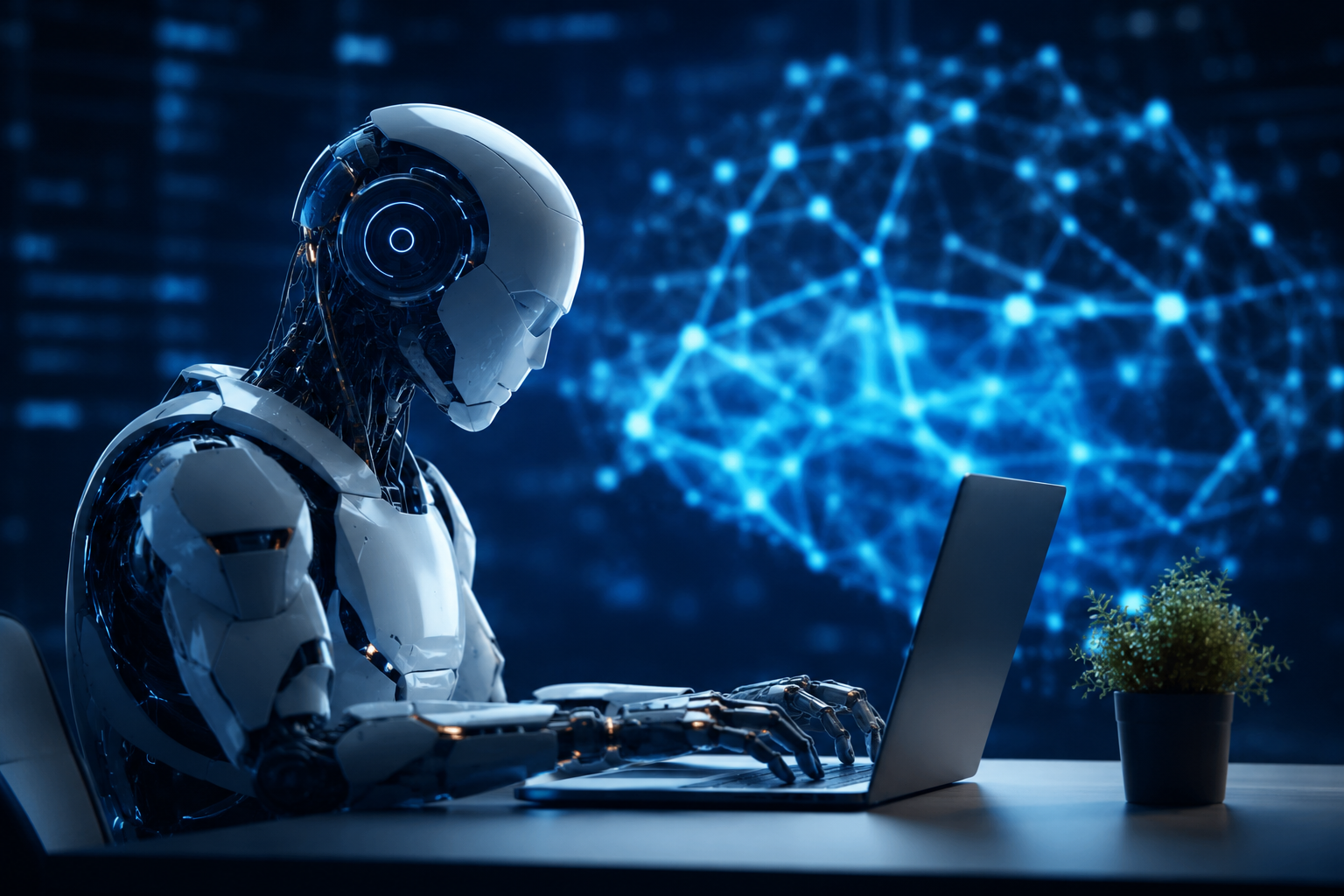
Automation has existed for many years.
But what is automation actually?
At its simplest, automation means using technology to complete tasks with less manual effort.
Traditional automation followed fixed instructions.
A developer created rules.
A system followed those rules.
But AI automation is different.
Modern AI systems can:
- Understand natural language instructions
- Generate solutions
- Analyze information
- Improve workflows
- Assist decision-making
- Help build applications faster
Tools like ChatGPT, Claude, and Google Gemini have changed how people interact with technology.
Instead of only giving machines commands, we can now collaborate with intelligent systems.
This has created a new generation of software development.
The Role of Developers Is Evolving in the AI Era
For decades, developers were mainly valued for writing code.
Learning programming meant:
Choosing a language.
Understanding syntax.
Practicing.
Building projects.
And improving over time.
Those skills still matter.
But AI has introduced a new layer.
Today, AI can:
- Generate application features
- Write documentation
- Debug errors
- Suggest architecture ideas
- Create test cases
- Improve existing code
This does not remove the need for developers.
It changes their role.
The future developer is not only a coder.
The future developer is a system designer, problem solver, and AI collaborator.
AI Can Write Code, But Humans Still Build Products
One of the biggest discussions happening around the impact of AI on jobs is whether AI will replace software developers.
The answer is not that simple.
AI can create code.
But software engineering is much bigger than writing lines of code.
Building real applications requires understanding:
- User problems
- System architecture
- APIs
- Databases
- Cloud infrastructure
- Security
- Performance
- Business requirements
AI tools can help you move faster.
But humans still provide direction.
Think of AI as a powerful assistant.
A developer using AI effectively can build faster, test faster, and experiment faster.
But the quality depends on the person guiding the technology.
ChatGPT, Claude, Google Gemini and the Rise of AI Coding Assistants
The last few years have introduced a completely new category of development tools.
ChatGPT helps developers brainstorm, debug, understand concepts, and generate solutions.
Claude is helping professionals work with larger contexts, documents, reasoning tasks, and coding workflows.
Google Gemini is bringing AI deeper into productivity, development, and everyday digital experiences.
Along with these, tools like GitHub Copilot, Cursor, and AI coding platforms are changing how developers build.
The workflow is shifting from:
“Write every line manually.”
to:
“Guide AI systems to build better solutions.”
This is one of the biggest transformations happening in software development.
Why AI Automation Skills Are Becoming Important
The future workplace will reward people who understand how to work with AI.
Companies are increasingly looking for professionals who can:
- Use AI tools effectively
- Automate repetitive workflows
- Build intelligent applications
- Understand AI-powered systems
- Improve productivity using automation
The advantage will not come from simply knowing how to use one AI tool.
Tools will keep changing.
The real advantage comes from understanding how AI fits into the complete development process.
The Future of Software Development Is AI + Engineering
AI does not remove the importance of strong technical skills.
Actually, it makes them more valuable.
Developers still need:
Programming Fundamentals
Understanding logic, problem-solving, and software principles helps developers verify and improve AI-generated solutions.
Full-Stack Development Knowledge
Modern developers need to understand how complete systems work:
Frontend.
Backend.
Databases.
Infrastructure.
Deployment.
Generative AI and AI Agents
The next generation of applications will include:
- AI agents
- LLM-powered applications
- RAG systems
- Intelligent workflows
- Automated assistants
Developers who understand these concepts will have an advantage.
Cloud, DevOps, and Security
Building applications is only one part.
Scaling them requires:
- Cloud platforms
- Automation pipelines
- Monitoring
- Security practices
AI-powered development still needs strong engineering foundations.
Read more….. AI for app development
Why Modern Coding Education Is Changing
Technology is evolving rapidly, and software development workflows have changed significantly in recent years.
Traditional coding education often focuses on learning individual programming languages, frameworks, or standalone projects. While these remain important, modern software development increasingly requires developers to work across multiple disciplines and use a broader set of tools.
Today, developers are expected to understand areas such as:
- AI-assisted coding
- Full-stack development
- Generative AI applications
- AI agents
- Cloud computing
- DevOps
- Cybersecurity
- Mobile development
- Game development
- Career-ready development practices
Rather than learning technologies in isolation, developers benefit from understanding how these areas connect throughout the software development lifecycle.
The focus has shifted from simply writing code to building, deploying, securing, and maintaining applications in an AI-assisted development environment.
Final Thoughts: AI Will Not Replace Builders, It Will Upgrade Them
The conversation around AI, automation, and jobs will continue.
Every major technology shift creates uncertainty.
But history has shown one thing:
People who learn to work with new technology create new opportunities.
AI is not just another tool.
It is becoming a new layer of how we think, create, and build.
The future belongs to people who know how to combine human creativity with intelligent systems.
Not developers versus AI.
Developers with AI.