Introduction to Multi-Model Databases
Choosing a database for a real-time application or game backend involves more than deciding where to store records. Developers must consider response times, concurrent users, data consistency, scalability, and the different ways an application accesses information. A Multi-Model Database can help address these requirements by supporting multiple data models within one database platform.
For example, a multiplayer game may need player profiles, inventories, session information, match histories, and relationships between players. A real-time collaboration platform may store documents, user preferences, activity records, and shared workspace data. Each type of information can have different access and consistency requirements.
This guide explains how multi-model databases work, compares MongoDB and Couchbase Server, and examines when a relational database or a specialized data store may be more appropriate. It also provides a practical framework for evaluating database performance, architecture, and operating costs.
The objective is not to identify one universally superior database. It is to help developers choose a solution that fits their application’s actual workload.
What Is a Multi-Model Database?
A Multi-Model Database is a database platform that supports more than one data model for storing, organizing, or querying information. Depending on the product, these models may include document, key-value, graph, relational, or wide-column structures.
Traditional relational databases organize data primarily into tables. Document databases store records as structured documents, while key-value systems retrieve values using unique keys. Graph databases focus on entities and their relationships.
A multi-model database can combine several of these capabilities, potentially reducing the need to operate separate database products for different workloads.
However, not every product supports every model. Some platforms focus on document and key-value access, while others offer graph or relational capabilities. Developers should confirm the supported features before selecting a system.
Understanding Multi-Model Database Architecture
A multi-model database architecture provides multiple ways to work with data within a database platform. The implementation differs by vendor, but common models include:
- Document: Stores records as JSON-like documents, often suitable for profiles, catalogs, and content.
- Key-value: Retrieves values through unique keys, which can be useful for sessions and frequently accessed records.
- Relational: Uses tables, relationships, constraints, and commonly SQL queries.
- Graph: Represents entities and connections, helping with relationship-heavy queries.
- Wide-column: Organizes distributed data into rows and groups of columns for particular access patterns.
The benefit of this architecture is flexibility. Teams may be able to simplify data access and reduce integration work by consolidating suitable workloads on one platform.
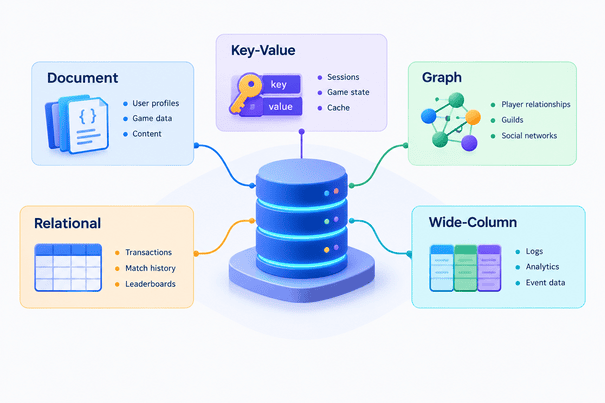
The limitation is that supporting multiple models does not guarantee equal performance or feature depth across all of them. A specialized database may still be better for a demanding workload.
Multi-Model Database Examples
Developers evaluating multi-model database examples should distinguish between products that natively support multiple data models and products that primarily support one model with additional features.
| Database | Relevant capabilities | Potential applications |
| MongoDB | Document storage, indexing, flexible document structures, and queries | Player profiles, inventories, and content |
| Couchbase Server | JSON documents, key-value access, SQL++ queries, and additional services | Low-latency application data and user records |
| PostgreSQL | Relational tables, transactions, JSON support, and extensions | Transactional applications with structured data |
| ArangoDB | Document, graph, and key-value capabilities | Connected data and relationship-heavy applications |
These options are not interchangeable. Compare their query features, transaction guarantees, scaling mechanisms, and deployment models against the needs of your application.
For example, MongoDB’s official data modeling documentation explains how developers can organize records around application requirements.
How a Multi-Model Database Management System Works
A multi-model database management system generally provides storage, indexing, query processing, access controls, and administration tools for its supported models.
An application connects through a driver, SDK, API, or query interface. The database processes the request and returns the requested information. Some platforms provide several interfaces or services within the same product.
Consider a game backend that retrieves a player profile by document ID, reads a session through key-value access, and queries match history using the platform’s query language. This design may reduce the need for separate data stores if the platform supports each operation efficiently.
The key consideration is whether these capabilities work well under real workloads. Schema design, indexes, query patterns, consistency requirements, and infrastructure configuration all affect the result.
Why Real-Time Apps and Game Backends Need Flexible Databases
Real-time applications must respond to changing information while users are actively interacting with them. Multiplayer games, chat services, collaborative editors, live-commerce platforms, and connected-device applications all depend on reliable data access.
Their workloads can be very different. Player profiles may change occasionally, while session information and event records change frequently. Purchases need strong integrity guarantees, while telemetry may prioritize high-volume ingestion.
A Multi-Model Database can help consolidate suitable workloads, provided its features match the application’s requirements.
Real-Time Data Processing and Low Latency
Low latency is important when an application needs to respond quickly. A slow database request can delay a game action, interrupt a chat experience, or make a live dashboard feel outdated.
Database response times depend on several factors:
- Network distance between the application and database
- Query complexity and index design
- Number of concurrent reads and writes
- Data volume and access patterns
- Connection pooling and client configuration
- Replication and consistency settings
- Infrastructure capacity during traffic spikes
Developers should measure average latency and high-percentile latency, such as p95 and p99. These figures help reveal slower requests that may affect user experience even when average performance looks good.
Testing should use representative data and realistic traffic patterns. A database that performs well with a small test dataset may behave differently under concurrent writes or peak demand.
Database performance also depends on efficient application design, caching, and request handling. Explore these web application optimization techniques and tools to understand how broader performance improvements can complement your database strategy.
Managing Game State, Player Profiles, and Multiplayer Events
A game backend may need to manage:
- Player profiles, settings, and achievements
- Inventories, equipment, and progression
- Match histories and leaderboards
- Sessions and matchmaking metadata
- Purchases, rewards, and audit records
- Telemetry and gameplay events
A document model can represent player profiles and nested settings. Key-value access can help retrieve frequently accessed records where the platform supports it. Query features may help developers retrieve match histories or filter player records.
However, persistent data and live simulation state are not the same thing. Movement, collision detection, and other time-sensitive game logic generally belong in the authoritative game-server process. Writing every simulation update to a general-purpose database can add unnecessary latency and load.
For valuable items, purchases, and rewards, use appropriate server-side validation and transaction safeguards. Database flexibility does not remove the need for reliable game logic.
Scalability and High Availability Requirements
As applications grow, databases may need to handle more users, larger datasets, and higher write volumes. A suitable platform should provide scaling mechanisms that align with expected demand.
Evaluate how the database handles replication, failover, backups, recovery, and increases in traffic. Test node failures and network interruptions rather than measuring only normal operating conditions.
High availability does not automatically guarantee that every read returns the latest committed value. Consistency behavior depends on the product, configuration, and operation being performed.
For a game, a short delay in displaying a noncritical statistic may be acceptable. A conflicting inventory update or duplicated purchase may not be. Define the required guarantees for each operation before selecting the database.
Relational vs Multi-Model Databases
The choice between relational vs multi-model databases depends on data structure, query patterns, transaction requirements, and operational complexity.
Relational databases organize information into tables with relationships and commonly use SQL. Multi-model databases support multiple data models, but the specific models and guarantees vary by platform. Some products also combine relational and non-relational capabilities.
Key Differences Between Relational and Multi-Model Databases
| Feature | Relational database | Multi-model database |
| Data structure | Tables and relationships | Multiple models, depending on the product |
| Schema | Often explicitly defined | May support flexible schemas for certain models |
| Querying | Commonly SQL | SQL, model-specific APIs, or multiple interfaces |
| Relationships | Strong support for joins and constraints | Depends on supported models |
| Transactions | Mature support in many systems | Capabilities and scope vary |
| Best fit | Structured transactional workloads | Applications benefiting from multiple supported models |
This is not a simple SQL-versus-NoSQL division. Relational systems can support JSON and extensions, while some multi-model platforms provide SQL-like queries and transactions.
For a deeper introduction, read CodeCondo’s guide to SQL vs NoSQL databases: key differences, pros, and cons.
Advantages and Limitations of Each Database Approach
Relational databases are often strong choices when applications rely on complex joins, constraints, and transactions across related records. They can be especially suitable for billing, payment processing, and order management.
A Multi-Model Database may simplify architecture when its supported models match multiple application requirements. Consolidating workloads can reduce integration code and the number of database systems a team maintains.
However, multi-model platforms can introduce learning and operational complexity. A product may not deliver the same performance for every model, and flexible schemas still require data validation and governance.
The correct decision depends on the workload, not on which category is considered more modern.
When to Choose a Relational or Multi-Model Database
Choose a relational database when data integrity, structured relationships, constraints, and transactional correctness are central to your application.
Consider a multi-model platform when the application genuinely benefits from multiple supported data models and the platform handles its critical operations effectively.
A hybrid design can be appropriate when different workloads have distinct requirements. For example, a game might use a relational database for purchases, a key-value store for temporary sessions, and an analytics platform for telemetry.
When conducting relational vs multi-model databases research, evaluate query performance, consistency, scaling, migration effort, and total operating cost. Avoid relying on a single benchmark or generalized product ranking.
MongoDB and Couchbase Server are useful candidates to evaluate for real-time applications. Both support document-oriented data, but they differ in architecture, query capabilities, and operational features.
MongoDB Features and Use Cases
MongoDB is a document database that stores records as BSON documents. Its flexible document model allows fields and structures to evolve as application requirements change.
Potential use cases include:
- Player profiles and preferences
- Game inventories and progression
- Product catalogs and application content
- User-generated content and match histories
- APIs that work naturally with document-shaped data
MongoDB supports document queries, indexing, and data-management features. Developers should still design schemas around access patterns, decide when to embed or reference related records, and index important queries carefully.
MongoDB should not be assumed to provide every data model supported by all multi-model database products. Evaluate its actual capabilities against your needs.
If you need a refresher on the fundamentals before comparing database platforms, read this guide to the basics of MongoDB concepts, including the core ideas developers should understand when working with document databases.
Couchbase Server Features and Use Cases
Couchbase Server combines JSON document storage with key-value access and SQL++ querying. It also offers additional services and capabilities, depending on the deployment and configuration.
Potential use cases include:
- Applications with frequent key-based lookups
- User profiles and session-related records
- JSON-based content and catalogs
- Applications that need SQL-like queries over documents
- Distributed application workloads
Its SQL++ language provides a SQL-like way to query JSON documents. Developers can explore the official Couchbase SQL++ query documentation to understand how queries are constructed.
As with MongoDB, suitability depends on the actual workload, indexes, deployment topology, and consistency requirements.
MongoDB vs Couchbase Server: Performance, Scalability, and Flexibility
Neither database is automatically faster or better for every application. Performance depends on schema design, query patterns, hardware, indexing, configuration, and deployment topology.
| Evaluation area | What to test |
| Read latency | Profile, inventory, and session lookups |
| Write throughput | Concurrent updates and event ingestion |
| Query flexibility | Filtering, aggregation, and relationships |
| Scaling | Behavior as traffic and data volumes grow |
| Reliability | Failover and recovery |
| Consistency | Correctness of purchases and inventory updates |
| Operations | Monitoring, upgrades, and troubleshooting |
| Cost | Infrastructure, licensing, and engineering time |
For a fair comparison, use the same representative data and similar workload assumptions. Include peak traffic, realistic document sizes, concurrent operations, and failure scenarios.
How to Compare Database Capabilities for Real-Time Apps
Start by listing your application’s critical operations. A game backend might require frequent profile lookups, inventory updates, match-history queries, and durable purchase records.
For each operation, define acceptable latency, expected throughput, and consistency requirements. Then test whether each database supports it efficiently.
Developer experience also matters. SDK availability, query tools, monitoring, documentation, deployment options, and team familiarity can all affect long-term cost.
The most useful comparison is based on measurable requirements, not a general ranking of popular database management systems.
How to Choose the Best Multi-Model Database
Choosing the best multi-model database means balancing performance, reliability, security, developer experience, and cost. A feature-rich platform is not necessarily the best choice if it makes your most important operations difficult or expensive.
Performance, Scalability, and Query Speed
Identify the operations your application performs most frequently. For a multiplayer game, these may include loading player profiles, updating inventories, recording matches, and retrieving session information.
Measure the following:
- Average, p95, and p99 request latency
- Reads and writes per second
- Performance under peak concurrent traffic
- Index and storage overhead
- Behavior during scaling and recovery
Test realistic datasets and workload patterns. Include traffic spikes and concurrent updates to identify bottlenecks that may not appear in a basic benchmark.
Data Consistency, Transactions, and Security
Not all application data requires identical consistency guarantees. A cosmetic preference may tolerate a short synchronization delay, while a purchase or valuable item transfer must avoid duplicate or conflicting updates.
Evaluate transaction support, replication behavior, read consistency, access controls, encryption, audit logging, and backup restoration. Verify the exact guarantees provided by the product and configuration you intend to use.
Security also depends on application design. Keep database credentials out of client-side code, enforce authorization in backend services, and validate important game actions on the server.
Deployment Options, Maintenance, and Total Cost
Compare managed services with self-managed deployments. Consider supported regions, monitoring tools, backup options, upgrade processes, and the operational skills your team needs.
Total cost of ownership includes more than hosting. Include compute, storage, network traffic, licensing, support, monitoring, developer training, and maintenance.
A consolidated database platform may reduce integration work. However, a specialized database can be more economical when one workload requires capabilities that a general-purpose platform cannot deliver efficiently.
Testing Databases with Realistic Workloads
Use a repeatable evaluation process:
- Identify your application’s data types and access patterns.
- Select two or three suitable database candidates.
- Prepare representative datasets and indexes.
- Test typical and peak workloads.
- Measure latency, throughput, and resource usage.
- Test failure recovery and consistency.
- Compare total cost and operational effort.
Document the configuration and test conditions so that results can be reproduced after application or database changes.
For additional background, see Eduonix’s guide to learning how data modeling works in MongoDB.
Multi-Model Database Examples for Real-Time Applications
Practical multi-model database examples show how different data models can serve real application needs. The goal is to match each workload with appropriate capabilities rather than forcing all data into one structure.
Multi-Model Databases for Multiplayer Games
A multiplayer game may store player accounts, settings, inventories, achievements, match histories, and progression records.
A document model can represent a player’s profile, while key-value access can support frequently used lookups when available. Query capabilities may help retrieve match histories or filter records for moderation and reporting.
However, active movement, collision detection, and time-sensitive simulation generally belong in the authoritative game-server process. Persist the information that needs durable storage, and protect purchases and item transfers with appropriate transactional safeguards.
Database Architecture for Chat and Collaboration Apps
Chat platforms manage messages, conversations, membership, profiles, and notification state. Collaboration tools may also need document metadata, permissions, and revision histories.
A document model may suit conversation metadata, while key-based access may help retrieve sessions or frequently accessed records. The architecture must still address message ordering, retention, synchronization, and access controls.
For collaborative editing, a database alone does not guarantee conflict-free changes. Applications may need explicit conflict-resolution rules or specialized synchronization algorithms.
Real-Time Commerce and IoT Applications
Real-time commerce platforms manage product catalogs, stock levels, orders, and payment events. IoT platforms ingest device readings, maintain device metadata, and process alerts.
A Multi-Model Database can consolidate some of these requirements if its models and consistency guarantees fit the workload. Payment processing and inventory updates may require strong transactional safeguards, while high-volume time-series processing may benefit from a specialized service.
The right architecture meets performance and reliability requirements without adding unnecessary complexity.
NoSQL Database Trends and Common Database Selection Mistakes
NoSQL Database Trends include flexible data models, distributed deployments, managed database services, and specialized platforms for different workloads. Multi-model databases are part of this broader landscape, but they do not eliminate the need to evaluate products individually.
Current NoSQL Database Trends
Several developments influence modern database architecture:
- Managed database services: Reduce routine infrastructure maintenance for many teams.
- Flexible data modeling: Helps accommodate evolving application requirements.
- Distributed deployments: Support replication and scaling across nodes or regions.
- Workload specialization: Separates demanding search, analytics, caching, and transactional workloads where appropriate.
- Operational testing: Gives greater attention to recovery, consistency, latency, and cost.
These trends do not guarantee that any particular database will be suitable for every application. Product features and workload requirements still matter most.
Multi-Model Databases vs Specialized Database Systems
A multi-model platform can simplify architecture when several of its supported capabilities fit the application. A specialized database may be a better choice when one workload has particularly demanding requirements.
For example, a game could use a document database for profiles, a cache for temporary state, a relational database for purchases, and an analytics platform for telemetry.
This hybrid approach introduces integration work, but it can provide more appropriate capabilities for each workload. The decision should consider operational overhead as well as performance.
Common Mistakes When Comparing Database Management Systems
Avoid these common mistakes:
- Choosing a product because it is popular rather than suitable.
- Assuming all multi-model databases support the same models.
- Ignoring schema design, indexes, and query optimization.
- Treating temporary session data like permanent business records.
- Overlooking consistency, security, and recovery requirements.
- Comparing benchmarks produced under different conditions.
- Ignoring migration effort and long-term operating costs.
Also distinguish between multi-model and multimodal when researching database tools. Multi-model databases support different data models, while multimodal systems often work with different kinds of content, such as text, images, and audio. A search for a “multimodal database comparison tool” may therefore return results unrelated to this article’s primary topic.
Frequently Asked Questions About Multi-Model Databases
What Is a Multi-Model Database?
A Multi-Model Database supports more than one data model within a database product or platform. Depending on the product, these may include document, key-value, graph, or relational models. Features vary by vendor.
Is MongoDB a Multi-Model Database?
MongoDB is primarily a document database with flexible document storage, indexing, and query capabilities. It should not be assumed to support every model offered by other multi-model database platforms.
Is Couchbase Server Suitable for Real-Time Applications?
Couchbase Server may suit applications that benefit from JSON document storage, key-value access, and SQL++ queries. Its suitability depends on the workload, deployment, consistency requirements, and measured performance.
Are Multi-Model Databases Better Than Relational Databases?
Not universally. Relational databases are often well suited to structured transactions, constraints, and complex joins. Multi-model databases can be useful when an application benefits from several supported models within one platform.
How Should Developers Choose a Database for Game Backends?
Evaluate latency, throughput, transaction support, consistency, scaling, security, recovery, and cost. Test realistic player profiles, inventory updates, match records, and peak traffic before committing to a solution.
Conclusion: Choosing the Right Multi-Model Database
A Multi-Model Database can simplify data architecture when an application needs multiple supported data models. For real-time applications and game backends, MongoDB and Couchbase Server are useful candidates to evaluate, but their capabilities and performance should be measured against the workload.
Start by identifying the data your application stores, the operations it performs most frequently, and the consistency guarantees it needs. Benchmark candidate databases under realistic conditions, compare operational costs, and consider a hybrid architecture if one platform cannot efficiently meet every requirement.
The goal is not to choose the database with the longest feature list. It is to build a reliable, secure, and maintainable backend that can grow with your application.