Introduction
Cybersecurity in 2026 is entering a completely new era — one where artificial intelligence is no longer just a business tool, but also a powerful weapon for cybercriminals. From AI-generated phishing emails to deepfake scams and self-learning malware, modern cyber threats are becoming faster, smarter, and far more difficult to detect.
What makes today’s AI-powered cyber attacks especially dangerous is their speed and personalization. Hackers no longer need advanced technical skills to launch sophisticated attacks. With publicly available AI tools, attackers can now create realistic phishing emails, clone voices, automate scams, and identify vulnerabilities within minutes. In many cases, AI can already write phishing emails that sound more convincing than those written by humans.
The numbers highlight how serious the situation has become. Reports show phishing attacks have increased by over 1,200% due to generative AI, while nearly 60% of cybercriminal groups now use AI tools to support cybercrime. Deepfake scams targeting businesses and executives are also rising rapidly, causing millions in financial losses worldwide.
Traditional security methods are struggling to keep up with this new threat landscape. Static defenses and manual monitoring are no longer enough when attacks can evolve in real time. This is why understanding cybersecurity tips in the era of AI has become critical for both businesses and individuals.
In this guide, we’ll break down how AI is reshaping cyber threats, explain the biggest security risks in cybersecurity in 2026, and explore practical strategies businesses can use to stay protected. From AI phishing prevention to Zero Trust security and AI-powered defense systems, this article focuses on real-world cybersecurity practices that actually work in the AI era.
Why Cybersecurity in the Era of AI Is Different
The biggest shift in cybersecurity in the era of AI is that cyberattacks are no longer fully dependent on human effort. Artificial intelligence has changed how attacks are created, launched, and scaled. Unlike traditional cyber threats, modern AI-powered cyber attacks can automate decision-making, adapt in real time, and target victims with incredible precision.
Earlier, cybercriminals needed advanced technical skills to build malware, write phishing emails, or scan systems manually. In cybersecurity in 2026, AI tools are reducing that skill barrier dramatically. Today, even low-skilled attackers can use AI platforms to create convincing scams, generate malicious code, and automate hacking attempts within minutes.
As cyber threats become more advanced, many professionals are upgrading their skills through specialized cybersecurity degree program options focused on AI-driven security and modern cyber defense strategies.
How AI Cyber Threats Differ from Traditional Attacks
| Traditional Cyber Threats | AI-Powered Cyber Attacks |
| Mostly manual execution | Highly automated |
| Generic phishing emails | Hyper-personalized phishing |
| Slower attack cycles | Real-time adaptive attacks |
| Required technical expertise | AI lowers skill barriers |
| Easier pattern detection | Harder to detect and predict |
One of the biggest concerns in cybersecurity in the era of AI is automation at scale. AI can analyze public data, social media activity, leaked credentials, and business information to craft highly targeted phishing attacks. These scams often look authentic because AI can imitate writing styles, business communication patterns, and even human voices using deepfake technology.
Why AI-Powered Cyber Attacks Are More Dangerous
- AI can launch attacks 24/7 without human involvement
- Deepfake technology enables identity impersonation scams
- AI-generated malware can modify itself to avoid detection
- Phishing emails are becoming more realistic and personalized
- Attackers can identify vulnerabilities much faster using AI automation
Another major challenge is speed. Traditional security systems rely heavily on known attack signatures and predefined rules. AI-driven threats evolve continuously, making static defenses less effective.
A critical reality of modern cybersecurity is this:
“Attackers only need to succeed once, while defenders must protect every possible entry point.”
This imbalance has become even more serious with AI. A single successful phishing email or stolen credential can lead to ransomware attacks, financial fraud, or large-scale data breaches.
Because of this, businesses are moving toward smarter defense strategies in cybersecurity in 2026, including:
- AI-powered threat detection
- Behavioral analytics
- Zero Trust security models
- Real-time monitoring systems
- Automated incident response
Modern cybersecurity is no longer just about reacting to attacks. In the AI era, organizations must predict threats, respond faster, and continuously adapt to an evolving threat landscape.
How AI Is Powering Modern Cyber Attacks
Understanding how AI is used in cyber attacks is essential in today’s threat landscape. Artificial intelligence has changed cybercrime from a manual process into a highly automated and scalable operation. Attackers are now using AI to create smarter phishing campaigns, generate adaptive malware, impersonate real people, and scan systems for weaknesses faster than ever before.
The biggest concern in cybersecurity in 2026 is that AI allows attackers to operate with speed, precision, and minimal effort. Tasks that once took days or weeks can now happen in minutes.
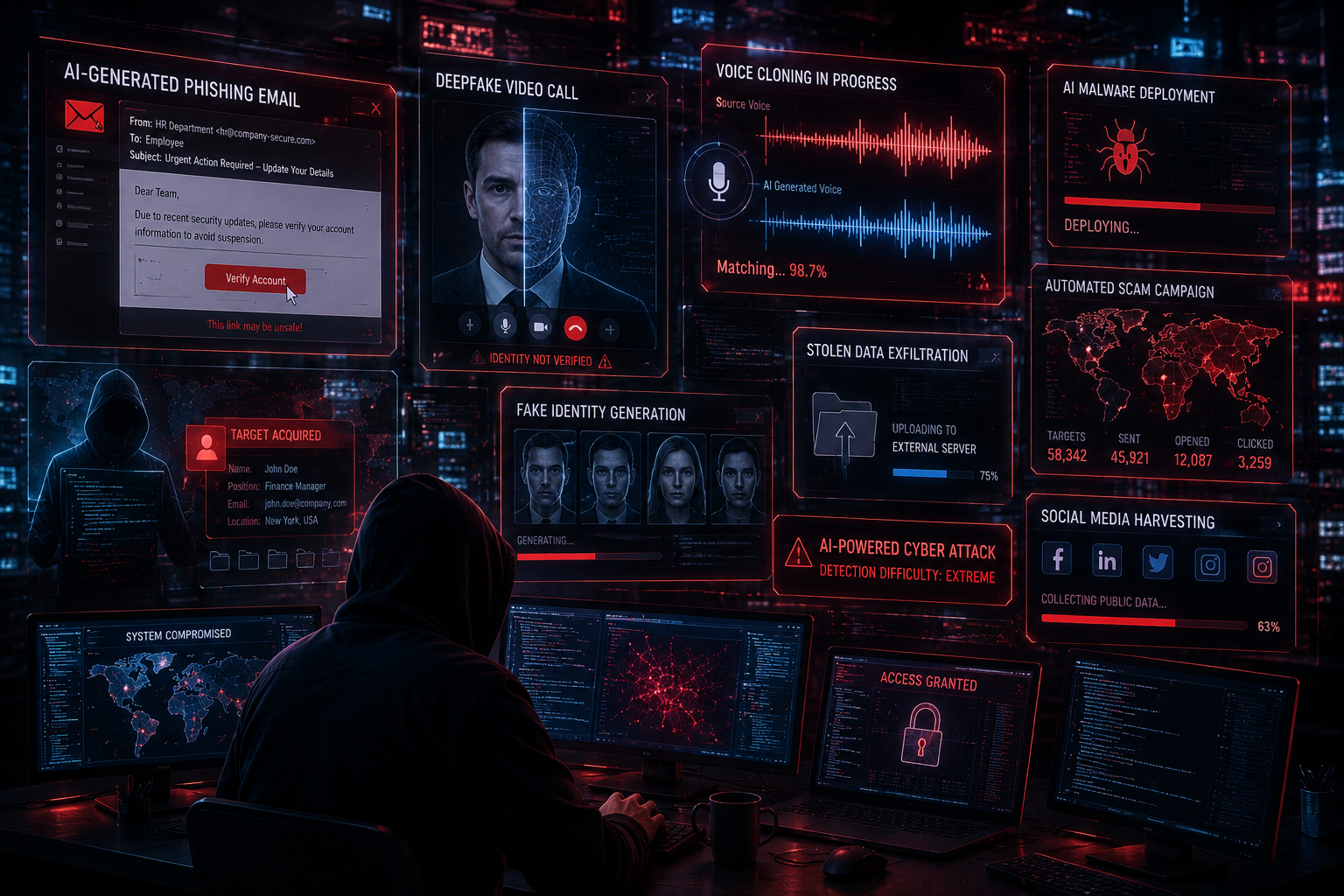
AI-Powered Phishing & Social Engineering
Phishing has evolved far beyond poorly written scam emails. AI now enables cybercriminals to create highly convincing and personalized attacks that are difficult to distinguish from legitimate communication.
Modern AI tools can:
- Analyze social media profiles and public data
- Mimic writing styles and communication tone
- Generate realistic business emails instantly
- Translate phishing messages into multiple languages
- Automate large-scale phishing campaigns
This is one of the clearest examples of how AI is used in cyber attacks today. AI-generated phishing emails often include accurate names, job roles, recent activities, and company references, making them feel authentic.
Voice cloning, also known as vishing, is becoming another major threat. Attackers can now use a few seconds of audio from social media videos, interviews, or voice notes to replicate someone’s voice. Criminals have already used this tactic in fake executive calls requesting urgent financial transfers.
Why AI Phishing Is More Dangerous
- Emails sound more natural and human-like
- AI removes spelling and grammar mistakes
- Attacks can target thousands of users simultaneously
- Personalized scams increase click-through rates
- Voice-cloning creates trust-based manipulation
As AI-powered cyber attacks continue evolving, phishing is becoming more psychological than technical.
Deepfakes & Identity Attacks
Deepfake technology is creating serious challenges for businesses and individuals alike. Cybercriminals now use AI-generated audio and video to impersonate executives, employees, celebrities, and even family members.
One growing threat is CEO fraud, where attackers use deepfake audio or video to imitate company leaders and request urgent wire transfers or confidential information. Because the communication appears authentic, employees may respond without suspicion.
AI-generated identity attacks are also being used in:
- Financial fraud
- Fake customer verification
- Social media impersonation
- Business email compromise (BEC) attacks
- Remote hiring scams
Unlike traditional identity theft, deepfakes exploit human trust directly. This makes them particularly dangerous in remote work environments where video calls and digital communication dominate daily operations.
In cybersecurity in the era of AI, verifying identity is becoming just as important as securing devices and networks.
AI-Generated Malware
Another major example of how AI is used in cyber attacks is malware development. Traditional malware followed predictable behavior patterns, which made detection easier for antivirus systems. AI-generated malware is far more adaptive.
Modern AI-powered malware can:
- Modify its behavior during attacks
- Hide malicious code using obfuscation techniques
- Avoid signature-based detection systems
- Learn from failed attack attempts
- Blend into normal system activity
Some advanced malware can even identify security tools running on a device and adjust its behavior to avoid detection. This creates major challenges for traditional cybersecurity systems that depend heavily on predefined attack signatures.
Key Risks of AI Malware
- Faster ransomware deployment
- Increased evasion capabilities
- Reduced detection accuracy
- Automated attack adaptation
- Greater scalability for attackers
This shift is forcing businesses to adopt AI-powered cybersecurity solutions capable of detecting abnormal behavior rather than relying only on static rules.
Automated Hacking & Reconnaissance
Artificial intelligence is also transforming the reconnaissance phase of cyberattacks. Attackers can now use AI to automate vulnerability scanning, collect massive amounts of public data, and identify weak targets quickly.
Instead of manually searching for vulnerabilities, AI systems can:
- Scan thousands of systems simultaneously
- Detect outdated software automatically
- Identify exposed credentials
- Scrape data from websites and social platforms
- Prioritize high-value targets using predictive analysis
This automation significantly reduces the time between discovering a vulnerability and exploiting it.
One dangerous trend in AI-powered cyber attacks is the rise of AI-driven reconnaissance bots. These tools continuously gather information from public sources, helping attackers build highly targeted attack strategies with minimal effort.
In cybersecurity in 2026, the challenge is no longer just preventing attacks — it’s dealing with attacks that can learn, adapt, and scale faster than human teams can respond manually.
Top Cybersecurity Risks in the AI Era (2026)
As artificial intelligence becomes deeply integrated into businesses, the threat landscape is evolving just as quickly. One of the biggest challenges in cybersecurity in the era of AI is that threats are becoming more automated, intelligent, and difficult to detect. Attackers are now using AI not only to scale attacks but also to manipulate trust, exploit human behavior, and bypass traditional security systems.
Below are some of the most critical AI-powered cyber threats businesses and individuals face in cybersecurity in 2026.
| Risk Type | Description | Impact Level |
| AI Phishing | AI-generated phishing emails and scams designed to mimic real communication styles | High |
| Deepfakes | AI-generated voice and video impersonation used for fraud and identity attacks | High |
| Data Poisoning | Manipulating AI training data to influence or corrupt AI system outputs | Medium |
| AI Malware | Adaptive malware capable of changing behavior to avoid detection | High |
| Insider AI Misuse | Employees using unsecured AI tools that may expose sensitive business data | High |
AI Phishing
AI phishing has become one of the fastest-growing threats in cybersecurity in the era of AI. Attackers use generative AI to create personalized scam emails that look highly authentic. Unlike traditional phishing, AI-generated messages often contain accurate names, company references, and natural language, making them much harder to identify.
Deepfakes
Deepfake technology is creating major identity security risks in cybersecurity in 2026. Cybercriminals can now clone voices, generate fake videos, and impersonate executives or employees during virtual meetings. These attacks are increasingly being used in financial fraud and business email compromise scams.
Data Poisoning
AI systems depend heavily on data. In data poisoning attacks, hackers intentionally manipulate training datasets to influence how AI models behave. This can weaken cybersecurity systems, create biased outputs, or allow attackers to bypass AI-driven defenses.
AI Malware
Modern AI-powered cyber attacks include malware that can adapt during execution. AI-generated malware can change code patterns, hide malicious behavior, and avoid traditional antivirus detection systems. This makes attacks more persistent and difficult to contain.
Insider AI Misuse
One overlooked cybersecurity risk is employees using public AI tools without proper security controls. Uploading confidential business data into unsecured AI platforms can accidentally expose sensitive information, intellectual property, or customer records.
Why These Risks Matter in 2026
The biggest shift in cybersecurity in the era of AI is that attacks are becoming:
- Faster
- More scalable
- Harder to detect
- More personalized
- Increasingly automated
Businesses can no longer rely only on traditional defenses. Modern cybersecurity strategies now require AI-powered monitoring, employee awareness, Zero Trust security, and continuous threat detection to reduce risks in an AI-driven world.
10 Cybersecurity Tips in the Era of AI (Actionable Guide)
As AI-powered threats continue to evolve, businesses can no longer rely on outdated security methods alone. Modern attacks are faster, more automated, and highly personalized, which means organizations need smarter defense strategies. These cybersecurity tips in the era of AI focus on practical actions businesses can implement to strengthen protection in cybersecurity in 2026.
1. Use AI-Powered Threat Detection
Traditional security tools often struggle to identify modern AI-powered cyber attacks. Businesses should adopt AI-driven security systems that use behavioral analysis and real-time monitoring to detect suspicious activity instantly.
AI-powered tools can:
- Identify unusual login behavior
- Detect abnormal network activity
- Flag ransomware behavior early
- Automate incident response
This approach improves threat visibility and reduces response times significantly.
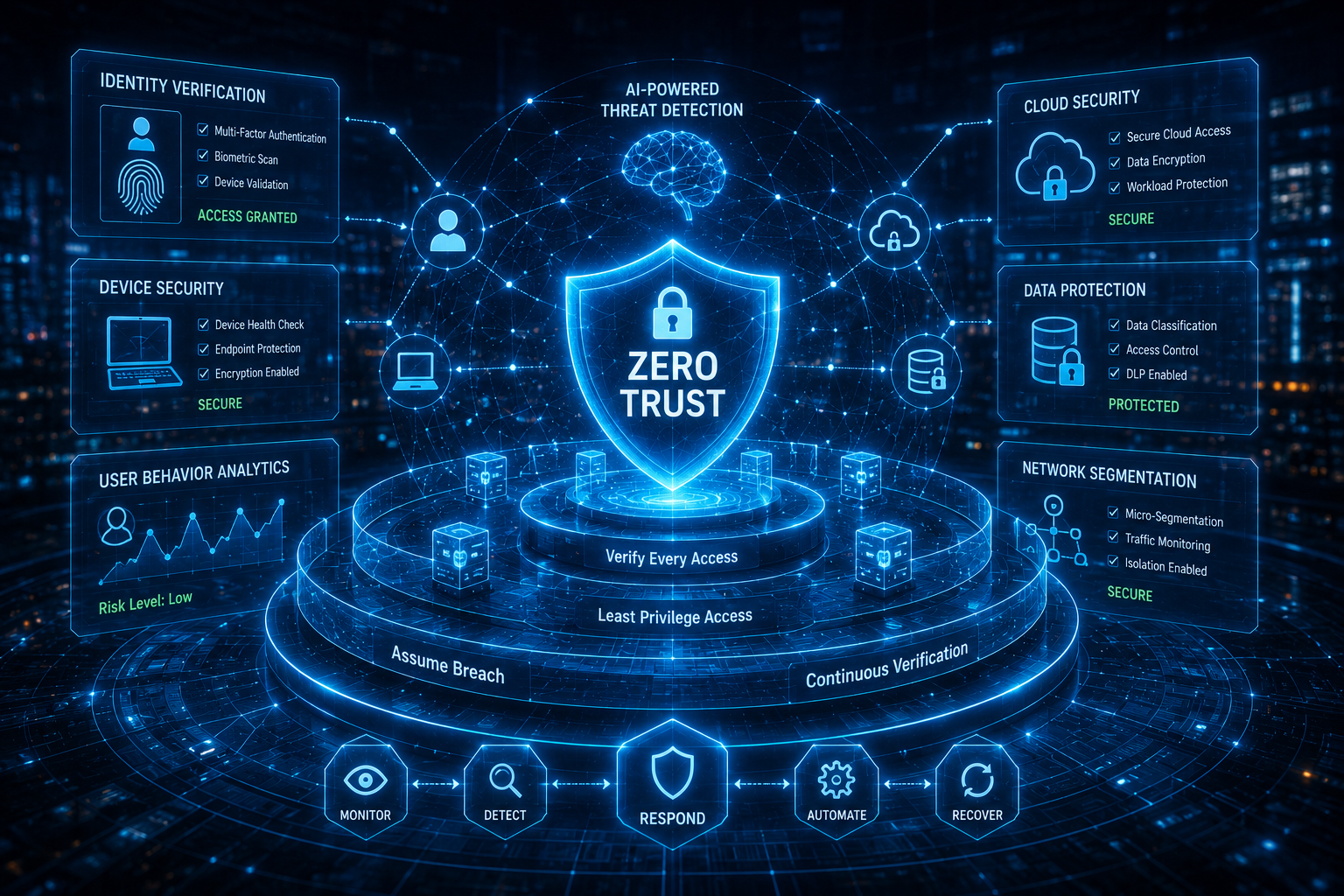
2. Implement Zero Trust Security Model
One of the most effective cybersecurity strategies for the AI era is adopting a Zero Trust Security AI framework.
The principle is simple:
“Never trust, always verify.”
Instead of automatically trusting users or devices inside a network, Zero Trust continuously validates identity, device health, and access permissions.
Key Zero Trust practices include:
- Continuous authentication
- Least-privilege access
- Device verification
- Micro-segmentation
This limits lateral movement during cyberattacks and reduces overall risk exposure.
3. Protect Against AI Phishing Attacks
AI phishing attacks prevention has become critical in modern cybersecurity. AI-generated phishing emails are now highly personalized and difficult to detect manually.
Businesses should implement:
- Advanced email filtering systems
- AI-based spam detection
- Employee phishing awareness training
- Verification procedures for financial requests
Employees should also be trained to identify deepfake voice scams and suspicious urgent requests.
4. Secure Your Data with AI-Ready Governance
Strong AI data security best practices are essential in cybersecurity in the era of AI. AI systems process massive amounts of sensitive information, making data protection a top priority.
Important data security measures include:
- Data encryption
- Role-based access control
- Secure cloud storage
- Data classification policies
- Backup and recovery systems
Businesses should also control how AI tools access internal data to prevent accidental leaks.
5. Regularly Update Systems & AI Models
Outdated software remains one of the easiest entry points for attackers. Businesses should continuously patch vulnerabilities and update operating systems, applications, and AI security tools.
Regular updates help:
- Fix known security flaws
- Improve threat detection accuracy
- Reduce exploit risks
- Strengthen system stability
In cybersecurity in 2026, delayed updates can quickly become major security liabilities.
6. Train Employees with AI Simulations
Employees remain one of the biggest cybersecurity risks. Human error still plays a major role in successful attacks.
Organizations should build a “human firewall” using:
- Simulated phishing campaigns
- AI-driven cybersecurity training
- Deepfake awareness exercises
- Security response drills
Practical training helps employees recognize modern scams before they become real incidents.
7. Monitor AI Tools Used by Employees
The rise of public AI platforms has introduced “Shadow AI” risks inside organizations. Employees may unknowingly upload confidential data into unsecured tools like ChatGPT or third-party AI apps.
To reduce risk:
- Monitor AI tool usage
- Create AI usage policies
- Restrict sensitive data uploads
- Use approved enterprise AI solutions
This is becoming a major focus area in AI security risks and solutions discussions.
8. Secure Your AI Supply Chain
Third-party AI tools and open-source AI libraries can introduce hidden vulnerabilities. Businesses should carefully evaluate vendors and software dependencies.
Important security steps include:
- Vendor risk assessments
- Software Bill of Materials (SBOMs)
- Open-source code audits
- API security monitoring
Securing the AI supply chain reduces the risk of inherited vulnerabilities.
9. Use Multi-Factor Authentication (MFA) Everywhere
Despite advances in AI-driven security, Multi-Factor Authentication remains one of the strongest cybersecurity defenses available.
MFA helps protect against:
- Credential theft
- Account takeovers
- Phishing attacks
- Unauthorized access
Businesses should enable MFA across all critical systems, especially cloud platforms and remote access tools.
10. Build a Cybersecurity-First Culture
Cybersecurity is no longer just an IT department responsibility. In cybersecurity in the era of AI, every employee plays a role in reducing security risks.
Organizations should:
- Encourage security awareness
- Create clear cybersecurity policies
- Promote responsible AI usage
- Conduct regular security training
The strongest cybersecurity strategies combine technology, awareness, and proactive security culture.
As AI-powered cyber threats continue evolving, businesses that prioritize continuous learning, AI-driven defense, and employee awareness will be far better prepared to handle future risks.
Traditional vs AI-Driven Cybersecurity
The rise of artificial intelligence has completely transformed how businesses approach cybersecurity. Traditional security systems were designed for predictable threats and manual investigation. However, modern AI-powered cyber attacks evolve much faster, making older defense models less effective in cybersecurity in 2026.
This is why organizations are increasingly adopting AI-powered security solutions that can detect threats in real time, automate responses, and analyze massive amounts of data instantly.
Traditional Security vs AI-Driven Security
| Feature | Traditional Security | AI-Driven Security |
| Detection Speed | Slow and reactive | Real-time threat detection |
| Threat Type | Detects mostly known threats | Identifies unknown and evolving threats |
| Response | Manual investigation and action | Automated response and containment |
| Accuracy | Moderate accuracy with higher false positives | High accuracy using behavioral analysis |
| Scalability | Limited by human resources | Highly scalable across systems and networks |
Why AI-Driven Cybersecurity Matters
Traditional cybersecurity systems mainly rely on predefined rules, signatures, and human intervention. While these methods still play an important role, they struggle against modern threats that continuously adapt and change behavior.
AI-driven cybersecurity solutions improve defense by:
- Monitoring systems 24/7
- Detecting unusual behavior instantly
- Reducing false alerts
- Automating threat response
- Predicting potential attack patterns
For example, AI-powered security systems can identify suspicious login attempts, abnormal network traffic, or ransomware activity before major damage occurs.
In cybersecurity in the era of AI, speed is critical. Modern attacks can spread within minutes, leaving little time for manual investigation. AI-powered defenses help organizations respond faster and reduce the impact of security breaches.
However, AI-driven cybersecurity does not completely replace human expertise. The most effective security strategies combine AI automation with human oversight, threat analysis, and decision-making.
As cyber threats continue evolving, businesses that rely only on traditional security approaches may struggle to keep up with increasingly intelligent and automated attacks.
Biggest Cybersecurity Mistakes in the AI Era
As businesses rapidly adopt artificial intelligence, many are focusing on productivity and automation while overlooking the security risks that come with it. One of the biggest challenges in cybersecurity in the era of AI is that organizations often underestimate how quickly AI-powered threats can exploit weak security practices.
In cybersecurity in 2026, the problem is no longer just external hackers — poor AI usage inside organizations is becoming a major security risk as well.
Below are some of the most dangerous cybersecurity mistakes businesses continue to make in the AI era.
1. Trusting AI-Generated Content Blindly
One of the fastest-growing risks in AI-powered cyber attacks is the misuse of AI-generated content. Many people still assume that if content looks professional or sounds convincing, it must be legitimate.
That assumption is becoming dangerous.
Attackers now use AI to create:
- Highly realistic phishing emails
- Fake customer support messages
- Deepfake videos and voice recordings
- AI-generated business documents
- Fraudulent social media content
Unlike older scams filled with spelling mistakes and obvious red flags, modern AI-generated scams are polished, personalized, and psychologically convincing.
Businesses should verify sensitive requests through secondary communication channels instead of relying solely on emails, voice notes, or video calls.
2. Using Public AI Tools with Sensitive Data
Another major mistake in cybersecurity in the era of AI is uploading confidential business data into public AI platforms without security controls.
Employees often use AI tools to summarize reports, analyze spreadsheets, write code, or generate content. However, entering sensitive information into unsecured AI systems can unintentionally expose:
- Customer data
- Financial information
- Internal documents
- Source code
- Intellectual property
This growing issue is commonly known as “Shadow AI.”
Organizations need clear AI governance policies defining:
- Which AI tools are approved
- What type of data can be shared
- How AI-generated outputs should be reviewed
Strong AI data security best practices are essential for preventing accidental data leakage.
3. Ignoring Employee Cybersecurity Training
Many companies invest heavily in security software while neglecting employee awareness. This creates a major gap in cybersecurity strategies for the AI era.
AI has made phishing attacks significantly more convincing. Employees now face:
- AI-generated phishing emails
- Voice-cloning scams
- Deepfake meeting invitations
- Fake login pages created with AI
Without proper training, even experienced employees can fall victim to highly personalized attacks.
Modern cybersecurity training should include:
- AI phishing simulations
- Deepfake awareness exercises
- Verification procedures for urgent requests
- Safe AI usage practices
In cybersecurity in 2026, employee awareness is becoming just as important as technical defense systems.
4. Having No AI Governance Policies
Many organizations are adopting AI tools faster than they can secure them. One overlooked mistake is failing to establish AI governance frameworks.
Without proper governance, businesses face risks such as:
- Uncontrolled AI usage
- Compliance violations
- Data privacy issues
- Bias in AI systems
- Weak access controls
AI governance is not just about compliance — it’s about accountability and risk management.
Organizations should create policies covering:
- AI tool approval processes
- Data handling standards
- Access permissions
- AI monitoring procedures
- Ethical AI usage guidelines
Strong governance helps reduce both operational and cybersecurity risks.
5. Over-Reliance on Automation
AI-powered security systems are extremely powerful, but relying entirely on automation can create new vulnerabilities.
One of the biggest misconceptions in cybersecurity in the era of AI is that AI can fully replace human oversight. In reality, AI systems can still make mistakes, miss context, or become targets themselves.
Over-automation may lead to:
- False threat classifications
- Missed security incidents
- Poor incident response decisions
- Blind trust in AI-generated recommendations
Cybersecurity works best when AI supports human expertise — not replaces it.
The most effective organizations combine:
- AI-driven threat detection
- Human-led security analysis
- Continuous monitoring
- Real-world decision-making
As AI-powered cyber threats continue evolving, businesses must balance automation with human judgment to build resilient cybersecurity strategies.
In the AI era, technology alone is not enough. Long-term cybersecurity success depends on awareness, governance, adaptability, and responsible AI usage across the entire organization.
Future of Cybersecurity in the AI Era (2026 & Beyond)
The future of cybersecurity in 2026 will be shaped by one major reality: artificial intelligence will power both cyber defense and cybercrime at the same time. As organizations adopt AI-driven security systems, attackers are also becoming more advanced by using AI to automate attacks, bypass defenses, and scale cybercrime faster than ever before.
This growing battle between defensive AI and offensive AI is redefining cybersecurity in the era of AI.
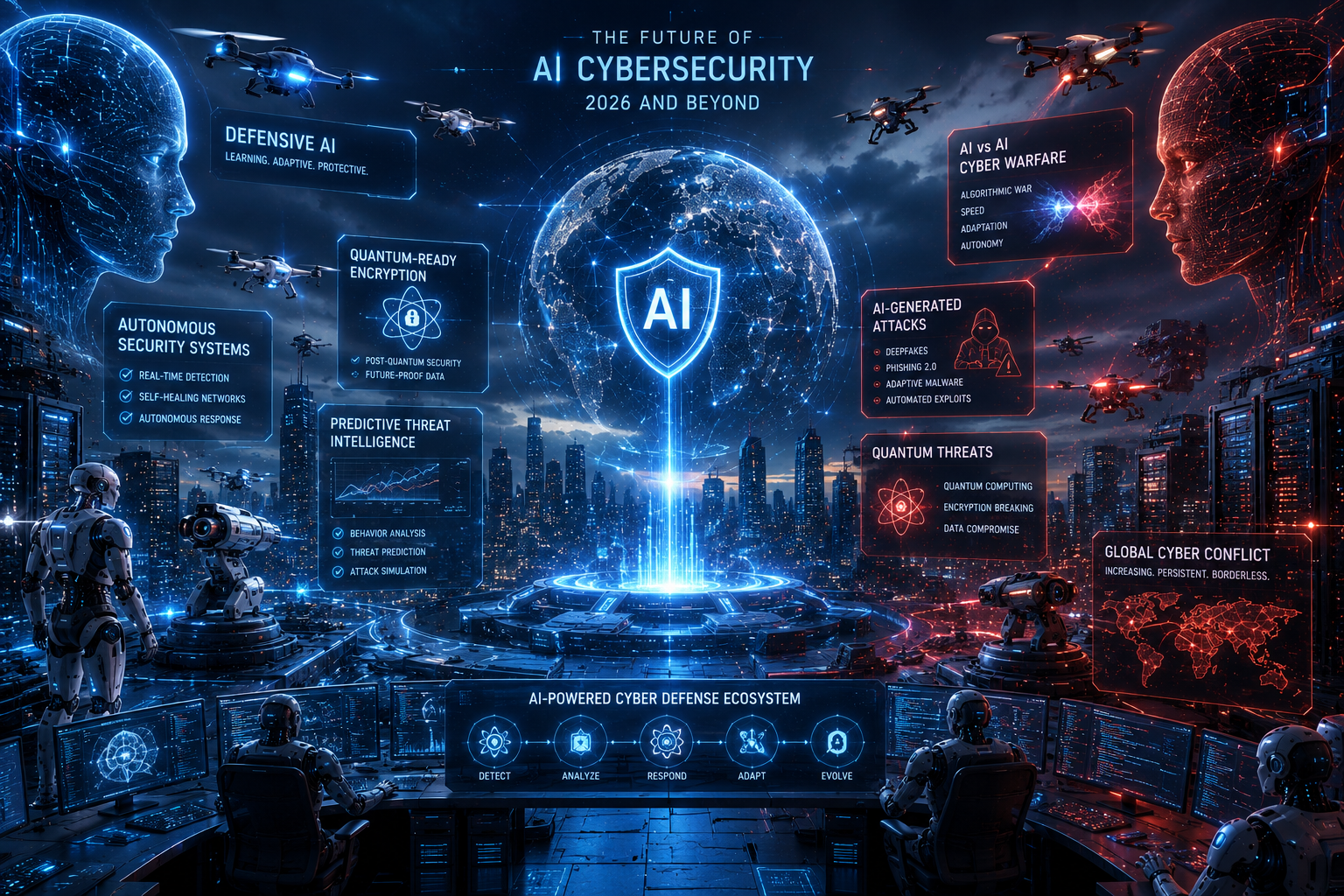
AI vs AI: The New Cybersecurity Battlefield
One of the biggest shifts in cybersecurity in 2026 is the rise of AI-versus-AI security models. Businesses are increasingly deploying AI-powered systems that can:
- Detect threats in real time
- Analyze user behavior patterns
- Predict suspicious activities
- Automate incident response
- Reduce false positives
At the same time, attackers are using AI to create adaptive malware, deepfake scams, automated phishing campaigns, and intelligent reconnaissance tools.
This creates a continuous cybersecurity arms race where both attackers and defenders rely on machine learning and automation to gain an advantage.
In the coming years, organizations that fail to integrate AI-powered defense systems may struggle to keep pace with evolving threats.
Rise of Autonomous Security Systems
Traditional cybersecurity teams often depend on manual monitoring and reactive workflows. However, the future of cybersecurity in the era of AI is moving toward autonomous security systems capable of making decisions instantly without waiting for human intervention.
These AI-driven systems can automatically:
- Isolate infected devices
- Block malicious IP addresses
- Detect abnormal network behavior
- Respond to ransomware activity
- Trigger security alerts in real time
This level of automation is becoming essential because modern AI-powered cyber attacks can spread within minutes.
Security Operations Centers (SOCs) are also evolving rapidly. Many organizations are now using AI copilots and intelligent automation to help analysts prioritize threats, investigate incidents, and respond faster.
However, human oversight will still remain critical. AI can improve speed and efficiency, but strategic decision-making and complex threat analysis still require experienced cybersecurity professionals.
Quantum Threats Are Emerging
Another important topic shaping cybersecurity in 2026 is quantum computing.
Although large-scale quantum attacks are not yet mainstream, cybersecurity experts are already preparing for future risks. Quantum computers may eventually become powerful enough to break traditional encryption methods used to secure sensitive data today.
This has introduced the concept of:
“Harvest now, decrypt later.”
Cybercriminals and nation-state actors may steal encrypted data now with the intention of decrypting it in the future once quantum technology becomes more advanced.
As a result, businesses are beginning to explore:
- Quantum-resistant encryption
- Post-quantum cryptography
- Future-proof security architectures
While still developing, quantum security preparation is expected to become a major part of long-term cybersecurity strategies.
Stronger AI Regulations and Governance
As AI adoption grows, governments and regulatory bodies are increasing their focus on cybersecurity governance and responsible AI usage.
Future regulations will likely focus on:
- AI transparency requirements
- Data privacy protections
- AI risk management standards
- Cybersecurity compliance frameworks
- Responsible AI deployment
Businesses using AI systems may soon face stricter requirements related to security audits, data handling, and AI accountability.
In cybersecurity in the era of AI, compliance is becoming more than a legal requirement — it is becoming a trust factor for customers, partners, and stakeholders.
What the Future Really Means
The future of cybersecurity in 2026 will not be defined only by technology. It will depend on how effectively businesses combine:
- AI-powered defense
- Human expertise
- Security awareness
- Governance frameworks
- Continuous adaptation
Cybersecurity is shifting from reactive protection to predictive intelligence. Organizations that invest early in AI-driven defense, employee training, and resilient security infrastructure will be far better prepared for the next generation of cyber threats.
Many enterprises are also adopting Cybersecurity Mesh Architecture to create more flexible, decentralized, and AI-ready security frameworks for modern digital environments.
Cybersecurity Tips in Simple Words
When people hear terms like artificial intelligence, malware, deepfakes, or Zero Trust security, cybersecurity can start to feel overly technical and difficult to understand. But the reality is much simpler.
The biggest lesson in cybersecurity in the era of AI is this:
AI is making cyberattacks smarter, faster, and more believable — but human mistakes are still the easiest way for hackers to succeed.
That’s why these cybersecurity tips simple enough for anyone to follow can make a huge difference in staying safe online.
AI Makes Attacks Smarter
Modern AI-powered cyber attacks no longer look like obvious scams. Attackers now use AI to create emails, messages, and even videos that appear real and trustworthy.
AI can help hackers:
- Write phishing emails without grammar mistakes
- Clone voices using short audio clips
- Create fake videos with deepfake technology
- Personalize scams using social media data
- Automate attacks at massive scale
This means people can no longer rely only on “spotting obvious mistakes” to identify scams.
If something feels urgent, emotional, or suspicious — verify it before responding.
Humans Are Still the Weakest Link
Even the best cybersecurity systems can fail if people make careless decisions.
Many successful cyberattacks happen because someone:
- Clicked a fake link
- Shared a password
- Trusted a fake message
- Uploaded sensitive data into public AI tools
- Ignored security warnings
In cybersecurity in 2026, attackers are targeting human behavior as much as technology itself.
This is why awareness matters just as much as security software.
Simple Cybersecurity Habits That Matter
Here are some practical cybersecurity tips simple enough for everyday users and businesses:
- Use strong, unique passwords
- Enable Multi-Factor Authentication (MFA)
- Avoid clicking unknown links or attachments
- Keep software and devices updated
- Verify requests for money or sensitive data
- Be careful when using public AI tools
- Never share confidential information casually online
Small habits often prevent big security problems.
If you’re new to online safety, this beginner-friendly guide on Cybersecurity 101 explains the fundamentals of staying secure in today’s digital world.
Security Is More Than Just Technology
One common misconception in cybersecurity in the era of AI is believing security tools alone can stop every threat.
Real cybersecurity works through a combination of:
- Smart security tools
- Safe online behavior
- Employee awareness
- Continuous learning
- Quick response to suspicious activity
AI can improve defense systems, but human judgment still plays a critical role.
Businesses that train employees, create clear security policies, and encourage awareness are often far more secure than organizations relying only on expensive software.
The Real Goal of Cybersecurity in 2026
The goal is not to become “unhackable.” No system is perfect.
The real goal of cybersecurity in 2026 is to:
- Reduce risk
- Detect threats early
- Respond quickly
- Prevent human mistakes
- Stay one step ahead of evolving attacks
In simple words, cybersecurity today is about being careful, informed, and prepared in a world where AI is changing both technology and cybercrime rapidly
Frequently Asked Questions (FAQs)
1. What are the biggest cybersecurity threats in the AI era?
AI phishing, deepfakes, automated malware, and data breaches are some of the biggest threats in cybersecurity in the era of AI. These attacks are faster, smarter, and more difficult to detect.
2. How does AI improve cybersecurity?
AI improves cybersecurity by detecting threats in real time and analyzing unusual behavior patterns. It also helps automate security responses and reduce manual workload.
3. Can AI prevent cyber attacks completely?
No, AI cannot completely stop cyberattacks because attackers also use AI tools. However, it significantly improves threat detection and response speed.
4. What is the best cybersecurity strategy in 2026?
The best strategy for cybersecurity in 2026 combines AI-powered security tools, Zero Trust security, and employee awareness training. Businesses also need strong data protection policies.
5. Are AI tools like ChatGPT a security risk?
Yes, public AI tools can become security risks if employees share sensitive or confidential information. Organizations should use clear AI usage and data security policies.
Conclusion
Artificial intelligence has completely changed the cybersecurity landscape. In cybersecurity in the era of AI, the same technology helping businesses improve security is also being used by attackers to create faster, smarter, and more convincing cyber threats. AI is no longer just a productivity tool — it has become both a weapon and a defense system.
What makes cybersecurity in 2026 different is the speed and scale of attacks. Phishing emails can now sound human, deepfakes can imitate real people, and malware can adapt to avoid detection. Traditional security methods alone are no longer enough to handle these evolving threats.
At the same time, AI is also helping organizations strengthen their defenses through real-time monitoring, behavioral analysis, automated threat detection, and predictive security systems. Businesses that combine AI-powered defense with human awareness and strong security policies will be in a much stronger position moving forward.
One thing is clear: cybersecurity is no longer optional or limited to IT teams alone. It has become a business priority that affects operations, trust, reputation, and long-term growth.
The companies that succeed in the AI era will not necessarily be the ones with the most tools — they will be the ones that stay informed, adapt quickly, and build a strong cybersecurity culture across the organization.
In 2026, cybersecurity is not just about protection anymore. It is about staying one step ahead of intelligent, AI-driven threats before they become real damage.