Introduction
Smartphones have become the primary computing device for millions of people worldwide. In 2026, most users rely on their phones for banking, digital payments, work communication, cloud storage, social media, and even identity verification. That’s exactly why the debate around Android vs iOS security matters more today than ever before.
Modern cyber threats are evolving rapidly. Malware, phishing attacks, spyware, credential theft, malicious apps, and AI-powered scams are now part of the everyday digital landscape. Mobile security in 2026 is no longer just about protecting photos or messages — it’s about protecting your finances, personal identity, and private data.
Recent cybersecurity reports show how serious the situation has become:
- Android devices continue to attract nearly 95%–98% of all mobile malware attacks globally
- Mobile malware incidents crossed 33 million attacks in 2024
- iPhone users are increasingly being targeted through phishing and social engineering attacks
These numbers make one thing clear: neither Android nor iPhone is completely immune to modern cyber threats.
For years, many users believed that iPhones were impossible to hack. While Apple’s ecosystem is often considered safer by default, sophisticated attacks like Pegasus spyware have shown that even iOS devices can be compromised. At the same time, Android’s open ecosystem faces higher malware risks because of app sideloading, fragmented updates, and inconsistent security practices across manufacturers.
The reality is that smartphone security depends on much more than just the operating system. Factors such as security updates, hardware protection, app permissions, cloud backup security, and user behavior all play a major role.
This is where the core difference between Android and iPhone becomes important. Android focuses on flexibility, customization, and openness, while Apple follows a tightly controlled “walled garden” approach centered around consistency and centralized security.
In this guide, we’ll break down:
- The core security architecture of Android and iOS
- A complete android vs iOS security comparison
- Real-world malware and hacking risks
- Privacy differences between iPhone and Android
- Samsung vs iPhone security comparisons
- Which platform is safest against hackers in 2026
By the end, you’ll clearly understand which platform offers better protection for your specific needs in today’s modern threat landscape.
Android vs iOS: Security Philosophy
When discussing android vs ios security which is better, the biggest difference comes down to philosophy. Android and iOS were built with completely different approaches to control, customization, privacy, and security. These design decisions directly affect how each platform handles malware protection, app security, software updates, and real-world cyber threats.
At the core of the debate:
- Android focuses on openness and flexibility
- iOS focuses on control and consistency
This open-vs-closed ecosystem approach shapes nearly every aspect of the modern android vs ios security comparison.
Android Security Philosophy: Open Ecosystem and Flexibility
Android is based on the Android Open Source Project (AOSP), which allows manufacturers like Samsung, Google, Xiaomi, OnePlus, Motorola, and others to customize the operating system for their own devices. This creates a highly diverse ecosystem with enormous flexibility for both users and developers.
One of Android’s biggest strengths is customization. Users can install third-party applications, sideload APK files, change launchers, modify system settings, replace default apps, and even install custom ROMs. This level of freedom is one reason Android remains popular among developers, advanced users, and technology enthusiasts.
Modern Android devices also include strong security technologies such as:
- Samsung Knox security platform
- Google Titan M security chips
- Hardware-backed encryption
- Secure Boot
- Runtime app permissions
- AI-powered malware detection
These improvements have made flagship Android phones significantly more secure than older Android generations.
However, Android’s openness also creates its biggest weakness: fragmentation. Since Android runs across thousands of devices from different manufacturers, security implementation varies heavily depending on the brand and model. Some premium devices receive years of timely security updates, while many budget Android phones stop receiving patches after only a short period.
This inconsistency increases Android’s overall attack surface and is one reason Android attracts nearly 95%–98% of mobile malware globally. Features like app sideloading and third-party app stores also create additional risks if users are not careful.
iOS Security Philosophy: Closed Ecosystem and Tight Control
Apple follows the opposite strategy with iOS. Instead of openness, Apple uses a tightly controlled “walled garden” ecosystem where the company controls the hardware, operating system, app distribution, chip architecture, and software updates.
This vertical integration allows Apple to enforce security policies consistently across all supported iPhones. Unlike Android, Apple does not rely on third-party manufacturers or carriers to distribute updates. When a security patch is released, it reaches compatible iPhones almost immediately.
Apple also maintains strict App Store review policies designed to detect:
- Malware behavior
- Privacy violations
- Hidden tracking activity
- Dangerous permissions
- Suspicious code execution
Combined with limited sideloading and stronger system restrictions, this creates a smaller and more controlled attack surface. This is one major reason many users believe iOS is safer than Android for average consumers using default settings.
The downside is reduced flexibility. Compared to Android, iOS offers less customization, limited system access, and stricter control over third-party apps. Power users often view these restrictions as limiting.
It is also important to understand that iPhones are not impossible to hack. Advanced spyware campaigns such as Pegasus have demonstrated that sophisticated attackers can still compromise iOS devices using zero-day exploits and phishing attacks.
Verdict: Android vs iOS Security Which Is Better?
For most users, iOS still has the advantage in default security because of:
- Faster updates
- Better ecosystem control
- Lower malware exposure
- Longer support cycles
- Consistent security enforcement
At the same time, premium Android devices like Samsung Galaxy and Google Pixel phones now offer enterprise-grade security features capable of competing closely with Apple.
In simple terms:
- Android = flexible but inconsistent security
- iOS = consistent but more restrictive security
And that difference continues to define the modern smartphone security landscape in 2026.
For a deeper understanding of how both platforms prioritize security, customization, and user experience differently, you can explore how Android and iOS differ in their core design philosophy here: how Android and iOS prioritize different design goals.
Android vs iOS Security: Key Differences
When discussing an android vs iOS security comparison, the differences extend far beyond simple malware statistics or brand reputation. Android and iOS are built on fundamentally different security philosophies, which directly impact how they handle privacy, software updates, app security, device management, and real-world cyber threats.
At a high level:
- Android prioritizes openness, flexibility, and customization
- iOS prioritizes centralized control, consistency, and strict security enforcement
These differences shape how secure each platform is in everyday use.
Android vs iOS Security Comparison Table
| Feature | Android | iOS |
| Ecosystem | Open ecosystem with multiple manufacturers | Closed ecosystem controlled by Apple |
| App Installation | Play Store + APK sideloading + third-party stores | Primarily App Store only |
| Security Updates | Fragmented; depends on OEM and carriers | Centralized and simultaneous updates |
| Malware Risk | Higher due to sideloading and fragmentation | Lower due to stricter app controls |
| Customization | Extensive customization and system access | Limited customization |
| Privacy Control | Flexible but varies by manufacturer | Strict and consistent privacy rules |
| Hardware Control | Depends on manufacturer | Fully controlled by Apple |
| Encryption | Strong but varies across devices | Consistent hardware-level encryption |
| Attack Surface | Larger due to openness | Smaller due to tighter ecosystem |
| Default Security | Moderate to high depending on device | Strong out-of-the-box security |
What These Differences Mean in Real Life
One of Apple’s biggest strengths is ecosystem consistency. Since Apple controls the hardware, operating system, and App Store, it can enforce strict security standards across all supported iPhones. This allows Apple to push security updates instantly, maintain consistent encryption practices, and reduce fragmentation across devices.
This controlled ecosystem also lowers malware exposure significantly. Because iOS restricts sideloading and carefully reviews apps before they reach the App Store, large-scale malware outbreaks are far less common compared to Android.
Android, however, offers greater flexibility and user control. Users can install third-party apps, customize system settings, and access deeper device functionality. Premium Android devices such as Samsung Galaxy and Google Pixel phones now include advanced protections like Samsung Knox, Google Titan security chips, hardware-backed encryption, AI-powered malware detection, and secure boot systems.
The biggest difference ultimately comes down to consistency versus flexibility. iPhones provide stronger default protection for most users, while Android gives advanced users more customization and control.
In practical terms:
- iOS is generally safer for average users
- High-end Android devices can closely match iPhone security when properly maintained
The safer platform ultimately depends on the device, update support, app behavior, and how responsibly the phone is used.
Core Security Architecture: What Actually Makes a Phone Secure?
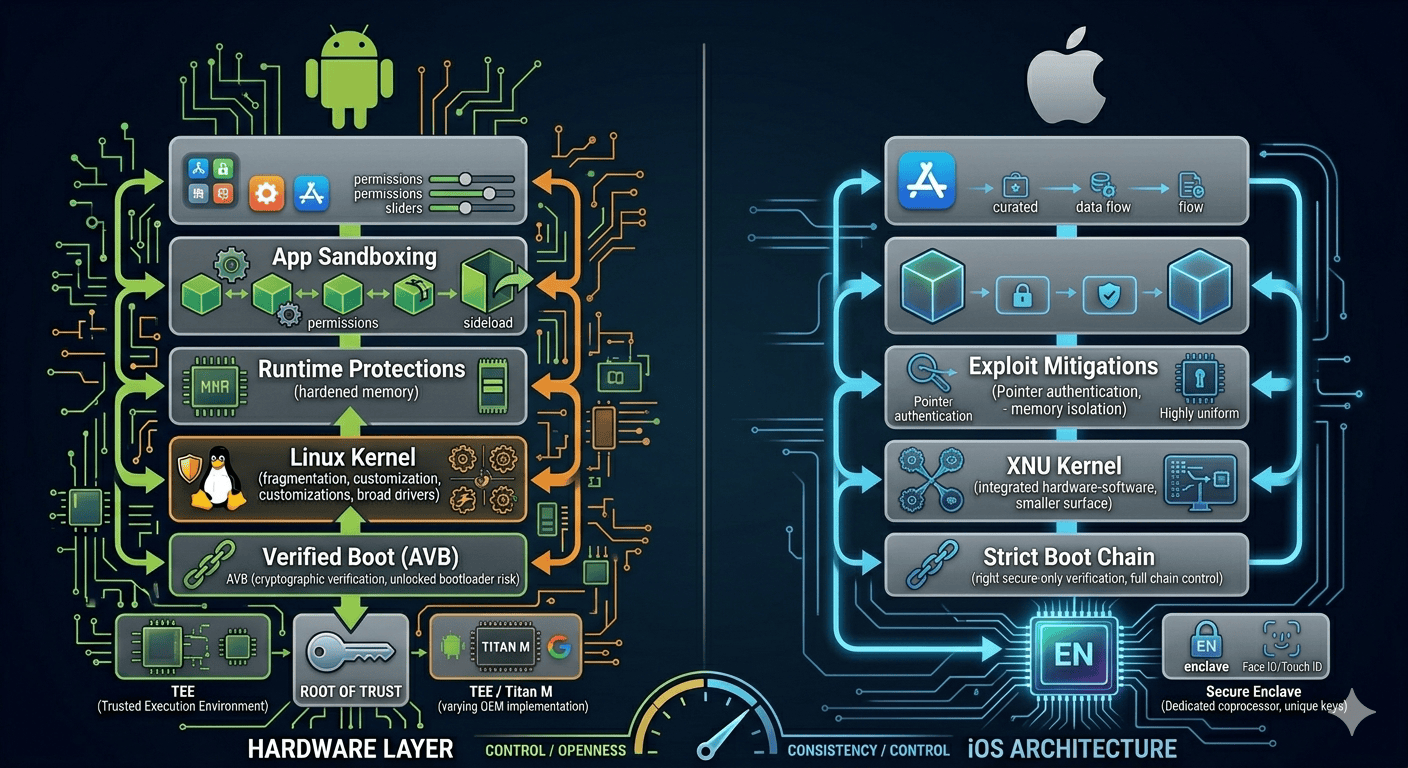
When analyzing android vs iOS security, the real differences are not just visible in malware statistics or privacy settings. They are deeply rooted in how each operating system is architected. Modern smartphones rely on multiple interconnected security layers such as secure boot, hardware-backed encryption, kernel isolation, sandboxing, permission systems, and memory protection. Modern security systems are becoming increasingly complex, with multiple layers working together to defend against evolving threats. You can explore more about this transformation in detail here: evolution of mobile security architecture. These layers collectively determine how resistant a device is to real-world cyberattacks.
Below is a detailed breakdown of the core security architecture behind Android and iOS.
1. Secure Boot & Root of Trust
Android:
Android uses Verified Boot (AVB) to ensure system integrity during startup. Each stage of the boot process is cryptographically verified. However, Android’s openness allows bootloader unlocking and custom ROM installation, which can weaken the secure boot chain and increase risk exposure.
iOS:
Apple uses a strict, fully signed boot chain. Every component must be verified by Apple before execution. If any modification is detected, the device refuses to boot. This creates a highly controlled and uniform security foundation.
2. Hardware Security
Android:
Modern Android devices use Trusted Execution Environments (TEE) and hardware security modules. Premium devices include Samsung Knox and Google Titan chips, offering strong encryption and secure processing. However, implementation varies by manufacturer.
iOS:
Apple uses the Secure Enclave, a dedicated security processor that handles Face ID, Touch ID, and encryption keys. It is consistent across all iPhones, making security predictable and tightly integrated.
3. Kernel Security
Android:
Built on the Linux kernel, Android benefits from openness but suffers from fragmentation. Multiple OEM customizations and third-party drivers increase the attack surface and create inconsistencies across devices.
iOS:
Apple uses the XNU kernel, tightly integrated with its hardware ecosystem. Because Apple controls hardware and software together, the kernel attack surface is smaller and more controlled.
4. Sandboxing & Permission Control
Android:
Android uses app sandboxing with flexible permission controls. Users can manage granular permissions, but behavior may vary across manufacturers. Sideloading apps increases potential exposure to malware.
iOS:
iOS enforces strict sandboxing where apps operate in isolated environments. Permissions for camera, location, microphone, and data access must be explicitly granted, ensuring strong default protection.
5. Memory Protection & Exploit Mitigation
Android:
Modern Android includes ASLR, CFI (Control Flow Integrity), hardened allocators, and runtime protections. However, availability depends on device quality and update cycles.
iOS:
Apple deploys advanced exploit mitigation techniques like pointer authentication, memory isolation, and hardware-assisted protections consistently across all supported devices.
6. Update Consistency (Critical Layer)
Android:
Updates depend on Google, OEMs, and carriers. This leads to fragmentation, delayed patches, and shorter support cycles on many devices.
iOS:
Apple pushes updates directly to all supported devices simultaneously, ensuring fast vulnerability patching and consistent security enforcement.
Final Verdict
- iOS offers stronger default security due to strict ecosystem control.
- Android provides greater flexibility and customization, but security varies by manufacturer.
- Premium Android devices like Samsung Galaxy and Google Pixel significantly reduce the gap.
- The biggest real-world factor is not OS alone, but updates + user behavior + device quality.
In the modern android vs iOS security comparison, iOS remains more consistent, while Android offers more control and potential—making the final choice dependent on user needs and threat model.
Security Updates: Android vs iOS
When discussing android vs iOS security updates, this is one of the most important real-world differences between the two platforms. A smartphone can have strong encryption, advanced hardware protection, and powerful privacy controls, but if security vulnerabilities are not patched quickly, the device can still become exposed to attacks.
In today’s cybersecurity landscape, threats evolve rapidly. Malware developers, phishing groups, and spyware operators constantly search for newly discovered vulnerabilities before companies can fix them. This makes update speed and long-term software support critical parts of modern mobile security.
For many cybersecurity professionals, this is the single biggest reason why iPhones are generally considered safer for average users.
Android Security Updates
Monthly Security Patches from Google
Google releases Android security patches every month to address vulnerabilities affecting the operating system, kernel, chipsets, browsers, and system services. These patches are designed to protect Android devices against newly discovered malware, privilege escalation flaws, and remote exploitation techniques.
Modern Android versions have improved significantly in terms of security infrastructure. Google has also introduced initiatives such as:
- Project Mainline
- Google Play System Updates
- Google Play Protect
These systems allow some security components to update independently through the Play Store, reducing dependency on full operating system updates.
Premium Android devices from Samsung and Google Pixel now receive much stronger long-term support than older Android generations.
The Biggest Android Problem: Delayed Rollouts
Despite these improvements, Android still faces a major issue: fragmentation.
Unlike Apple, Google does not fully control the Android ecosystem. Security updates must often pass through:
- Chip manufacturers
- Device manufacturers (OEMs)
- Mobile carriers
before finally reaching users.
This process creates delays that can last weeks or even months. Budget Android phones are especially problematic because many stop receiving updates entirely after only 2–3 years.
As a result, millions of Android devices continue running outdated software, increasing malware exposure and security risks.
iOS Security Updates
Instant Updates Across Supported Devices
Apple uses a centralized update system, which is one of the biggest strengths in the overall android vs iOS security updates debate.
When Apple releases a security patch:
- All supported iPhones receive it simultaneously
- No carrier approval is required
- No manufacturer customization delays exist
This dramatically reduces the number of vulnerable devices in the ecosystem.
Longer Support Lifecycle & Higher Adoption
Apple also supports devices for much longer periods. Many iPhones continue receiving security updates for 5–7 years, far longer than most Android phones.
Another advantage is update adoption rate. iPhone users typically install updates quickly, meaning a larger percentage of devices run the latest secure version of iOS.
This consistency gives Apple a major edge in real-world protection.
Verdict: Biggest Real-World Advantage of iOS
In the broader android vs iOS security comparison, update consistency remains Apple’s biggest advantage.
- iOS offers faster patches, longer support, and higher adoption rates
- Android offers improving security but still struggles with fragmentation
For average users who want strong protection without managing security manually, iOS currently provides the safer update ecosystem in 2026.
Malware & Hacking: What Gets Hacked More?
One of the biggest questions in the android vs iOS security debate is: what gets hacked more iPhone or Android?
The answer is not completely black and white.
In real-world cybersecurity, Android devices experience far more large-scale malware attacks, while iPhones are more commonly targeted in sophisticated and high-value attacks. The type of threat matters just as much as the operating system itself.
Android Malware: Why Android Gets Targeted More
Android remains the biggest target for mobile malware globally. Multiple cybersecurity reports estimate that over 90% of mobile malware attacks target Android devices, with some studies placing the number as high as 95%–98%.
The main reason is scale. Android dominates the global smartphone market, making it the most profitable platform for cybercriminals. More users mean more opportunities for financial fraud, credential theft, ransomware, and spyware campaigns.
Another major factor in the android vs iOS security comparison is Android’s open ecosystem. Android allows:
- APK sideloading
- Third-party app stores
- Custom software installations
While this flexibility benefits developers and power users, it also increases the attack surface significantly. Many malware infections occur through fake apps, modified APK files, cracked software, or unofficial downloads.
Android fragmentation also creates security inconsistencies. Some premium devices like Samsung Galaxy and Google Pixel receive fast updates and advanced protections, while many low-cost Android phones stop receiving updates after only a few years. Outdated devices become easy targets for hackers exploiting known vulnerabilities.
Common Android threats include:
- Banking Trojans
- Spyware
- Ransomware
- Fake cryptocurrency apps
- Adware
This is why Android experiences more mass malware attacks globally.

iPhone Security: Fewer Attacks but More Sophisticated Threats
Many users assume iPhones cannot be hacked, but that is no longer true. While iOS generally offers stronger default protection, iPhones are still vulnerable to phishing, spyware, and advanced zero-day attacks.
Apple reduces large-scale malware risks through:
- Strict App Store review policies
- Limited sideloading
- Strong sandboxing
- Faster security updates
These protections make malware distribution much harder compared to Android.
However, iPhones are frequently targeted in high-value attacks involving journalists, executives, politicians, and enterprise users. Advanced spyware like Pegasus proved that even Apple devices can be compromised using sophisticated exploit chains.
Phishing is also becoming a major issue in the iPhone vs android security discussion. Recent reports suggest iPhone users now face increasing phishing attacks because attackers often view them as financially valuable targets.
Verdict: What Gets Hacked More — iPhone or Android?
- Android → More mass malware attacks due to openness and fragmented updates
- iPhone → More advanced targeted attacks against high-value users
For readers who want to go beyond theory and understand real-world hacking techniques, threat detection, and mobile defense strategies in depth, you can explore a structured cybersecurity and mobile security learning path.
In 2026, the biggest risks on both platforms remain:
- phishing,
- unsafe app downloads,
- weak passwords,
- and poor user behavior.
Privacy Comparison: iPhone vs Android
When discussing iPhone vs android privacy, it is important to understand that privacy and security are closely connected but not identical. Security protects devices from hackers and malware, while privacy determines how much personal data companies, apps, and services can collect from users. In 2026, smartphones store highly sensitive information including banking details, biometric data, browsing history, locations, health records, and private conversations. That is why the iOS vs android privacy debate has become a major part of the overall android vs iOS security comparison.
iOS Privacy Strengths
Apple positions privacy as a core part of the iPhone ecosystem. One of the biggest advantages of iOS is App Tracking Transparency (ATT), which forces apps to request permission before tracking users across apps and websites. This significantly reduces invasive advertising and improves user awareness about data collection practices.
Apple also applies stricter permission controls across iPhones. Apps must explicitly request access to the camera, microphone, contacts, location, photos, and Bluetooth. iOS additionally warns users when apps access sensitive sensors or clipboard data, increasing transparency and limiting background tracking.
Another major strength is Apple’s tightly controlled ecosystem. Because Apple controls both hardware and software, privacy protections remain consistent across devices. Features like Face ID and biometric authentication are processed largely on-device through the Secure Enclave, reducing unnecessary cloud exposure.
However, Apple’s privacy model is also restrictive. Users have limited ability to customize system-level privacy behavior or replace default services compared to Android.
Android Privacy Strengths
Android takes a different approach by prioritizing flexibility and user control. Users can customize permissions, replace default apps, install alternative app stores, modify DNS settings, and even use privacy-focused operating systems like GrapheneOS or CalyxOS. This openness makes Android attractive for advanced users who want deeper control over their data.
A major advantage of Android is its open-source foundation through AOSP (Android Open Source Project). Researchers and developers can independently audit code, build custom privacy tools, and reduce dependence on large ecosystems.
The downside is complexity. Privacy on Android often depends heavily on the manufacturer, installed apps, and user behavior. Many users never configure privacy settings properly, leaving tracking and telemetry enabled.
Verdict: Which Offers Better Privacy?
For most users, iPhones provide stronger default privacy protections with less effort. Android, however, offers better configurable privacy for advanced users who understand customization and security management.
In simple terms:
- iOS = easier privacy protection by default
- Android = more freedom and advanced privacy control
Samsung Knox vs Apple Security
When comparing samsung knox vs apple security, the discussion goes far beyond the typical Android vs iPhone debate. Not all Android devices provide the same level of protection, and premium Samsung Galaxy phones are a completely different category compared to low-cost Android devices with limited support. In today’s android vs ios security comparison, Samsung’s flagship ecosystem has become one of Apple’s closest competitors.
Samsung Knox: Defense-Grade Android Security
Samsung Knox is Samsung’s multi-layered security platform built directly into Galaxy devices. It combines hardware protection, firmware security, runtime monitoring, and enterprise-grade management tools into a single ecosystem. Originally designed for business and government use, Knox now plays a major role in consumer mobile security as well.
One of Knox’s biggest strengths is its hardware-backed security architecture. Samsung devices use secure boot validation, encryption protection, and tamper detection to reduce the risk of rooting, malware persistence, and unauthorized modifications. Features like Secure Folder create an isolated encrypted environment where users can store sensitive apps, documents, and private data separately from the main system.
Samsung also stands out in enterprise environments. Knox supports advanced device management, work-profile separation, remote security policies, and real-time threat monitoring. This is why many organizations consider Samsung one of the strongest Android options for business security.
However, the biggest limitation is consistency. Premium Galaxy devices receive the strongest Knox implementation and longer updates, while lower-end Android phones may not offer the same level of protection.
Apple Security: Tight Ecosystem Control
Apple approaches security differently. Instead of layering protections onto an open platform, Apple controls the entire ecosystem — including hardware, chips, software, App Store policies, and security updates.
At the center of Apple’s security model is the Secure Enclave, an isolated processor that protects Face ID, Touch ID, encryption keys, and authentication data. Combined with Apple’s strict App Store review process and fast software updates, this creates a smaller attack surface compared to most Android devices.
Apple’s biggest advantage in the iPhone vs android security debate is consistency. Every supported iPhone receives updates simultaneously, reducing vulnerability windows and improving long-term protection.
Verdict: Samsung Knox vs Apple Security
For average users, Apple still provides stronger default protection with minimal effort. But flagship Samsung devices powered by Knox have narrowed the gap significantly. In fact, high-end Samsung phones can rival iPhones in several security areas.
The real difference is simple:
- Apple: Better consistency and out-of-the-box security
- Samsung Knox: Better flexibility, enterprise tools, and advanced control
In 2026, the real comparison is no longer just Android vs iPhone — it is premium Android security versus Apple’s tightly controlled ecosystem.
Android vs iOS Security in Simple Words
For most users, the android vs iOS security in simple words debate can be explained very simply:
Android gives you more freedom, while iPhone gives you stronger protection by default.
Android is designed for flexibility. Users can customize the interface, install third-party apps, change system settings, and even use custom software. This openness is one of Android’s biggest strengths, especially for developers and advanced users. However, that same flexibility also creates more opportunities for security risks such as malicious apps, phishing attempts, and malware infections. In the overall iPhone vs android security discussion, Android’s security often depends on the device manufacturer, update support, and how carefully the user manages the phone.
Modern Android phones are far more secure than they were years ago. Premium devices like Samsung Galaxy and Google Pixel include advanced protections such as hardware-backed encryption, secure boot, sandboxing, and AI-powered threat detection. Still, security quality varies heavily between high-end and low-end Android devices, which is a major factor in the broader android vs iOS security comparison.
Apple follows a very different approach. iPhones are more restricted, but Apple controls the entire ecosystem — including hardware, software, app distribution, and updates. This allows Apple to push security updates quickly, reduce malware exposure, and maintain consistent protection across devices. That is one major reason many users believe is iOS safer than android for everyday use.
In simple terms:
- Android = customizable but needs careful handling
- iPhone = locked down but safer by default
That said, no phone is completely immune to cyber threats. Both Android and iPhone users can still become victims of phishing scams, unsafe downloads, weak passwords, or social engineering attacks.
Ultimately, the safest smartphone depends not only on the operating system, but also on:
- regular software updates,
- trusted app sources,
- strong passwords and 2FA,
- and safe user behavior.
Which Phone Is Safest Against Hackers?
One of the most common questions in mobile cybersecurity is: which phone is safest against hackers? The answer depends on both the device and the user. For most everyday users, iPhones are generally considered safer because Apple controls the entire ecosystem — including hardware, software, app distribution, and security updates. This centralized approach allows Apple to deliver security patches quickly across supported devices, reducing exposure to known vulnerabilities.
Apple’s strict App Store policies, limited sideloading, and smaller attack surface also reduce large-scale malware risks. In the overall iPhone vs android security debate, this is one of the biggest reasons iPhones are viewed as safer by default. Users who simply want strong protection without constantly managing settings usually benefit from Apple’s tightly controlled ecosystem and long-term update support.
However, that does not mean Android is insecure. Premium Android devices such as Samsung Galaxy and Google Pixel phones now include advanced protections like hardware-backed encryption, secure boot, AI-powered threat detection, and enterprise-grade security systems like Samsung Knox. In the android vs iOS security comparison, well-maintained flagship Android devices can provide security levels very close to iPhones.
The biggest challenge with Android is inconsistency. Security quality varies depending on the manufacturer, update support, and device category. A high-end Samsung phone with long-term updates is far more secure than a cheap Android device that stops receiving patches after a few years.
Ultimately, the safest smartphone depends on three major factors:
- Regular security updates
- Trusted app sources
- Safe user behavior
Even the most secure phone can be compromised through phishing links, weak passwords, fake apps, or social engineering attacks.
Final Verdict
- For average users: iPhone is generally safer by default
- For tech-savvy users: Secure Android devices can match or even exceed iPhone security
In 2026, smartphone security is no longer just about Android vs iPhone — it’s about how securely the entire ecosystem is managed and how carefully the device is used.
Real-World Use Cases: Which Platform Fits Your Security Needs?
The android vs iOS security debate becomes much easier to understand when viewed through real-world usage instead of just technical specifications. Both platforms offer strong security in 2026, but they are designed for different types of users. The safest choice often depends on how much control, customization, and manual security management a user prefers.
Choose iOS If
You Want Maximum Security With Minimal Effort
For most everyday users, iPhones provide stronger default protection with very little manual setup. Apple controls the hardware, operating system, app distribution, and security updates, creating a tightly managed ecosystem that reduces common security risks automatically. This is one reason many experts believe is iOS safer than Android for average users.
iOS is ideal for users who regularly use:
- Mobile banking apps
- Digital payment systems
- Work and business communication
- Cloud storage and sensitive personal accounts
Because Apple handles updates and security enforcement centrally, users rarely need advanced technical knowledge to stay protected.
You Don’t Want to Manage Security Settings
iPhones are designed for simplicity and consistency. Most protections are enabled by default, including:
- App sandboxing
- Hardware encryption
- Biometric authentication
- Privacy permissions
Apple also limits risky actions like unrestricted app sideloading and deep system modifications. This makes iPhones a strong choice for:
- Non-technical users
- Professionals
- Students
- Older users
In the iPhone vs android security comparison, Apple’s biggest strength is reducing user error through tighter ecosystem control.
You Value Strong Default Privacy
Apple has heavily focused on privacy features such as:
- App Tracking Transparency (ATT)
- Limited cross-app tracking
- On-device processing
- Strict app permission controls
For users comparing iPhone vs android privacy, iOS generally offers better privacy defaults without requiring extensive customization.
Choose Android If
You Want More Customization and Control
Android is better suited for users who prefer flexibility. Users can:
- Install custom launchers
- Use third-party app stores
- Modify permissions deeply
- Change system behavior
- Install custom ROMs
This openness gives advanced users more control over privacy and device behavior, making Android popular among developers and cybersecurity enthusiasts.
You Use Advanced Security Tools
Android supports a wider range of configurable security tools, including:
- VPNs
- Custom firewalls
- Antivirus software
- Privacy-focused browsers
- Encrypted DNS services
For experienced users, Android’s flexibility can become a major advantage in the broader android vs ios security comparison.
You Choose Premium Android Devices
Not all Android phones offer the same level of protection. High-end devices like:
- Samsung Galaxy
- Google Pixel
now include advanced security technologies such as:
- Samsung Knox
- Hardware-backed encryption
- Secure Boot
- AI-powered threat detection
In the modern Samsung vs iPhone security debate, flagship Android devices can closely compete with iPhones when properly maintained and regularly updated.
Common Security Mistakes to Avoid
Even the strongest smartphone can become vulnerable if basic security habits are ignored. In the modern android vs ios security debate, many successful attacks happen because users unintentionally weaken their own protection. One of the biggest mistakes is using outdated phones that no longer receive security updates. Unsupported devices remain exposed to known vulnerabilities that hackers actively target. Ignoring Android or iOS security patches also increases the risk of malware, spyware, and phishing attacks.
Another major issue is installing apps from unofficial or unknown sources. This is especially risky on Android, where sideloaded APK files may contain trojans, fake apps, ransomware, or hidden spyware. Weak passwords and reused credentials are equally dangerous, as many modern attacks focus on phishing and account theft rather than direct device hacking.
Common Security Mistakes
- Using outdated smartphones
- Ignoring OS and app updates
- Downloading apps from unofficial stores
- Clicking suspicious links or pop-ups
- Reusing weak passwords
- Jailbreaking or rooting devices unnecessarily
Best Practices to Improve Security
- Enable two-factor authentication (2FA)
- Use strong, unique passwords
- Keep apps and software updated
- Install apps only from trusted stores
In real-world mobile security, safe user behavior often matters more than whether you choose Android or iPhone.
Future Trends in Mobile Security (2026)
Mobile security is rapidly evolving as threats become more advanced and smartphones store increasingly sensitive data. In the modern android vs iOS security landscape, protection is no longer just about malware—it now includes AI-driven attacks, spyware, zero-day exploits, and hardware-level defenses.
AI-Powered Threat Detection
Both Android and iOS are integrating AI systems that detect suspicious behavior in real time, such as phishing attempts, unusual logins, or malicious app activity. These systems move beyond traditional antivirus models by predicting threats using behavioral analysis and machine learning.
Privacy-First OS Features
Apple and Android are expanding privacy tools like App Tracking Transparency and granular permissions. Users now demand stronger control over how apps collect and share data, pushing both ecosystems toward stricter default privacy protections.
Secure Hardware Chips Evolution
Technologies like Apple’s Secure Enclave, Samsung Knox, and Google Titan chips are strengthening encryption, authentication, and boot security at the hardware level.
Rise of Zero-Day Exploits
Attackers increasingly use unknown vulnerabilities, making zero-day exploits one of the biggest risks in both iPhone vs android security systems.
Convergence of Security Models
Android is becoming more locked down, while iOS is gaining flexibility, narrowing the security gap between the two platforms.
Frequently Asked Questions (FAQs)
1. Is iOS actually safer than Android?
Yes, for most users iOS is generally safer because Apple controls hardware, software, and updates, leading to faster patches and more consistent protection.
2. What’s harder to hack, iPhone or Android?
iPhones are harder to hack at scale due to their closed ecosystem, but they are still targeted by advanced spyware and zero-day attacks.
3. Which phone is the safest against hackers?
iPhones and premium Android devices like Samsung Galaxy and Google Pixel are the safest, depending on updates, usage habits, and app sources.
4. Why does Gen Z prefer iPhone?
Gen Z prefers iPhone due to ecosystem features like iMessage, strong privacy reputation, smooth performance, and long-term software support.
5. Can Android be as secure as iOS?
Yes, high-end Android devices can match iOS security when properly configured and regularly updated with strong security practices.
6. What gets hacked more: Android or iPhone?
Android is hacked more frequently due to its larger market share, sideloading support, and fragmented update system across devices.
7. Is Samsung more secure than iPhone?
High-end Samsung devices with Knox can rival iPhone security, but lower-end Android phones generally offer weaker protection.
Conclusion
The android vs ios security debate in 2026 is more complex than ever because smartphones now store highly sensitive data like banking details, personal identities, work files, and biometric information. This makes both Android and iOS major targets in today’s evolving cyber threat landscape.
One key reality is that no operating system is 100% secure. Both platforms face risks such as phishing attacks, spyware, malicious apps, zero-day exploits, and social engineering scams. In many cases, user behavior plays an equally important role in overall security. Ignoring updates, using weak passwords, or installing unsafe apps can compromise even the most secure device.
Final Verdict
- iOS wins for default security and consistency due to faster updates, strict ecosystem control, lower malware exposure, and strong privacy defaults.
- Android wins for flexibility and control, offering customization, advanced security tools, and strong protection on premium devices like Samsung and Pixel.
Final Takeaway
In the end, choosing between Android vs iOS security is not just about the operating system—it is about ecosystem design, update support, and how responsibly the device is used.