Introduction
The AI orchestrator role is rapidly becoming one of the most valuable positions in software engineering. In 2026 and 2027, developers who only write code risk falling behind. Those who can design, coordinate, and govern systems of AI agents will stay in high demand.
This shift is already visible across job postings and engineering teams. The AI orchestrator role moves the focus from writing every line of code to directing intelligent systems that produce, test, and improve software. Developers who master this role will remain essential even as agents handle more implementation work.
What Is the AI Orchestrator Role?
The AI orchestrator role centers on designing and managing systems of AI agents so they deliver reliable outcomes. An orchestrator defines goals, assigns responsibilities to specialized agents, sets guardrails, and reviews results.
Unlike a traditional developer who implements features directly, the orchestrator treats AI agents as a team. The human provides direction, judgment, and accountability while agents handle volume and repetition.
From Coder to Orchestrator
For years the primary value of a developer was the ability to write correct, efficient code. AI coding tools changed that equation. Agents can now generate large portions of production code, tests, and documentation.
The new high-value skill is the ability to specify what should be built, break work into agent-ready tasks, coordinate multiple agents, and verify that the final system meets quality and safety standards. This is the core of the AI orchestrator role.
Why the Role Matters in 2026–2027
Organizations are adopting multi-agent systems at scale. Teams that lack strong orchestration experience produce inconsistent results, hidden costs, and reliability problems.
Developers who understand how to design agent workflows, enforce human approval gates, and measure agent performance become the people who keep these systems productive and safe. That combination of technical depth and systems thinking creates lasting career value.
Core Responsibilities of an AI Orchestrator
An AI orchestrator does more than prompt models. The role involves architecture, process design, and continuous improvement of agent systems.
Designing Multi-Agent Systems
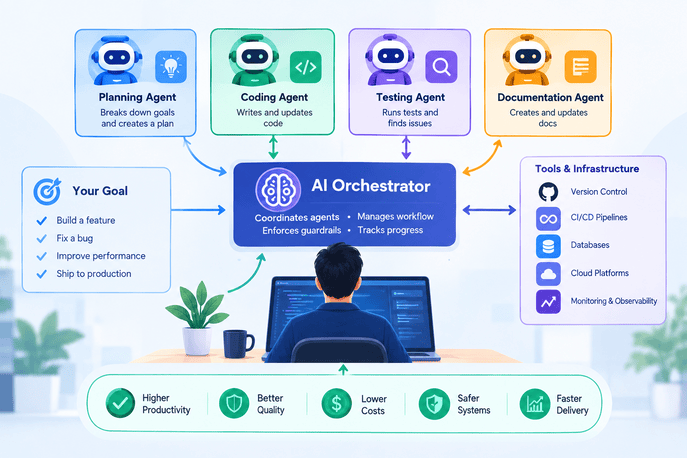
Effective orchestrators break complex goals into clear roles. One agent may plan, another will implement, a third test, and a fourth document or review.
The orchestrator defines how agents share context, how they hand off work, and what happens when an agent fails or needs human input. This design work determines whether the system scales cleanly or collapses into chaos.
For a practical foundation in how these systems operate, review this guide to multi-agent systems
Managing AI Workflow Automation
Orchestrators also design the surrounding workflow. They decide which tasks are fully automated, which require human review, and how results flow into existing tools such as version control, CI pipelines, and issue trackers.
Strong AI workflow automation reduces manual toil while keeping critical decisions under human control. The orchestrator continuously refines these processes based on real outcomes.
Essential Skills for the AI Orchestrator Role
Technical coding skill remains important, but it is no longer sufficient. The AI orchestrator role demands a broader set of capabilities.
LLM Orchestration Mastery
LLM orchestration is the ability to connect language models with tools, memory, retrieval systems, and other agents so they complete multi-step work reliably.
Developers need fluency with frameworks that manage state, tool calling, retries, and evaluation. Understanding how to design durable agent loops and handle non-deterministic behavior is now a core skill.
AI Agent Coordination and Guardrails
Coordinating multiple AI agents requires clear role definitions, shared context strategies, and explicit escalation paths. Orchestrators must also implement guardrails: approval gates, cost limits, policy checks, and audit logging.
Without these controls, agents can produce incorrect results, burn budget, or take unsafe actions. The ability to design safe agent systems is what separates valuable orchestrators from experimental users.
System Thinking and Evaluation
Orchestrators evaluate entire systems rather than individual outputs. They measure success rates, latency, cost per task, and failure modes.
They also think in terms of architecture: how agents interact with data stores, APIs, and human processes. This system’s perspective allows them to improve reliability over time instead of treating each agent run as an isolated experiment.
Further reading on related agentic patterns is available in this overview of autonomous coding approaches
Tools That Power the AI Orchestrator Role
The right tools make orchestration practical rather than theoretical.
Frameworks for AI Agents and Orchestration
Popular frameworks include LangGraph for stateful multi-agent graphs, CrewAI for role-based teams, and the various official agent SDKs from major model providers.
These tools let developers define agent roles, manage memory, call external tools, and insert human approval steps. Mastery of at least one strong orchestration framework is expected for the AI orchestrator role.
Platforms for AI Workflow Automation
Beyond agent frameworks, orchestrators use platforms that connect agents to the rest of the engineering stack. These include CI/CD systems, observability tools, and internal developer platforms that support agent-driven pull requests and deployments.
The goal is seamless AI workflow automation that still respects existing governance and review processes.
You can explore additional practical automation examples in this collection of AI workflows that deliver time savings
How Developers Can Transition into the AI Orchestrator Role
The transition is achievable for experienced developers who deliberately build the new skills.
Practical Learning Path
Start by running single agents on well-scoped tasks and carefully reviewing every output. Progress to multi-agent workflows with clear hand-offs.
Next, add evaluation metrics, cost tracking, and mandatory human approval steps. Finally, document reusable patterns so other team members can adopt the same disciplined approach.
Hands-on practice with real codebases produces far more learning than tutorials alone.
Building a Portfolio That Demonstrates Orchestration
Hiring managers look for evidence that a developer can design reliable agent systems. Strong portfolio pieces include multi-agent workflows with clear role definitions, documented guardrails, and measured results.
Open-source contributions, internal tools that reduced toil, or detailed case studies of successful agent deployments all demonstrate readiness for the AI orchestrator role.
Additional context on building agentic systems appears in this article about agentic software patterns
Two useful external references are the official documentation for LangChain and LangGraph and current guidance on agent systems from Anthropic.
Career Outlook and Value of the AI Orchestrator Role
Demand for people who can orchestrate AI agents is rising faster than demand for pure coding roles.
Demand and Compensation Trends
Job data from 2026 shows strong growth in roles that require multi-agent orchestration, LLM orchestration, and AI workflow design. Compensation for these skills often exceeds traditional software engineering averages, especially when the work includes production reliability and governance.
Companies that have deployed agents at scale quickly discover they need dedicated orchestrators to keep systems productive and safe.
Staying Valuable as an AI Orchestrator
The developers who remain most valuable continuously update their mental models. They treat agents as evolving teammates rather than static tools. They invest in evaluation, observability, and process design.
They also maintain strong judgment about when human involvement is essential. That combination of technical fluency and responsible systems thinking is what keeps the AI orchestrator role relevant through 2027 and beyond.
Conclusion – Becoming the Developer Who Directs AI
The AI orchestrator role represents the next evolution of software engineering. Developers who can design multi-agent systems, implement reliable AI workflow automation, and maintain clear human control will stay highly valuable.
The path forward is practical: master LLM orchestration, learn to coordinate AI agents safely, measure results rigorously, and build a body of work that proves the ability to direct intelligent systems.
Those who make this transition will not be replaced by AI. They will be the people who make AI productive, reliable, and accountable inside real engineering organizations.